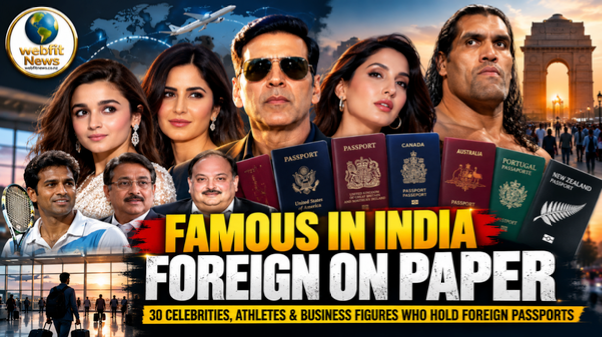
What does it mean to be Indian when cultural identity, birthplace, professional representation and legal citizenship do not always match?
1. The Great Khali: An Indian Wrestling Icon Who Became American
For millions of wrestling fans, The Great Khali is one of India's most recognisable international sporting personalities.
Born Dalip Singh Rana in Himachal Pradesh, he rose to worldwide prominence through WWE and became the first Indian-born World Heavyweight Champion in the promotion.
Yet in February 2014, Khali became a naturalised United States citizen, according to contemporary wrestling industry reporting.
His story demonstrates why birthplace and citizenship must be distinguished.
Khali's Indian origins and achievements are not in question. However, his acquisition of American citizenship changed his legal nationality under India's rules on foreign naturalisation.
The case also raises a wider sporting question: how should countries recognise athletes who become international symbols of their homeland but later change nationality?
2. The Full List: 20 Famous Personalities Associated With Foreign Citizenship
The following table reproduces the 20 names in the infographic's foreign-passport category, with their reported citizenship histories and connections to India.
| Personality | Reported foreign nationality | Why they are known |
|---|
| Alia Bhatt | British | Leading Bollywood actor, born in Mumbai |
| Soni Razdan | British | Actor and director, born in Birmingham |
| Katrina Kaif | British | Bollywood star, born in Hong Kong |
| Amy Jackson | British | Actor prominent in Tamil and Hindi cinema |
| Imran Khan | American | Hindi-film actor, born in Wisconsin |
| Nargis Fakhri | American | American-born Bollywood actor |
| Orry (Orhan Awatramani) | American | Social-media personality associated with Bollywood |
| Sunny Leone | Canadian and American | Entertainer and actor, born in Canada |
| Nora Fatehi | Canadian | Dancer and actor, born in Toronto |
| Lisa Ray | Canadian | Actor and model with Indian family roots |
| Kalki Koechlin | French | Indian-film actor, born in Puducherry |
| Elli AvrRam | Swedish and Greek | Actor and television personality |
| Jacqueline Fernandez | Sri Lankan | Bollywood actor, born in Bahrain |
| Ileana D'Cruz | Portuguese | Indian-film actor, reported to have acquired Portuguese citizenship in 2014 |
| The Great Khali | American | Indian-born WWE wrestling champion |
| Shirley Setia | New Zealander | Auckland-raised singer and actor |
| Vinod Adani | Cypriot | International businessman and Gautam Adani's elder brother |
| Mehul Choksi | Antiguan | Businessman associated with the Punjab National Bank fraud case |
| Prakash Amritraj | American | Tennis player who represented India in Davis Cup |
| Lalit Modi | Vanuatu citizenship reported, status contested | Former IPL chairman whose citizenship and passport situation requires further confirmation |
Source: Visualized.in citizenship compilation. The table records the source's reported classifications, not independently authenticated current passport holdings. In particular, Lalit Modi's status should not be presented as settled.
3. Bollywood's Foreign-Passport Connection
Bollywood is often treated as an expression of Indian cultural identity.
Its leading actors are associated with Indian languages, traditions, cinema and national celebrations.
However, working in Indian cinema does not require Indian citizenship.
Alia Bhatt is a prominent example. Born in Mumbai, she has publicly discussed her British citizenship through her mother, Soni Razdan.
Katrina Kaif, born in Hong Kong, is another widely recognised British national whose career has been built primarily in India.
Jacqueline Fernandez, born in Bahrain, represented Sri Lanka at Miss Universe 2006 before establishing herself in Hindi cinema.
Nora Fatehi was born in Canada and became a prominent performer in India's entertainment industry.
Kalki Koechlin, born in Puducherry to French parents, illustrates another dimension: someone can be born and raised in India without necessarily being an Indian citizen.
The stories differ, but they expose the same misconception.
Being a Bollywood star does not automatically mean holding an Indian passport.
4. Beyond Bollywood: Sport, Business and Public Life
The infographic becomes considerably more interesting when the focus moves beyond actors.
Prakash Amritraj: Representing India With an American Passport
Prakash Amritraj, son of Indian tennis legend Vijay Amritraj, was born in California.
He represented India in Davis Cup competition, but his American citizenship later became significant when nationality-based eligibility rules affected his ability to continue representing the country.
His case shows that representing a nation in sport and holding its citizenship are not necessarily the same thing, although eligibility requirements vary by sport and governing body.
Vinod Adani: International Business and Citizenship
Vinod Adani, the elder brother of industrialist Gautam Adani, is listed in the infographic as having acquired Cypriot citizenship in 2016 through the country's former citizenship-by-investment programme.
This is a materially different story from that of a Bollywood celebrity.
Citizenship-by-investment programmes have attracted international scrutiny over transparency, due diligence and the movement of wealthy individuals across jurisdictions.
However, participation in a lawful citizenship programme does not itself establish wrongdoing. The specific citizenship claim and its date should be checked against reliable documentation before publication as a confirmed fact.
Mehul Choksi: Citizenship and Cross-Border Legal Proceedings
Mehul Choksi, associated with the Punjab National Bank fraud case, acquired Antiguan and Barbudan citizenship through an investment programme, according to widely reported accounts.
His case illustrates how nationality, extradition proceedings and international law can intersect.
Allegations and proceedings concerning Choksi must be distinguished from any final judicial findings, and the current status of his citizenship and legal proceedings requires up-to-date confirmation.
Lalit Modi: The Complications of Changing Citizenship
Former IPL chairman Lalit Modi appears in the infographic with a reported Vanuatu citizenship connection.
The graphic also notes complications concerning an application to surrender Indian nationality and action by Vanuatu authorities.
This is not a straightforward case of an established foreign citizen.
Until the legal position is independently confirmed, it would be misleading to place him in the same category as a person whose foreign naturalisation is publicly documented.
5. New Zealand Connection: Shirley Setia and the Indian Diaspora
For Webfit News readers in New Zealand, Shirley Setia's story is particularly relevant.
Born in Daman, India, Setia grew up in Auckland and gained recognition through online music performances before developing a career in India's entertainment industry.
The infographic identifies her as a New Zealand citizen, demonstrating how a person can retain strong Indian cultural connections while holding another country's nationality.
Her story also reflects a wider experience shared by many Indian-origin New Zealanders.
People can be deeply connected to India through family, language and culture while legally belonging to New Zealand.
For some, the decision to acquire New Zealand citizenship involves surrendering Indian nationality because India does not generally permit dual citizenship.
This can affect voting rights, passports, property arrangements and future family decisions.
6. Five Personalities Who Became Indian Citizens
The reverse journey is equally important.
Some well-known personalities have given up foreign citizenship to become Indian citizens.
| Personality | Previous nationality | Indian citizenship history |
|---|
| Akshay Kumar | Canadian | Acquired Indian citizenship in August 2023 |
| Adnan Sami | Pakistani | Granted Indian citizenship effective 1 January 2016 |
| Sonia Gandhi | Italian | Became an Indian citizen in April 1983 |
| Arata Izumi | Japanese | Acquired Indian citizenship in 2012 |
| Ryan Williams | Australian | Acquired Indian citizenship in 2025 to represent India's football team |
Adnan Sami's citizenship was confirmed by India's Home Ministry in 2015, with the change taking effect on 1 January 2016.
Ryan Williams provides a more recent sporting example. The Australian-born footballer relinquished Australian citizenship to represent India, with FIFA subsequently approving his change of international eligibility in November 2025.
These cases are important because a person who previously held foreign citizenship should not automatically be described as a foreign national today.
7. Five Names Where the Citizenship Story Needs More Care
The infographic also identifies five people whose citizenship has been the subject of speculation, misunderstanding or inaccurate claims.
| Personality | Citizenship issue | What can responsibly be reported |
|---|
| Deepika Padukone | Born in Copenhagen, Denmark | Birthplace alone does not establish Danish citizenship; she has publicly identified as an Indian passport holder |
| Rahul Gandhi | Allegations of British citizenship | Claims have been disputed; an allegation or company filing is not proof of British citizenship |
| Nirav Modi | Reported Vanuatu citizenship application | The application was reportedly rejected, which does not establish Vanuatu citizenship |
| Zubin Mehta | Long international career and residence abroad | Has publicly stated that he retained his Indian passport |
| Amartya Sen | Long academic career in the US and UK | International residence does not establish foreign citizenship; he has retained Indian nationality |
These cases should not be grouped with confirmed foreign citizens.
For instance, reporting in March 2025 documented that Vanuatu had rejected Nirav Modi's citizenship application. An unsuccessful application cannot be treated as evidence of acquiring that nationality.
The same principle applies to political citizenship allegations. Claims require credible documentary evidence and proper legal context before being presented as facts.
8. India's Citizenship Law: Why One Passport Changes Everything
India's legal position makes these stories particularly significant.
Under the Citizenship Act, 1955, voluntarily acquiring another country's citizenship generally results in the loss of Indian citizenship.
India's Overseas Citizen of India scheme allows eligible foreign nationals to maintain important connections with the country, but it does not grant Indian citizenship.
The Ministry of External Affairs and India's official OCI guidance make that distinction explicit.
| Right or privilege | Indian citizen | OCI cardholder |
|---|
| Indian passport | Yes | No |
| Vote in Indian elections | Yes, subject to eligibility | No |
| Stand for Parliament | Subject to eligibility | No |
| Reside in India | As a citizen | Generally permitted under OCI provisions |
| Work in India | Subject to applicable laws | Generally permitted, with restrictions |
| Purchase ordinary residential property | Subject to applicable laws | Generally permitted |
| Acquire agricultural land | Subject to applicable laws | Generally prohibited |
| Hold government positions | Subject to eligibility | Generally restricted, with limited exceptions |
This means a person can live in India, work there, maintain family connections and contribute to its economy without possessing the political rights of an Indian citizen.
It also means not every foreign national with Indian connections necessarily holds an OCI card. Eligibility and registration are separate matters.
9. The Bigger Question: Can You Represent India Without Being Indian?
The stories of The Great Khali, Prakash Amritraj and Ryan Williams highlight a particularly interesting distinction between nationality and sporting representation.
Sports governing bodies establish their own eligibility requirements, subject to applicable national laws.
Historically, these rules have not always required every athlete to hold citizenship in the country they represent.
However, eligibility standards can change.
Prakash Amritraj's case illustrates how passport requirements can affect participation, while Ryan Williams' decision to acquire Indian citizenship demonstrates how nationality can become central to international sporting eligibility.
The question is therefore not simply whether an athlete is Indian by heritage.
It is whether they meet the legal and sporting requirements to represent India at a particular time.
10. Golden Passports: When Citizenship Becomes an Investment
The citizenship histories of Vinod Adani, Mehul Choksi and Lalit Modi introduce another issue: citizenship-by-investment programmes.
Such schemes allow qualifying applicants to obtain citizenship through specified investments or financial contributions, subject to government approval and due diligence.
These programmes have operated in countries including Antigua and Barbuda, Cyprus and Vanuatu, although individual programmes and eligibility rules have changed over time.
They raise questions about transparency, financial scrutiny, national security and the responsibilities that accompany citizenship.
Lalit Modi's case illustrates the complications.
In March 2025, Vanuatu's prime minister directed authorities to begin cancelling a passport issued to the former IPL chairman. A subsequent government statement confirmed that the Citizenship Commission had begun examining the matter under the country's legal procedures.
That distinction matters. A political direction to revoke citizenship is not necessarily the same as a completed legal revocation.
Citizenship-by-investment arrangements are also not inherently unlawful. Each case must be evaluated on its own facts.
11. What This Means for Indian Families in New Zealand
The celebrity examples connect to an everyday decision faced by Indian migrants.
Should someone retain Indian citizenship while living permanently in New Zealand, or become a New Zealand citizen and potentially qualify for OCI status?
New Zealand permits multiple citizenship, but India's restrictions mean that an Indian citizen voluntarily acquiring New Zealand citizenship generally cannot retain Indian nationality.
| Question | Indian citizen with NZ permanent residence | NZ citizen with OCI |
|---|
| Passport | Indian | New Zealand |
| Right to live in New Zealand | Based on permanent residence | As a citizen |
| Right to live in India | As a citizen | Under OCI provisions |
| Indian voting rights | Potentially, subject to electoral rules | No |
| Indian passport eligibility | Yes | No |
| Agricultural property in India | Subject to applicable laws | Acquisition generally restricted |
The Indian Consulate in Auckland confirms that OCI should not be confused with dual citizenship and explains the relevant eligibility and restrictions.
For migrants, citizenship can influence travel, political participation, family planning, property rights and long-term security.
That is why this discussion matters far beyond entertainment headlines.
12. Indian by Identity, Foreign by Citizenship: Is There Really a Contradiction?
A person can be Indian by birth, ethnicity, language or cultural identity while legally holding another country's citizenship.
These are different concepts.
Alia Bhatt's British citizenship does not erase her career in Indian cinema.
The Great Khali's American naturalisation does not erase his Indian birthplace or achievements in international wrestling.
Shirley Setia's New Zealand connection does not erase her Indian cultural roots.
Likewise, an overseas-born athlete who legally becomes an Indian citizen should not continue to be labelled a foreign national simply because of their birthplace.
The more useful question is not whether someone is Indian enough.
It is whether the public understands the difference between nationality, citizenship, heritage, residence and representation.
13. The Bigger Picture: A World Where Identity Crosses Borders
India has one of the world's largest overseas communities.
Its diaspora includes entrepreneurs, entertainers, athletes, academics and professionals who maintain connections with India while living under different nationality laws.
Some retain Indian citizenship. Others naturalise abroad. Some later return and acquire Indian citizenship.
These choices reflect personal circumstances, family decisions, professional opportunities and legal requirements.
They cannot automatically be interpreted as statements of patriotism or loyalty.
A passport establishes a person's legal nationality. It does not, by itself, measure their contribution to a country or their sense of belonging.
That is the central lesson behind the 30 names featured in the infographic.
And it is why the subject deserves more than a celebrity list.
For Webfit News readers in New Zealand and internationally, these stories offer a window into the increasingly complex relationship between citizenship, identity and global mobility.
Webfit News | International Affairs, Sport & Entertainment