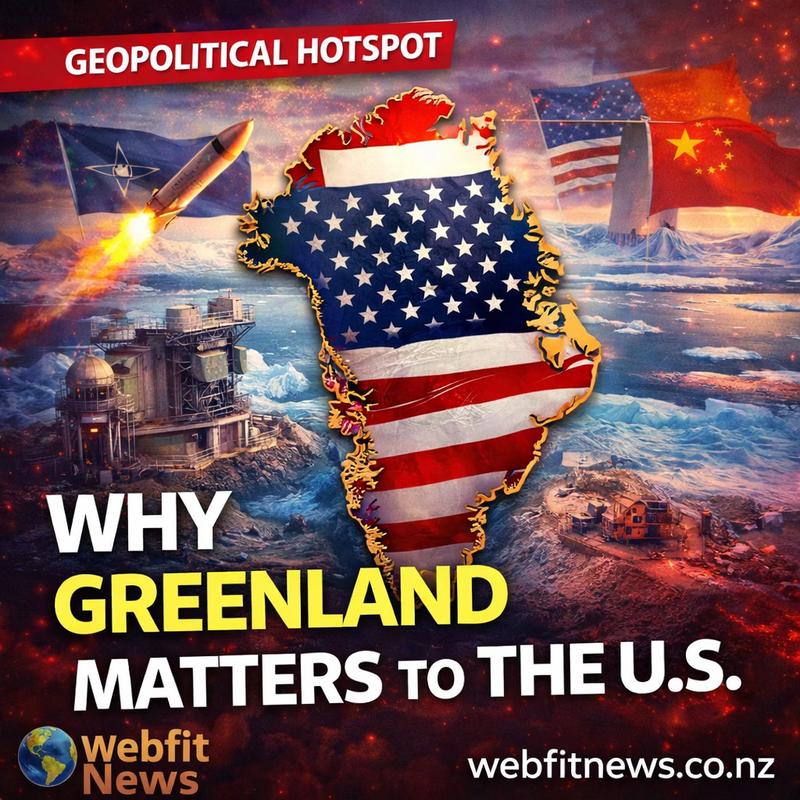
<p>Greenland has emerged as a global geopolitical flashpoint as US strategy, Arctic militarisation, rare earth resources, and NATO tensions collide in 2026.</p>
What once looked like a frozen blank space on the map has become one of the most contested strategic assets on Earth.
In 2026, Greenland has moved from geopolitical curiosity to geopolitical flashpoint. The United States, under Donald Trump’s second administration, has elevated control of Greenland from a rejected idea to a declared strategic necessity. What makes this moment different is not rhetoric alone. It is the convergence of military technology, Arctic climate change, rare-earth supply chains, and a revived expansionist doctrine that openly challenges post-World War II norms.
This is not about buying land. It is about rewriting power structures.
Webfit News breaks down what is actually happening, why Greenland matters now, and why this confrontation risks reshaping global alliances.
Why Greenland Suddenly Matters More Than Ever
Greenland’s importance is not emotional or symbolic. It is structural.
At the intersection of Arctic geography, missile defense, and mineral security, Greenland sits at the center of three overlapping strategic realities.
1. Geography That Controls the Arctic
Greenland occupies the shortest aerial and missile routes between Russia and North America. Any weapon launched across the North Pole passes Greenland first.
This makes Greenland the highest ground in Arctic warfare.
2. Military Infrastructure Already Exists
The United States already operates Pituffik Space Base in northwest Greenland under a defense treaty with Denmark.
That base hosts early-warning radar systems designed to detect intercontinental ballistic missiles.
What has changed is scale.
3. Resources the World Cannot Replace
Greenland holds some of the largest untapped reserves of rare earth elements outside China. These materials power:
Electric vehicle motors
Wind turbines
Military guidance systems
Artificial intelligence hardware
The global race for these resources has become a national security issue.
The Map Illusion That Shaped Political Imagination
A major psychological driver behind Greenland’s appeal is cartographic distortion.
Most people see Greenland through the Mercator projection, which dramatically exaggerates land near the poles.
Actual Size Comparison
Region
Actual Land Area (sq km)
Greenland
~2.16 million
Africa
~30.37 million
Australia
~7.69 million
India
~3.29 million
Africa is nearly 14 times larger than Greenland. Yet on most maps, Greenland looks comparable.
This visual inflation reinforces the idea of Greenland as a continental prize rather than a sparsely populated Arctic territory.
Politics follows perception.
A 150-Year American Obsession With Greenland
This is not a new ambition. It is a delayed one.
Key Historical Attempts
1868: U.S. studies Greenland after purchasing Alaska