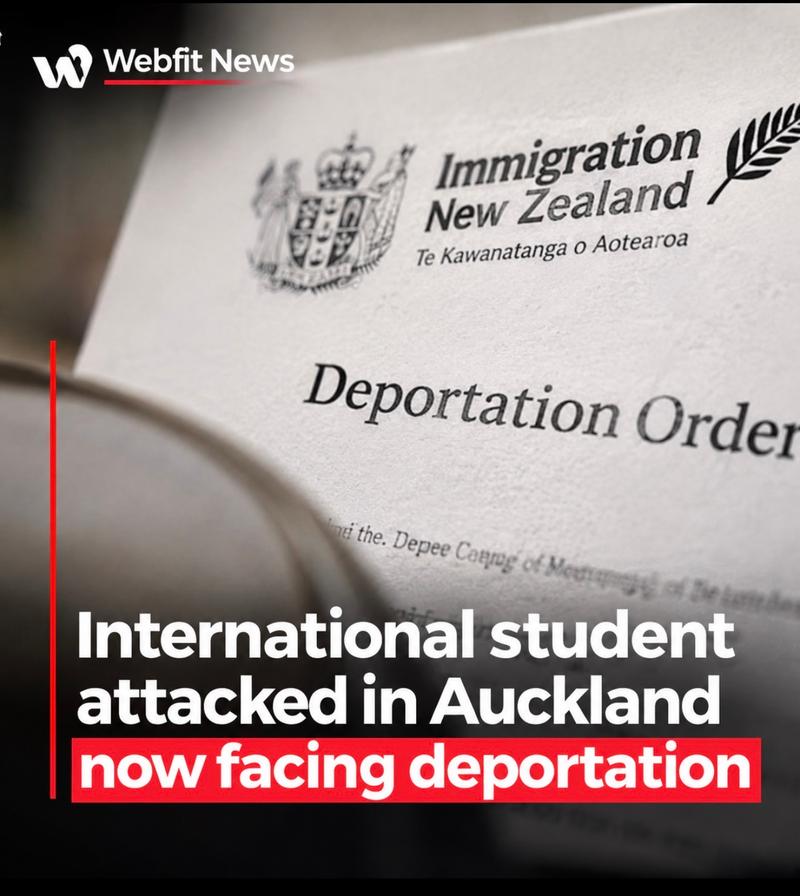
One important development offers some clarity. Immigration New Zealand has confirmed it will await the outcome of Bahia’s criminal proceedings before making decisions regarding his deportation.
But that does not mean the deportation order has been cancelled or that his immigration future is secure.
A violent encounter in a Manukau car park
On 19 October, Bahia was parked near Manukau Station Road when someone approached him asking for money.
According to police information provided to RNZ, the person returned shortly afterwards with a group.
One individual allegedly threatened Bahia, demanded money and assaulted him.
Bahia said he was stabbed in a finger and repeatedly struck on the head with the handle of a knife. His phone, wallet and passport were stolen.
Police took him to Middlemore Hospital, where he underwent surgery on his injured finger.
The recovery has been difficult. Bahia told RNZ that he was still receiving treatment and could not stand or walk for extended periods.
He said surgical wires and screws were due to be removed after eight weeks.
Police located a vehicle of interest on the day of the attack and spoke with its occupants. However, officers said there was insufficient evidence to make an arrest.
The aggravated robbery investigation remains ongoing.
His visa problems started months earlier
There is an important distinction in Bahia’s case: the robbery did not start his immigration difficulties.
After arriving in New Zealand in 2024, Bahia completed a Level 5 Diploma in Ageing and Disability Services.
He subsequently enrolled in a Level 7 Diploma in Community Healthcare and Support.
However, family difficulties affected his attendance, and he was unable to complete the second qualification.
An attempt to extend his visa in April 2026 was unsuccessful. He applied for another student visa in June, but Immigration New Zealand declined that application too.
The precise grounds for those decisions have not been established in the information available to Webfit News.
By the time the robbery occurred in October, Bahia was already dealing with an uncertain immigration situation.
The second legal battle: Five theft charges
Bahia is also facing criminal proceedings relating to alleged petrol thefts in August.
He has been charged with five counts of theft after a former flatmate allegedly used his car to obtain fuel without paying.
Bahia disputes responsibility.
He told RNZ he was unaware of the alleged offending and had always paid for his own petrol.
He also alleged that the same person stole his laptop and phone before blocking contact with him.
Those allegations have not been established in court.
Being charged with an offence is not the same as being convicted. Bahia’s criminal proceedings remain unresolved, and he is due to appear in court again on 15 December.
While attending court earlier this month, he was served with a deportation order by Immigration Compliance.
The combination of the unresolved criminal case, immigration proceedings and medical recovery has left him in an exceptionally difficult position.
Immigration NZ says it will wait
Immigration New Zealand has provided an important update on Bahia’s situation.
Steve Watson, the agency’s Immigration Compliance and Investigations general manager, told RNZ that relevant information would be considered in the deportation decision-making process, including any request to cancel the order.
The agency also confirmed it would await the outcome of Bahia’s criminal proceedings before making decisions regarding his deportation.
This means there are still decisions to be made.
However, the distinction between a deportation order being served and that order being cancelled is crucial. No cancellation has been confirmed.
Bahia’s immigration adviser, Jagdeep Singh Sidhu, president of the NZ Forum for Immigration Professionals, has applied to have the deportation order cancelled.
Sidhu says Bahia wants to complete his studies and continue receiving medical treatment.
Immigration lawyer Mathew Harrington of Queen City Law told RNZ that the available options are limited, although immigration authorities have powers to consider exceptional personal circumstances.
Whether those powers will be exercised in Bahia’s favour remains unknown.
The timeline: How the situation developed
|
When
|
What happened
|
|
2024
|
Bahia arrives in New Zealand to study
|
|
2024–2026
|
Completes Level 5 and enrols in Level 7 studies
|
|
April 2026
|
Visa extension attempt unsuccessful
|
|
June 2026
|
New student visa application declined
|
|
August 2026
|
Alleged petrol thefts involving his vehicle
|
|
19 October
|
Assaulted and robbed in Manukau
|
|
November
|
Served with a deportation order
|
|
20 November
|
Immigration NZ’s position reported by RNZ
|
|
15 December
|
Next scheduled criminal court appearance
|
What other international students should know
Bahia’s experience highlights several immigration rules that students may not fully understand until something goes wrong.
1. Missing classes can affect future visa applications
Student visa holders are generally expected to attend their courses and make satisfactory academic progress.
Immigration New Zealand recognises that students can have genuine reasons for absences, but those circumstances may need to be explained and supported with evidence when applying for another visa.
Medical certificates, academic records and correspondence with education providers can be important.
An absence does not automatically lead to deportation.
2. An expired visa and a deportation order are different situations
A person who becomes unlawful in New Zealand may, in some circumstances, request a visa under section 61 of the Immigration Act 2009.
However, Immigration New Zealand’s published guidance states that a section 61 visa cannot be granted after a deportation order has been issued.
At that stage, different legal processes and discretionary powers may become relevant.
This is why obtaining qualified advice early is important.
3. Being a crime victim does not automatically protect immigration status
New Zealand does not have a general immigration visa category specifically for victims of crime, according to immigration lawyer Mathew Harrington’s explanation to RNZ.
A person’s medical condition and other circumstances may be relevant to discretionary immigration decisions, but they do not automatically establish a right to remain.
4. Criminal charges and convictions must not be confused
An unresolved criminal charge does not establish guilt.
Criminal proceedings and immigration decisions operate under different legal frameworks, although the outcome of a criminal case may become relevant to immigration authorities.
Students facing both issues should obtain advice from appropriately qualified legal professionals.
Where students can seek help
International students experiencing serious difficulties can contact several organisations, depending on their circumstances.
|
Situation
|
Where to seek help
|
|
Visa concerns or declined applications
|
Immigration New Zealand or a licensed immigration adviser
|
|
Deportation notices or orders
|
Immigration lawyer or licensed immigration adviser urgently
|
|
Problems with attendance or course completion
|
Education provider’s international student support team
|
|
Assault, threats or theft
|
New Zealand Police, 111 for emergencies or 105 for non-emergencies
|
|
Support following a crime
|
Victim Support New Zealand
|
|
Disputes with an education provider
|
NZQA or the relevant student complaints service
|
Students should not assume that reporting a crime, applying for medical leave or having an unresolved court case automatically extends their visa.
A community stepping in where family cannot
While the legal processes continue, Bahia is relying on people around him.
According to his adviser, he has no family in New Zealand. Friends are allowing him to stay without paying rent, and a local gurdwara has been providing food.
That support is helping him recover from the attack, but his longer-term situation remains uncertain.
His next court appearance is scheduled for 15 December. Immigration New Zealand has said it will await the outcome of the criminal proceedings before making decisions regarding deportation.
There are still important unanswered questions, including the precise grounds for his visa refusals, the evidence being considered in the request to cancel his deportation order, and how his ongoing treatment may affect the process.
None of those questions should be answered through speculation.
For Bahia, the immediate priorities are recovering from his injuries, responding to the charges before the court and resolving his immigration situation.
Beyond the legal complexities, his original ambition has not changed.
He wants to finish his education.
And for thousands of other international students navigating life far from home, his experience illustrates how quickly an unexpected crisis can become much more complicated when visa conditions, legal proceedings and personal hardship overlap.
Source and reporting note: Gurleen Bahia’s circumstances, the police investigation, statements from immigration professionals and Immigration New Zealand’s response were originally reported by Blessen Tom for RNZ on 20 November 2026. Webfit News has expanded on the case with a chronological breakdown, explanations of relevant immigration rules and practical guidance for international students. Webfit News has not independently interviewed Bahia or the authorities involved.