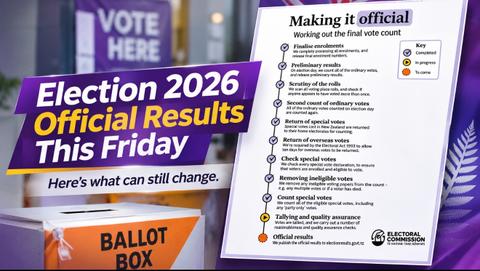
Even after Friday, judicial recounts could still extend the process.
Almost 400,000 votes were missing on election night
The preliminary election-night result was based on about 2.43 million ordinary votes.
The Electoral Commission estimates another 399,365 special votes will be included in the official result.
That includes almost 97,000 overseas and dictation votes.
Combined, those figures put the expected total vote at about 2.83 million.
It means roughly 14 percent of the expected vote was not included in the result New Zealand saw on election night.
That is why some of the country’s closest electorate races remain impossible to call with confidence.
Four electorates are separated by fewer than 500 votes
Several seats are still sitting on margins that could easily move once special votes are counted.
|
Electorate
|
Preliminary leader
|
Challenger
|
Margin
|
|
Wairarapa
|
Mike Butterick, National
|
Kieran McAnulty, Labour
|
139
|
|
Mt Roskill
|
Michael Wood, Labour
|
Carlos Cheung, National
|
262
|
|
Te Tai Tokerau
|
Aperahama Edwards, Te Pāti Māori
|
Hūhana Lyndon, Green
|
436
|
|
Hamilton East
|
Ryan Hamilton, National
|
Georgie Dansey, Labour
|
456
|
Whangārei and Takanini are also relatively close, with National leading by about 1000 votes in each.
But the four seats above are where the numbers could have a wider effect on Parliament.
Wairarapa could cost National an MP
National’s Mike Butterick leads Labour’s Kieran McAnulty in Wairarapa by just 139 votes.
Butterick has 17,943 preliminary votes against McAnulty’s 17,804.
McAnulty has a route back to Parliament through Labour’s list if he loses the electorate.
Butterick does not have the same protection.
Because National has won more electorate seats than its party vote would normally entitle it to, it currently has an overhang.
That means if Butterick loses Wairarapa, National could lose an MP altogether rather than simply replacing him with somebody from the party list.
That makes the seat nationally important.
Hamilton East carries a similar risk
National’s Ryan Hamilton leads Labour’s Georgie Dansey by 456 votes.
Hamilton has 14,139 preliminary votes.
Dansey has 13,683.
In 2023, Hamilton won the seat by more than 5000 votes.
This time, the race is much tighter.
Again, because of National’s current overhang, a loss in Hamilton East could reduce the party’s total number of MPs.
Mt Roskill is simple: winner stays, loser is out
Labour’s Michael Wood leads National’s Carlos Cheung by 262 votes.
Wood has 13,582 preliminary votes.
Cheung has 13,320.
Unlike some candidates in other close races, neither has a realistic list route back into Parliament if they lose the electorate.
For both men, Mt Roskill is likely to determine whether they return to Parliament at all.
That makes special votes decisive.
Te Tai Tokerau could change the size of Parliament
Te Tai Tokerau is even more unusual.
Te Pāti Māori candidate Aperahama Edwards leads Green candidate Hūhana Lyndon by 436 votes.
Edwards has 8484 preliminary votes.
Lyndon has 8048.
If the Greens take the electorate, they would not necessarily gain another MP because their overall representation is already determined by their party vote.
Te Pāti Māori, however, currently benefits from an overhang.
If it loses an electorate, Parliament itself could shrink.
That means an electorate changing from one opposition party to another could still alter the total number of MPs.
This is one of the stranger effects of the 2026 result.
Why Parliament currently has 131 MPs
New Zealand normally has a 120-seat Parliament.
The preliminary 2026 result has produced 131 seats because of overhangs.
Under MMP, the party vote generally determines how many MPs each party receives.
But a party keeps every electorate it wins, even if that number exceeds what its party vote would normally entitle it to.
Those extra electorate seats are added to Parliament.
That is why the final size of Parliament is still not completely settled.
Preliminary seat numbers
|
Party
|
Preliminary seats
|
|
National
|
42
|
|
Labour
|
36
|
|
Green
|
16
|
|
ACT
|
13
|
|
NZ First
|
12
|
|
Opportunity Party
|
7
|
|
Te Pāti Māori
|
5
|
|
Total
|
131
|
The preliminary National-ACT-NZ First bloc has 67 seats.
A majority in a 131-seat Parliament requires 66.
That leaves the bloc only one seat above the majority line.
But if the size of Parliament changes after electorate results and overhangs are recalculated, the number required for a majority could also change.
That is why the final result cannot be understood by watching only one electorate.
Labour and National are also separated by just 3650 party votes
The nationwide party vote is extremely close.
Labour received 710,330 preliminary party votes.
National received 706,680.
The gap between the two largest parties is just 3650 votes.
The number of special votes being added on Friday is more than 100 times larger than that difference.
Special votes do not necessarily break in the same way as ordinary votes.
If party percentages shift enough, list seats can move between parties.
That could change the coalition arithmetic even if none of the close electorates flips.
Friday’s result could change several things at once
When the official results are released, the Electoral Commission will not simply add the special votes to the election-night totals.
The process also includes checking eligibility, recounting ordinary votes and recalculating the final allocation of list seats.
That means Friday could produce changes in several areas at once:
- electorate winners
- party vote percentages
- list seats
- overhang seats
- the total size of Parliament
- the majority required to govern
That is why the official count matters far more than simply confirming the preliminary result.
Friday may still not end the process
Candidates who lose close electorates can apply for judicial recounts after the official result.
Applications must be made within three working days.
A District Court judge supervises the recount.
Those recounts can take several days.
New Zealand saw three electorate recounts after the 2023 election.
With several margins this year measured in the hundreds, further challenges are possible.
There is also a mechanism for a political party to seek a recount of the nationwide party vote if the final allocation is exceptionally close.
That would be rare.
But the legal option exists.
The most important number is 399,365
The 139-vote margin in Wairarapa will attract attention.
So will the 262 votes separating Michael Wood and Carlos Cheung in Mt Roskill.
Te Tai Tokerau and Hamilton East could also move.
But the biggest number in the story is still 399,365.
That is how many special votes are expected to be brought into the official result.
They represent roughly one in seven of all expected votes.
In a close election, that is not a footnote.
It is a substantial part of the electorate.
New Zealand voted on 7 November.
On Friday, the country will finally see the official numbers.
But if some of those margins remain tight, one final count may still not bring one final answer.
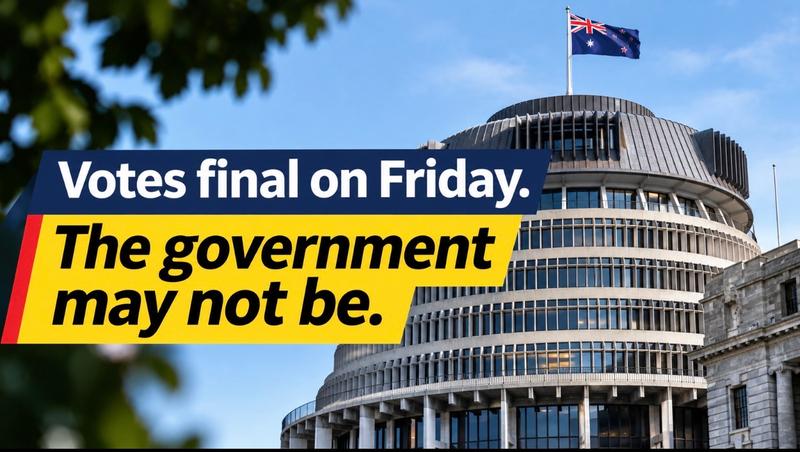
The votes may be final on Friday. The government may not be.