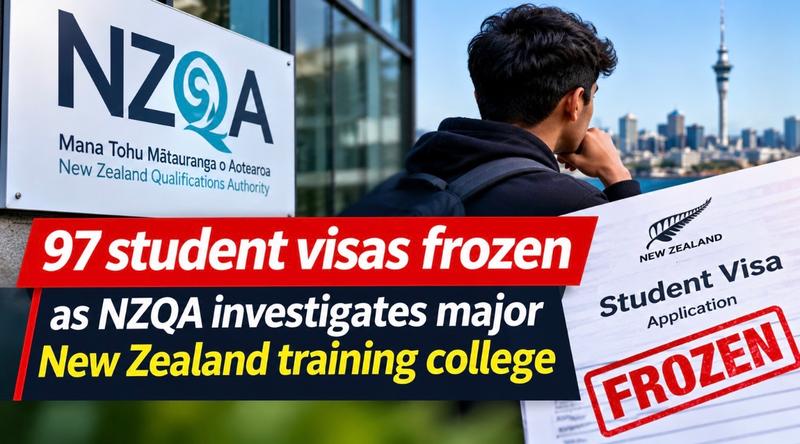
They have been frozen while NZQA investigates.
For applicants who may already have paid tuition fees, arranged accommodation or planned international travel, however, that distinction may offer limited comfort.
The suspension can initially remain in place for up to six months.
What exactly has happened?
Immigration New Zealand can suspend student visa processing when an education provider is being investigated by NZQA or another relevant agency.
The power is designed to prevent new visas being issued while questions about a provider’s compliance are still unresolved.
For NZTC, the freeze applies to all programmes and courses for people seeking new student visas.
A suspension does not mean NZQA has already found wrongdoing.
It means immigration officials are waiting for more certainty before allowing new applications linked to the provider to proceed.
What is NZQA investigating?
NZQA has confirmed an investigation is under way but has not publicly detailed its full scope.
The regulator does not normally discuss the substance of an active investigation while inquiries are continuing.
Separate allegations have been reported publicly about admission and assessment practices at the college, including claims made by whistleblowers.
Those allegations should not be treated as findings by NZQA.
At this stage, the confirmed position is that NZQA is investigating NZTC.
The outcome is not known.
NZTC has said it is cooperating with the regulator and providing information requested as part of the process.
The college has also said teaching, student support and placements are continuing.
Who is actually affected?
The distinction between different groups of students is important.
|
Student situation
|
What happens now
|
|
New NZTC student visa application already lodged
|
Processing is suspended
|
|
Student already holds a valid visa
|
Not affected by the suspension
|
|
Existing NZTC student needing another visa to continue the same programme
|
Can continue through the visa process
|
|
Student has an NZTC offer but has not yet applied for a visa
|
Should wait before proceeding
|
|
New international applicant seeking admission
|
New international applications and offers have been paused
|
|
Applicant wants to withdraw
|
Can withdraw and explore available refunds
|
|
Applicant wants to change provider
|
May be able to provide Immigration New Zealand with a new qualifying offer
|
This matters because the words “student visas frozen” can easily create the impression that every international student already studying at NZTC is affected.
They are not.
The three choices facing affected applicants
For the 97 visa applicants caught in the suspension, there are three broad options.
Wait
Students can leave their visa applications on hold until processing resumes.
The problem is that there is currently no guaranteed date for that to happen.
The suspension could remain in place for months depending on how long the investigation takes.
Change provider
Students may be able to submit an offer of place from another approved education provider.
If immigration requirements are met, their application could then continue using the new programme or institution.
Anyone considering this option should carefully check whether the new course matches their study plans and immigration requirements.
Changing provider should not be treated as simply swapping one college name for another.
Withdraw
Applicants can withdraw their visa application.
Students should also check directly with the provider and Immigration New Zealand about what refunds may be available for tuition and visa costs.
Do not panic and cancel everything immediately
For affected students and families, the understandable reaction may be to panic.
That would be premature.
A processing suspension is not a visa refusal.
Nor is an NZQA investigation proof that the provider has breached education rules.
Students should first establish exactly where their application sits.
They should keep copies of:
- their offer of place
- tuition-fee receipts
- visa application records
- accommodation commitments
- travel bookings
- emails from the provider
- correspondence from Immigration New Zealand
Anyone considering changing provider should also understand the academic and immigration consequences before making that decision.
Why NZTC matters
This is not an investigation involving a tiny provider with only a handful of students.
New Zealand Tertiary College has operated for decades and specialises heavily in education and care training.
Its programmes include early childhood education qualifications ranging from certificate and diploma study through to bachelor’s, postgraduate and master’s programmes.
NZTC has been registered as a tertiary provider since the early 1990s.
Its previous external evaluation gave it strong ratings for educational performance and self-assessment.
That history makes the current investigation particularly notable.
A provider can have a strong past record and still face a new investigation if fresh concerns arise.
Why international students should pay attention
The case also comes at a time when New Zealand is applying greater scrutiny to international student visa processing and education-provider compliance.
For students overseas, that matters because a visa application is only one part of the process.
The status of the education provider itself can now directly affect whether an application proceeds.
International students often commit substantial sums before travelling.
Tuition fees.
Accommodation.
Flights.
Insurance.
Deposits.
Living costs.
For many families, the financial commitment can run into tens of thousands of dollars.
That makes a provider investigation much more than an administrative issue.
There are real people and real money behind every suspended application.
Indian students are among those who need to be careful
India remains one of New Zealand’s largest sources of international students.
Thousands of Indian students apply each year to study in New Zealand, often through education agents and overseas recruitment networks.
That makes due diligence important.
Students should not rely solely on what an agent tells them.
Before paying large sums, they should check:
- whether the provider is currently approved
- whether the course is recognised
- whether visa processing is operating normally
- whether the provider is under investigation or restriction
- what refund rules apply
- whether the qualification supports their actual study or career goals
An approved course and a legitimate provider are important, but students also need to know the provider’s current regulatory status.
What happens next?
NZQA’s investigation is now the key process.
Immigration New Zealand can lift the suspension once it is satisfied the provider is meeting its obligations and visa processing can safely resume.
There is no public finding against NZTC at this stage.
There is also no guarantee the freeze will end quickly.
That leaves 97 applicants in an uncomfortable position.
Their visas have not been rejected.
Their study plans are not necessarily cancelled.
But their applications are not moving.
For anyone planning to study in New Zealand, the lesson is simple:
Do not check only the course and the college. Check the provider’s current visa-processing and regulatory status before committing your money.