
Nearly 180 hectares of former dairy farmland will be converted largely to native forest as part of a long-term effort to reduce nitrogen flowing into Lake Rotorua.
By Webfit News | 26 November 2026
Friday 25 December
Countdown to ChristmasNearly 180 hectares of former dairy farmland will be converted largely to native forest as part of a long-term effort to reduce nitrogen flowing into Lake Rotorua.
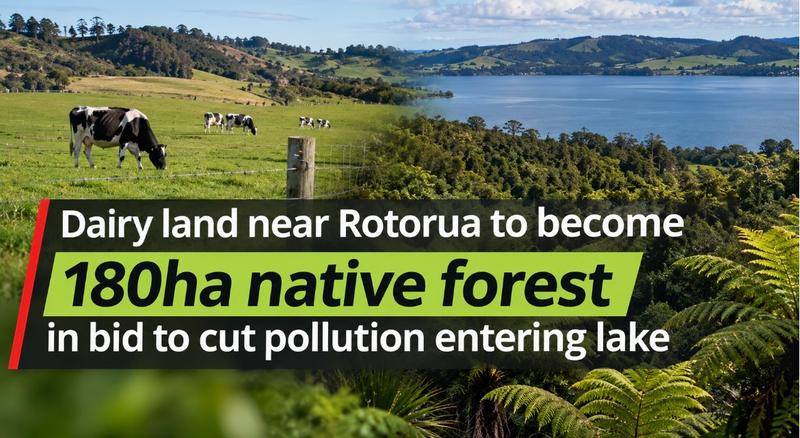
Nearly 180 hectares of former dairy farmland will be converted largely to native forest as part of a long-term effort to reduce nitrogen flowing into Lake Rotorua.
By Webfit News | 26 November 2026
Nearly 180 hectares of former dairy farmland near Rotorua is set to be transformed predominantly into native forest, in a project expected to remove about five tonnes of nitrogen a year from the Lake Rotorua catchment.
Bay of Plenty Regional Council and BayTrust are partnering on the project at the 266-hectare Kererū property, which the council purchased as part of its long-running effort to improve the lake’s water quality.
The land had previously been used for dairy farming and was contributing more than six tonnes of nitrogen a year towards Lake Rotorua.
Retiring the dairy operation and restoring much of the property with native vegetation is expected to reduce that loss by about five tonnes annually.
The change represents a substantial reduction from one property, but is also part of a much larger effort to control nutrients entering the lake.
Why nitrogen matters to Lake Rotorua
Too much nitrogen entering a lake can encourage excessive algae growth and contribute to deteriorating water quality.
In the Lake Rotorua catchment, farming has historically been one of the largest sources of nitrogen entering the water.
The region has spent years trying to bring those losses down through changes to farming practices, land-use controls, incentives and other environmental work.
The long-term target is to limit the amount of nitrogen reaching Lake Rotorua to 435 tonnes a year by 2032.
Turning higher-nitrogen land uses such as dairy farming into forestry is one way of helping reach that target.
Trees generally require far less intensive fertiliser use and can substantially reduce the amount of nitrogen leaching through soil compared with dairy farming.
From cows to native forest
Regional Council chief executive Fiona McTavish said forestry had been identified as one of the most viable long-term uses for the Kererū property.
“This partnership presents a significant opportunity to establish native forest at scale, helping reduce nitrogen entering Lake Rotorua while delivering wider benefits for the environment and future generations,” she said.
The project will focus predominantly on native planting rather than simply establishing a commercial forestry block.
That means the council and BayTrust expect the land to eventually provide benefits beyond reducing nitrogen.
Those include restoring habitat, increasing biodiversity, storing carbon and improving the surrounding landscape.
BayTrust to fund establishment and maintenance
Under the proposed arrangement, BayTrust will fund investigations required before planting begins, as well as forest establishment and ongoing maintenance.
The Regional Council will work alongside BayTrust and other partners as the project develops.
BayTrust impact investment adviser Terri Eggleton said the trust wanted to support a local project that could contribute both to its environmental goals and to the health of Lake Rotorua.
“By working with the Regional Council at the Kererū Property, we can help bring native forest back to former farmland and support efforts to improve the health of Lake Rotorua,” she said.
BayTrust is aiming to become carbon neutral by 2050.
Why not simply keep farming the land?
The project highlights a difficult issue facing some environmentally sensitive catchments.
Dairy farming produces food, employment and economic value, but intensive pastoral land use can also produce considerably higher nitrogen losses than forestry.
Around Lake Rotorua, authorities have been trying to reduce those losses without requiring farming to disappear from the entire catchment.
That means identifying properties where changing the way land is used can deliver larger environmental gains.
The Kererū property is one of those cases.
Instead of attempting to make the existing dairy operation progressively less intensive, the council has chosen to retire dairy farming on the property altogether.
The result is expected to cut nitrogen losses from more than six tonnes a year to roughly one tonne.
In percentage terms, that is an expected reduction of about 80 percent from the property’s previous contribution.
Native forest brings another benefit
There is also a significant difference between simply planting trees and establishing native forest.
Native planting can provide habitat for birds, insects and other wildlife while creating ecological connections with existing vegetation.
It also avoids turning the site into a short-cycle plantation that may eventually be harvested.
Native forest takes time to establish, however.
Young plants require weed control, pest management and ongoing maintenance, particularly during their early years.
That is why the long-term funding arrangement is important.
Planting thousands of trees is relatively straightforward.
Keeping enough of them alive to eventually become a forest is the harder part.
Part of a much bigger Lake Rotorua programme
The Kererū project will not solve Lake Rotorua’s water-quality problems on its own.
The lake’s nutrient issues have developed over decades and involve farming, urban activity, wastewater and nutrients moving slowly through groundwater.
Some nitrogen entering the lake today may have entered the groundwater system years earlier.
That makes improving water quality a long-term exercise rather than something that changes immediately after land is planted.
The Rotorua Te Arawa Lakes Programme has been working towards reducing the sustainable nitrogen load through a combination of regulation, land-use change, incentives and engineering interventions.
The conversion of the Kererū property is another piece of that programme.
Nearly 180 hectares will change permanently
For people driving past the property, the most visible change will eventually be straightforward.
Land that was once dairy country will increasingly look like native bush.
But underneath that visible transformation is a bigger environmental calculation.
The land previously sent more than six tonnes of nitrogen towards Lake Rotorua each year.
The aim is to bring that down by about five tonnes.
At the same time, almost 180 hectares will begin storing carbon and providing new habitat.
The public will not see those benefits overnight.
A native forest takes decades to mature.
Lake water quality can take even longer to respond.
But that is also the point of the project.
Rather than trying to produce a quick environmental improvement, the council and BayTrust are changing how the land will be used for generations.
The cows are leaving. The trees will take their place. And the measure of success will ultimately be what stops flowing into Lake Rotorua.
Was this article useful?