
An overtime ban is now in force at the country’s state housing agency, with further strike action planned as workers push for better pay, manageable workloads and greater access to flexible working.
By Webfit News | 26 November 2026
Friday 25 December
Countdown to ChristmasAn overtime ban is now in force at the country’s state housing agency, with further strike action planned as workers push for better pay, manageable workloads and greater access to...
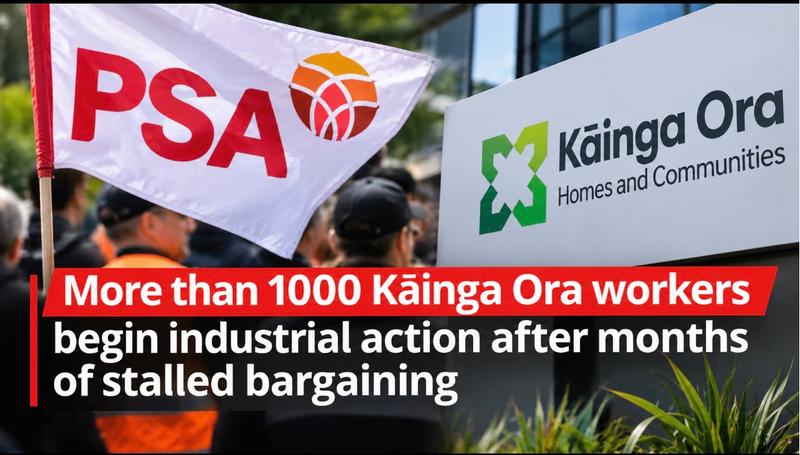
An overtime ban is now in force at the country’s state housing agency, with further strike action planned as workers push for better pay, manageable workloads and greater access to flexible working.
By Webfit News | 26 November 2026
More than 1000 Kāinga Ora workers have begun industrial action, refusing to work overtime after five months of bargaining failed to produce an agreement.
The overtime ban began just after midnight on Thursday and is scheduled to remain in place until 24 December.
It is the first of three planned actions by members of the Public Service Association, with workers also planning to stay away from Kāinga Ora offices on Monday and work remotely instead.
A one-hour nationwide walkout is scheduled for 9 December if the dispute remains unresolved.
The union says staff are being asked to carry increasingly heavy workloads following major workforce reductions at the state housing agency.
Kāinga Ora manages homes for about 200,000 tenants, meaning any prolonged dispute will raise questions about whether services to residents could be affected.
Workers say overtime has become routine
PSA National Secretary Fleur Fitzsimons said workers had reached the point where overtime was no longer occasional.
“Overtime has become the expectation, not the exception,” she said.
“Members tell us the high workload is making them unwell.”
Under the current action, union members will work their normal paid hours but will not take on additional overtime.
The PSA says workers voted overwhelmingly in favour of industrial action earlier this week after months of collective bargaining.
The dispute covers pay, workloads, flexible working and a proposed new remuneration system.
The union also alleges some employees temporarily working in higher-level positions have not been paid the corresponding higher rate.
What happens next
The industrial action will escalate in stages.
The overtime ban runs from 26 November to 24 December.
On Monday, 30 November, participating workers will perform their normal duties remotely rather than attending Kāinga Ora offices.
The union says that action is intended to support its claim for more consistent access to flexible working.
Then, unless an agreement is reached, workers plan to withdraw their labour completely between 11am and midday on Wednesday, 9 December.
The PSA says it has sought facilitation through the Employment Relations Authority after Kāinga Ora declined mediation.
Why Monday’s action is different
The remote-working action is unusual because employees will still be working.
They simply will not be working from Kāinga Ora premises.
The union argues that many of the affected roles can be performed effectively from home and says access to flexible working is being applied inconsistently.
Fitzsimons said flexible working should be available fairly rather than depending on individual managers.
The action is therefore designed to demonstrate that staff can continue performing their roles without being physically present in the office.
Kāinga Ora has already become much smaller
The dispute comes after a major reduction in the size of Kāinga Ora.
Official figures show the organisation had 3398 full-time-equivalent staff in 2023/24.
By the end of the 2025/26 financial year, that had fallen to about 2244 FTEs.
That is a reduction of more than 1100 positions, or roughly one-third of the workforce in two years.
The agency has been undergoing a government-directed reset aimed at reducing costs and returning its focus to managing and providing social housing in a financially sustainable way.
Kāinga Ora has previously said much of its restructuring has targeted corporate, back-office and support functions rather than frontline tenancy management.
Its own reporting shows substantial reductions in staffing costs as the organisation has become smaller.
Union says remaining staff are carrying more work
The PSA argues the reductions have had consequences for employees who remain.
It says at least 900 workers were made redundant between December 2023 and June 2026, with about $36.5 million paid in redundancy costs.
It also says Kāinga Ora spent another $8.6 million on consultants and contractors between July 2024 and June 2026.
Those figures have become a key part of the union’s argument.
Its position is that the organisation has reduced permanent staffing while continuing to spend millions on restructuring and outside expertise.
Kāinga Ora, however, has previously said its workforce changes are necessary to make the organisation financially sustainable and more focused on its core social-housing responsibilities.
What could this mean for tenants?
For most Kāinga Ora tenants, the immediate effect of the overtime ban may not be obvious.
Staff will continue working their normal hours.
The larger question is what happens if work that has previously relied on overtime begins to accumulate.
Kāinga Ora deals with tenancy management, rent issues, customer enquiries, housing placements, maintenance coordination and support for households experiencing complex problems.
A prolonged reduction in staff availability could put pressure on response times if workloads cannot be completed within ordinary hours.
The PSA says that is precisely the point it wants to demonstrate.
The union argues that services have increasingly depended on staff working beyond their contracted hours.
Kāinga Ora has previously reported improvements in several tenant measures during its restructuring, including customer satisfaction and the time taken to turn vacant homes around.
How those gains hold up during industrial action will now be closely watched.
The fight is also about pay
The union says five months of bargaining has failed to produce what it considers an acceptable cost-of-living pay increase.
It is also opposing aspects of a proposed remuneration system.
No detailed figures for the competing pay positions were provided in the PSA’s release.
That makes it difficult to independently assess the distance between the union and Kāinga Ora on wages.
But the dispute has moved beyond negotiation-room frustration.
Workers are now taking formal industrial action, and a complete one-hour stoppage is less than two weeks away.
A difficult equation for Kāinga Ora
The agency faces competing pressures.
It has been directed to operate more efficiently and reduce costs.
At the same time, it manages one of the country’s largest housing portfolios and provides services to around 200,000 tenants.
Reducing staff can save money.
But the work does not necessarily disappear at the same speed.
That is the central issue behind the current dispute.
The PSA says too much work is now falling on too few people.
Kāinga Ora’s restructuring programme has been based on the argument that a smaller organisation can continue delivering its core services more efficiently.
The industrial action is likely to become an early test of those competing claims.
For now, more than 1000 workers are making their position straightforward.
They will do the hours they are paid to do.
The next question is whether Kāinga Ora can continue delivering the same level of service without the extra hours those workers say have become routine.
Was this article useful?