
Federated Farmers says proposed changes could significantly reduce RNZ’s specialist rural reporting capacity, raising questions about how regional communities will be covered as the public broadcaster restructures.
By Webfit News | 26 November 2026
Friday 25 December
Countdown to ChristmasFederated Farmers says proposed changes could significantly reduce RNZ’s specialist rural reporting capacity, raising questions about how regional communities will be covered as...
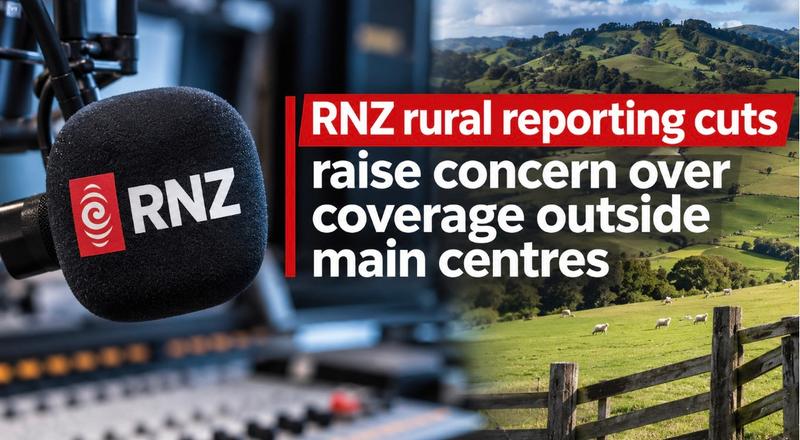
Federated Farmers says proposed changes could significantly reduce RNZ’s specialist rural reporting capacity, raising questions about how regional communities will be covered as the public broadcaster restructures.
By Webfit News | 26 November 2026
Federated Farmers is raising concerns about proposed changes to RNZ’s rural news operation, saying the restructure could significantly reduce specialist reporting from farming and provincial communities.
The organisation says documents outlining the proposal show three-quarters of RNZ’s specialist rural reporters would be affected.
It says the changes could ultimately leave RNZ Rural with only one specialist rural journalist, who may also be required to carry out other reporting duties.
The proposal has not yet been described as a final decision, and being affected by a restructure does not necessarily mean every position involved will be removed.
But farming representatives say the potential reduction comes at a time when regional journalism is already under pressure.
Rural bulletin has already become shorter
Federated Farmers North Canterbury president Bex Green said rural listeners had already noticed a reduction in the service.
She said RNZ’s midday rural news bulletin had fallen from about six-and-a-half minutes last year to around three-and-a-half minutes this year.
“The broadcasts are getting shorter, the rural team is getting smaller,” Green said.
“If this goes ahead, with just one specialist rural journalist also expected to take on other RNZ duties, you’ve got to ask what’s going to be left of RNZ Rural.”
Green said specialist rural news had been part of everyday life for farming communities for decades.
“For decades, farmers have tuned in during morning milking, while they’re having lunch or out working on the farm,” she said.
“It’s how we find out what’s happening in the wider farming world, keep up with important agricultural and trade news, and stay connected to other rural communities.”
Why specialist rural reporting matters
The concern goes beyond the length of a radio bulletin.
Agriculture remains closely connected to New Zealand’s export economy, while decisions involving biosecurity, trade, animal health, water, climate policy and transport can have significant consequences for rural businesses and communities.
Specialist reporting can also provide context that is difficult to replicate through general news coverage.
A journalist regularly covering the sector develops contacts across farming organisations, rural towns, government agencies and individual farms.
That can become particularly important during droughts, floods, disease outbreaks or sudden changes in international markets.
Federated Farmers Bay of Plenty president Brent Mountfort said rural reporting also mattered to people living in cities.
“RNZ Rural is also one of the ways people in our cities find out what’s happening out in the provinces,” he said.
“RNZ has a really important role in telling those stories to a much wider audience.”
Rural New Zealand has already lost news coverage
The proposed changes come during a difficult period for regional journalism.
Local newspapers and commercial news organisations have faced sustained financial pressure, with newsroom reductions affecting coverage in smaller centres.
That means national organisations such as RNZ can become particularly important in areas where fewer reporters are available locally.
Green said rural communities were already seeing traditional sources of local information disappear.
“Rural New Zealand is already losing its local newspapers and other sources of news,” she said.
The concern is that further reductions at RNZ could leave fewer journalists regularly reporting from outside the main metropolitan centres.
RNZ also faces a financial problem
The debate is taking place as RNZ works through wider financial pressures and restructuring across the organisation.
That context matters.
The proposed changes are not confined to rural journalism, and RNZ has been examining staffing and costs more broadly.
A public broadcaster still has to operate within its available funding.
But deciding where savings are made can directly affect what stories are regularly covered.
Rural reporting is particularly vulnerable because it can require more travel and specialist knowledge while serving an audience spread across a large geographic area.
What does RNZ’s Charter require?
Federated Farmers is also pointing to RNZ’s statutory Charter.
Under the Radio New Zealand Act, RNZ is expected to provide comprehensive, independent, accurate, impartial and balanced regional, national and international news and current affairs.
The Charter does not specify how many rural journalists RNZ must employ.
Nor does it guarantee the continuation of any particular programme or bulletin.
RNZ is also required to operate in a financially responsible way.
The issue, therefore, is not simply whether RNZ is allowed to restructure its rural team.
The question is whether the service that remains can continue providing meaningful regional coverage.
Farmers question what would remain
Mountfort said rural New Zealand should not be treated as a niche audience.
“Nearly one in five Kiwis live in rural communities, we produce the food that feeds the country, and we help keep the economy on its feet,” he said.
He said a substantial reduction in specialist reporting would make it harder for rural issues to reach a national audience.
For Federated Farmers, the concern is that the changes could eventually leave RNZ Rural carrying the name of a specialist service without enough dedicated reporting capacity behind it.
The issue is bigger than farmers
There is another side to the debate.
Rural reporting is not simply information produced for farmers.
Stories originating in the regions can affect everyone.
Food prices.
Export earnings.
Road closures.
Extreme weather.
Water supply.
Animal disease.
Trade restrictions.
These are rural stories until they suddenly become national stories.
Specialist reporters often identify those issues before they reach that point.
Without them, coverage can become more dependent on official announcements, industry statements and major events rather than reporting generated from within communities themselves.
What happens next
The restructuring process will determine how many specialist rural reporting positions remain and how RNZ plans to maintain coverage if staffing is reduced.
That explanation will be important.
The number of reporters alone will not determine whether the service succeeds.
The more meaningful questions will be whether RNZ continues to regularly produce original rural journalism, whether reporters are still able to travel into regional communities, and whether agricultural and provincial issues retain a consistent place in national coverage.
Federated Farmers wants RNZ to explain how any substantial reduction would fit with its public-service responsibilities.
For rural listeners, the concern is more immediate.
They want to know whether the service they have relied on for decades will still sound like rural New Zealand once the restructuring is finished.
Was this article useful?