
New Zealand’s largest detailed survey of business AI use suggests the technology is moving rapidly into everyday work, but the feared wave of job losses has not appeared.
By Webfit News Business & Technology Desk | 26 November 2026
Friday 25 December
Countdown to ChristmasNew Zealand’s largest detailed survey of business AI use suggests the technology is moving rapidly into everyday work, but the feared wave of job losses has not appeared.
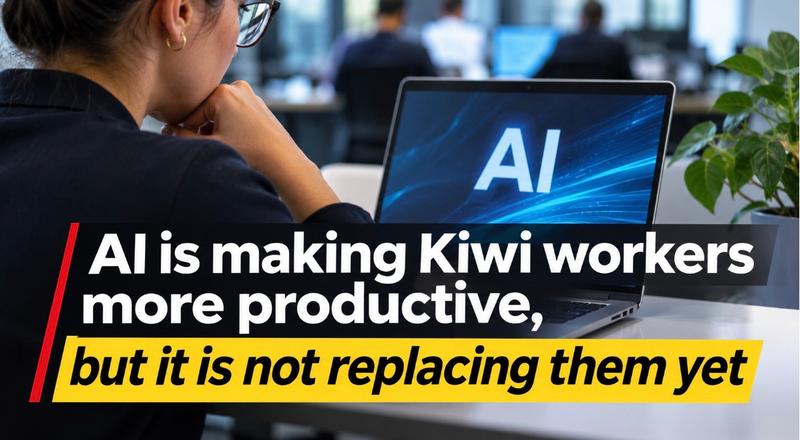
New Zealand’s largest detailed survey of business AI use suggests the technology is moving rapidly into everyday work, but the feared wave of job losses has not appeared.
By Webfit News Business & Technology Desk | 26 November 2026
Artificial intelligence is already being used by more than half of New Zealand businesses, and most of those adopting it say the technology is helping their staff get more done.
But one of the most closely watched consequences of AI has barely moved.
Jobs.
New data from the 2026 Survey of Business Operations shows 52 percent of businesses are already using AI, while another 18 percent intend to adopt it.
Put together, seven in every 10 businesses surveyed are either using AI now or preparing to.
Among businesses already using it, almost 60 percent reported improved worker productivity.
At the same time, almost 90 percent said AI had made no difference to their overall employment numbers.
That combination provides one of the clearest pictures yet of how AI is actually changing New Zealand workplaces.
So far, businesses appear to be using it more to change the work people do than to remove the people doing it.
AI has moved beyond the experiment stage
Almost 10,000 businesses took part in the survey, conducted by Ipsos for the Ministry of Business, Innovation and Employment and Stats NZ.
That scale makes it significantly more useful than the smaller technology surveys that have tracked AI adoption since tools such as ChatGPT became widely available.
The latest numbers suggest AI is no longer something being tested only by technology companies or large corporates.
It is moving into ordinary businesses.
Writing and summarising.
Finding information.
Analysing data.
Helping staff make decisions.
Automating repetitive administration.
Supporting customer service.
The important shift is not simply that businesses know AI exists.
They are beginning to build it into how work gets done.
The productivity result may matter more than the adoption number
The headline figure of 52 percent adoption will attract attention.
But the more important number may be 60 percent.
Almost six in 10 businesses already using AI say it has increased worker productivity.
That is significant for New Zealand because poor productivity growth has been one of the country’s long-running economic problems.
Productivity is essentially about producing more value from the same amount of work.
If a staff member can complete in three hours a task that previously required five, the business has gained capacity.
That does not necessarily mean somebody loses their job.
It may mean the same employee can spend the remaining time dealing with customers, solving more complex problems or taking on additional work.
The new survey suggests that is closer to what is happening, at least for now.
Where businesses say AI is helping
The benefits are broader than simply saving time.
About 68 percent of businesses using AI reported operational benefits, including faster access to accurate information for decision-making.
That matters because much of office work is not creating something from scratch.
It is searching.
Reading.
Summarising.
Comparing.
Checking.
Reformatting.
Preparing.
AI can compress parts of that process dramatically.
For a small business with limited staff, saving even several hours of administrative work each week can be meaningful.
The technology does not have to replace an employee to change the economics of the business.
So where are the job losses?
This is the question hanging over almost every discussion about artificial intelligence.
For several years, businesses and workers have heard predictions that AI could eliminate large numbers of white-collar jobs.
The latest New Zealand data does not show that happening at scale.
Almost nine in 10 businesses using AI reported no change in their overall employment levels.
That does not prove AI will never reduce employment.
Nor does it tell us what may happen as the technology becomes more capable.
But it does challenge the simplest version of the argument that AI adoption automatically means fewer workers.
At least at this stage, New Zealand businesses appear far more likely to be using AI alongside employees than instead of them.
The job may change before the job disappears
That distinction could become increasingly important.
A business may still employ the same number of people while fundamentally changing what those employees spend their day doing.
A marketing worker may produce a first draft with AI but spend more time checking facts and refining strategy.
An accountant may automate routine document processing but spend more time advising clients.
A customer-service worker may use AI to retrieve information faster while still handling difficult conversations personally.
A manager may use AI to summarise data but remain responsible for the decision.
Employment figures alone will not capture those changes.
The first major impact of AI may therefore be on tasks, rather than jobs.
There is another side to the productivity story
Getting more work done does not automatically mean getting better work done.
AI systems can produce errors.
They can generate convincing but incorrect information.
They can mishandle confidential information if businesses use them carelessly.
And employees can become less productive rather than more productive if they spend significant time correcting poor AI output.
That is why the productivity numbers need to be read alongside questions about accuracy, privacy, cybersecurity and human oversight.
A business saving an hour through AI but losing two hours fixing a mistake has not gained much.
The businesses extracting the most value are likely to be those that understand where AI is useful and where a human still needs to check the work.
The divide may soon be between businesses that know how to use AI and those that do not
The survey also points towards another potential shift.
With 52 percent already using AI and another 18 percent planning to, businesses that remain outside the technology may increasingly find themselves competing against companies operating differently.
Not necessarily because AI produces a better product.
But because competitors may be able to answer customers faster, prepare proposals sooner, process information more efficiently or reduce administrative costs.
For small firms in particular, that could matter.
AI gives a small team access to capabilities that once required additional staff, specialist software or outside contractors.
That can narrow the gap between a small business and a much larger competitor.
But it can also create a new gap between companies with the skills to use AI effectively and those that do not know where to begin.
The numbers do not mean every business needs AI
There is also a danger in treating adoption itself as the goal.
Not every problem needs an AI solution.
A café does not become more successful simply because it buys an AI subscription.
A builder does not become more productive by adding a chatbot where none is needed.
The business case depends on whether the technology solves a real problem.
That might mean reducing paperwork.
Finding information more quickly.
Producing quotes.
Managing stock.
Analysing customer demand.
Or removing repetitive work staff would rather not be doing.
The useful question for businesses is not “Are we using AI?”
It is “What are we doing with it that is actually making the business better?”
New Zealand now has something more useful than the hype
For the past few years, much of the debate around artificial intelligence has been based on predictions.
AI will transform productivity.
AI will destroy jobs.
AI will create new industries.
AI will change everything.
The latest survey begins to replace some of that speculation with evidence from New Zealand workplaces.
More than half of businesses are already using the technology.
Most users reporting employment numbers have not cut staff.
Almost six in 10 say worker productivity has increased.
And more than two-thirds are reporting practical operational benefits.
That does not settle the debate over AI.
It changes it.
The question is no longer whether New Zealand businesses will start experimenting with artificial intelligence.
Thousands already have.
The more important question now is what happens when those experiments become normal business practice.
Because the first major lesson from New Zealand’s largest AI business survey is surprisingly straightforward:
AI has started changing the workplace faster than it has started removing workers from it.
Was this article useful?