The final at a glance
|
Match detail
|
Result
|
|
Tournament
|
ACC Men’s U-19 Asia Cup 2026
|
|
Final
|
India vs Pakistan
|
|
Date
|
14 November 2026
|
|
Venue
|
Al Amerat, Oman
|
|
Pakistan
|
337/9 (50 overs)
|
|
India
|
339/9 (50 overs)
|
|
Result
|
India won by 1 wicket
|
|
Winning moment
|
Boundary off the final ball
|
|
Player of the Match
|
Mohit Ulva
|
|
Title
|
India’s ninth U-19 Asia Cup crown
|
Pakistan set India a mountain to climb
Pakistan’s young batters had done almost everything right.
After electing to bat first, they piled up 337 runs for the loss of nine wickets, setting India a target that would test even an experienced batting line-up.
Opener Usman Khan led the charge with an outstanding 107 from 111 deliveries. Abdul Qadir accelerated brilliantly with 80 from just 54 balls, while captain Farhan Yousaf contributed a valuable 60.
Pakistan’s innings was a reminder of the batting talent emerging from across the border. Their top order combined patience with aggressive strokeplay and gave their bowlers a substantial total to defend.
For India, Kavya Patel was the leading wicket-taker with four for 68, while Chigurupati Venkata claimed three for 40.
Even with those wickets, 338 was never going to be a straightforward chase.
A captain’s innings and a familiar cricketing surname
India needed a strong opening partnership, and captain Lakshya Rajesh Raichandani provided exactly that alongside Aaryavir Sehwag.
The pair added 95 runs for the first wicket, giving India a platform from which to challenge Pakistan’s imposing total.
Aaryavir, son of former Indian international Virender Sehwag, scored 58 from 61 balls, striking nine boundaries.
His innings carried its own significance. Playing in a high-pressure India-Pakistan final is demanding enough for any young cricketer. Doing so while carrying one of Indian cricket’s most recognisable surnames brings another level of public attention.
But Aaryavir played his own game, attacking when opportunities appeared and helping India stay in contention.
At the other end, Raichandani displayed patience and responsibility. His 80 from 101 deliveries anchored the chase and ensured India remained competitive despite the growing required run rate.
For a young captain, it was an innings that demonstrated an ability to absorb pressure.
Yet even his contribution would not be enough to prevent the middle order from running into serious trouble.
At 252 for eight, Pakistan could almost see the trophy
The match changed dramatically as India lost wickets in the middle overs.
The dismissals of Raichandani and Anvay Dravid in quick succession added to the pressure. Pakistan’s bowlers sensed an opportunity, tightened their grip and pushed India towards defeat.
By the 42nd over, India had slumped to 252 for eight.
They still needed 86 runs with just two wickets remaining.
Pakistan had every reason to believe the championship was theirs.
But Manal Chauhan and Mohit Ulva had other ideas.
The pair launched a counterattack that completely changed the mood of the final.
Manal struck 47 from just 32 balls, including three sixes and three fours. Mohit matched his aggression, finding boundaries at critical moments and refusing to let the required rate put him off.
Their 57-run partnership for the ninth wicket brought India back into the contest.
When Manal was eventually dismissed, Pakistan again had a chance to finish the match.
India still needed 36 runs, with only the final wicket standing between them and defeat.
Mohit Ulva: The unlikely hero who refused to give up
Mohit Ulva entered the match better known for his bowling than his batting.
By the end of the evening, his name was at the centre of India’s celebrations.
Batting at number ten, Mohit produced an extraordinary unbeaten 49 from just 26 balls, hitting five fours and three sixes.
His final partnership with Chigurupati Venkata, who contributed an unbeaten 11 from eight deliveries, gave India one last opportunity.
The pair added 30 runs from just 16 balls.
India needed eight runs from the final over.
Then came the final delivery.
Three runs were required to win. Pakistan leg-spinner Ahmed Hussain had the ball. Mohit was on strike.
With the championship on the line, Mohit advanced and struck the ball past long-off for four.
India had done it.
One wicket remaining. One ball left. An Asia Cup won in extraordinary fashion.
Mohit’s teammates rushed to celebrate with him. The young bowler who had been expected to contribute primarily with the ball had instead delivered one of the most important batting performances of the tournament.
It was a reminder that cricket matches are not decided by reputations or batting positions. Sometimes, the player least expected to finish the job becomes the one everyone remembers.
From Gonda to India’s Under-19 captaincy: The story of Lakshya Raichandani
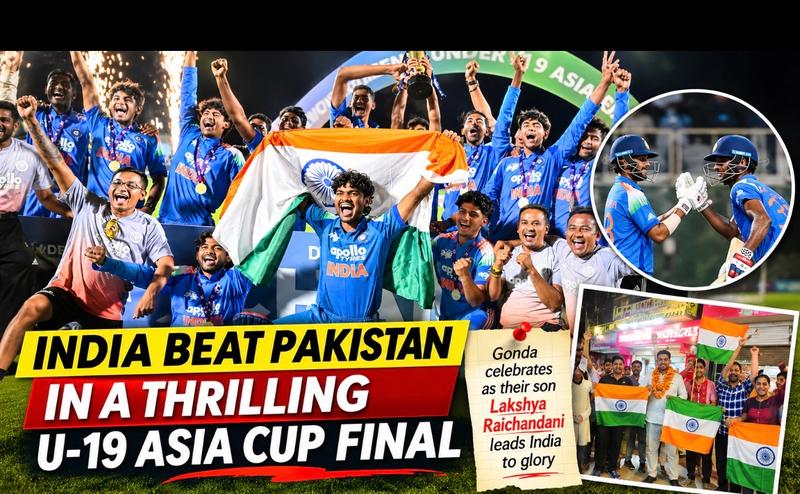
While India’s young cricketers celebrated in Oman, another celebration was unfolding thousands of kilometres away in Gonda, Uttar Pradesh.
Videos shared by news agency IANS showed supporters waving Indian flags and celebrating the team’s victory. The celebrations had a special connection to the town: India’s captain, Lakshya Rajesh Raichandani, comes from Gonda.
For those following his journey, Saturday’s achievement was another important chapter in a career that has progressed rapidly through Indian youth cricket.
Lakshya, born in October 2008, grew up in Gonda before pursuing his cricketing development through Uttarakhand. He attended Raghukul Vidya Peeth Academy during his early schooling and went on to establish himself as a promising young batter.
His breakthrough performances included an outstanding Vijay Merchant Trophy campaign in which he scored 833 runs, including four centuries and two half-centuries. That achievement earned him the prestigious Jagmohan Dalmiya Award in 2025.
His progress continued in 2026.
During India’s youth tour of Sri Lanka, he scored 207 in one Youth Test and followed it with another century, finishing the two-match series with 307 runs.
He subsequently produced another double-century against Australia Under-19 in Rajkot, strengthening his reputation as a batter capable of constructing long innings.
In June 2026, he was appointed vice-captain of India’s Under-19 team for the Sri Lanka tour. He later captained India in youth one-day matches against Australia before taking charge during the Asia Cup.
His family has been closely associated with his cricketing journey. His parents, Rajesh and Lakshmi Raichandani, have supported his development, while his grandfather, former Uttar Pradesh legislator Tulsidas Raichandani, is a familiar figure in Gonda.
The sight of supporters celebrating in Gonda after the Asia Cup final showed how far his achievements have resonated beyond the cricket ground.
For a young player from a district better known for its local communities than international cricket, captaining India to a continental title is a significant achievement.
And for the next generation of aspiring cricketers in towns like Gonda, Lakshya’s journey offers something tangible: a young player from their region has made it to the international stage.
Prime Minister Narendra Modi congratulates India’s young champions
The achievement also drew congratulations from Indian Prime Minister Narendra Modi.
In a message shared on his official social media account, Modi described the victory as an outstanding occasion for Indian cricket and praised the young players for their performance.
He expressed pride in the team and said their success would inspire other youngsters to pursue their ambitions.
The message reflected the wider significance of the result. India’s Under-19 cricket programme continues to produce players capable of competing under intense international pressure.
For the players themselves, recognition at this level is another encouragement as they work towards professional and potentially senior international careers.
Pakistan deserve credit for an exceptional final
While India’s comeback will dominate the headlines, Pakistan’s young team deserves considerable credit.
A total of 337 for nine in a major tournament final was an excellent batting performance.
Usman Khan’s century, Abdul Qadir’s attacking 80 and the contribution from captain Farhan Yousaf gave Pakistan a commanding position.
Their bowlers then fought back after India’s opening partnership, reducing the opposition to eight wickets down and placing themselves within touching distance of the trophy.
Rizwanullah finished with three wickets for 53 runs, while Niqab Shafiq took two.
The final was decided by a handful of moments, not by a lack of effort from either side.
That is what made the contest compelling.
Two talented young teams competed fiercely, and the result remained uncertain until the final delivery.
What this victory says about India’s next generation
India’s ninth Under-19 Asia Cup title is another significant result for the country’s youth cricket system.
But beyond the trophy, the final offered a glimpse of several players who could become important names in Indian cricket over the coming years.
Lakshya Raichandani showed leadership and composure at the top of the order. Aaryavir Sehwag demonstrated his attacking ability. Manal Chauhan produced a valuable innings when the pressure was at its highest.
And Mohit Ulva showed that determination and confidence can change a match even when the odds appear overwhelming.
The challenge now will be translating these performances into sustained success at higher levels.
Youth cricket has produced many exciting talents over the years, but the journey from Under-19 success to senior international cricket requires consistency, fitness, discipline and opportunities.
For now, these young players have earned their moment.
They have beaten a strong Pakistan side, won a continental championship and given cricket supporters a final that will be remembered for its extraordinary finish.
And somewhere in Gonda, as Indian flags were raised in celebration, another generation of young cricketers may have found a new reason to pick up a bat.
India needed three runs from the final ball. Mohit Ulva struck four. A championship was won, and a new group of young cricketers wrote their own chapter in India’s cricketing story.