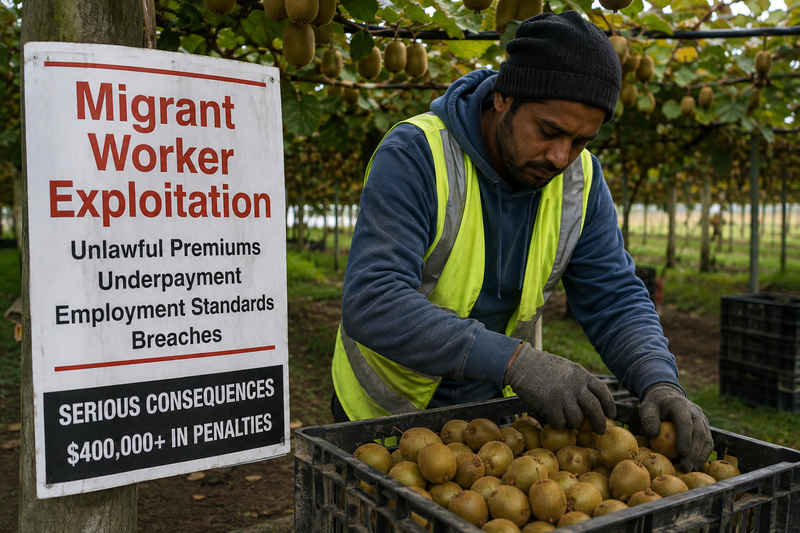
A Bay of Plenty horticulture labour hire company and its former director have been ordered to pay more than $400,000 in penalties and arrears after four migrant workers were underpaid, denied minimum employment entitlements and, in three cases, required to make unlawful payments connected with their employment.
The Employment Relations Authority has ordered Indo Kiwi Horticulture Limited to pay $176,000 in penalties, while former director Boota Singh Dhillon has been ordered to pay a further $88,000.
The company must also repay more than $152,000 in wage arrears, holiday pay arrears and unlawful premium payments to four former workers.
The decision follows a Labour Inspectorate investigation that began after a complaint was received in July 2024.
More than $400,000 in penalties and repayments
The financial orders against the company and its former director include several separate components.
Indo Kiwi Horticulture Limited has been ordered to pay:
$176,000 in penalties
More than $152,000 in wage arrears, holiday pay arrears and unlawful premiums
Former director Boota Singh Dhillon has separately been ordered to pay:
$88,000 in penalties
Employment Relations Authority member Jeremy Lynch also directed that each of the four complainants receive $33,000 from the penalties imposed, with the remaining penalty money to be paid to the Crown.
The total financial consequences exceed $400,000.
Workers were employed on employer-specific visas
Indo Kiwi Horticulture supplied workers to kiwifruit orchards across the Bay of Plenty.
According to the Labour Inspectorate, the four complainants were Indian nationals working in New Zealand on employer-specific visas.
The investigation found they had been underpaid and had not received minimum employment entitlements.
Three of the workers had also paid what the Labour Inspectorate described as unlawful premiums totalling more than $65,000.
Some of those payments were made into bank accounts linked to Dhillon's family members in India.
Under New Zealand employment law, employers cannot demand or receive money from workers in exchange for providing them with employment.
A major part of the decision focused on the imbalance of power between the workers and their employer.
Lynch said the workers had travelled to New Zealand looking for employment opportunities and were particularly vulnerable because their immigration status was connected with their employer.
"The complainants were all Indian nationals who had come to New Zealand in search of employment opportunities," he said.
"There was an inherent power imbalance in the employer/employee relationship, which was amplified by the fact the complainants were relying on the support of their employer in respect of their immigration status."
Because the workers held employer-specific visas, they were authorised to work only for Indo Kiwi Horticulture.
Lynch said this could only have increased their vulnerability.
That issue is significant because workers whose immigration status is closely tied to one employer may feel they have fewer practical options if they are underpaid, mistreated or asked to make unlawful payments.
Company gained an unfair advantage, ERA says
The Authority also found that the company's conduct had implications beyond the workers directly affected.
Lynch said Indo Kiwi Horticulture had gained an unfair advantage over competing businesses by withholding wages and holiday pay that should have been paid to its employees.
That is an important part of the enforcement approach to employment standards.
Businesses that comply with wage, holiday and employment requirements carry the proper cost of employing staff. Employers that avoid those obligations can reduce their labour costs unlawfully and gain an advantage over businesses following the rules.
Lynch said the penalties needed to send a clear message to employers and others involved in breaches of employment standards.
Non-compliance, he said, would not be tolerated.
Labour Inspectorate says exploitation for profit is unacceptable
Labour Inspectorate Migrant Exploitation Manager Natalie Gardiner said the case demonstrated both the vulnerability of migrant workers and the consequences facing employers who attempt to profit from that vulnerability.
"New Zealand law is clear. Employers cannot demand or receive payments from workers in exchange for employment," Gardiner said.
"Exploiting workers for financial gain is unacceptable."
She said the penalties against Indo Kiwi Horticulture and Dhillon, combined with the substantial payments ordered for the affected workers, reflected the seriousness of the offending.
Gardiner said the outcome should serve as a warning about the importance of complying with employment standards.
Company no longer operating
Dhillon was the sole director and shareholder of Indo Kiwi Horticulture during the period when the breaches occurred.
He sold the company in October 2024.
According to the Labour Inspectorate, the business is no longer operating.
The fact that the company has ceased trading did not prevent enforcement action from continuing against both the company and the former director.
The orders demonstrate that employers and individuals involved in employment breaches can still face significant financial consequences after a business has been sold or stopped operating.
Why the case matters
Migrant worker exploitation can be difficult to detect because workers may be dependent on an employer not only for income, but also for their ability to remain employed lawfully in New Zealand.
That dependence can make people less likely to complain when something goes wrong.
This case involved four workers, but the ERA's decision is intended to send a wider message to employers across industries that rely heavily on migrant labour.
The most serious concern highlighted by the decision is the combination of underpayment, unpaid entitlements and workers being required to hand over money connected with obtaining or keeping employment.
For legitimate horticulture operators, the case also matters from a competition perspective. Businesses that pay workers correctly should not be forced to compete against employers reducing costs through unlawful practices.
The financial penalties in this case are substantial, but the decision also puts emphasis on compensating the workers directly.
With each complainant receiving part of the penalties in addition to arrears owed, the ruling recognises both the financial loss suffered and the seriousness of the employment breaches.
Source
This article is based on a 19 August 2026 media release from the Labour Inspectorate concerning the Employment Relations Authority's decision involving Indo Kiwi Horticulture Limited and former director Boota Singh Dhillon.
All figures, findings and quotations in this report are drawn from that release.