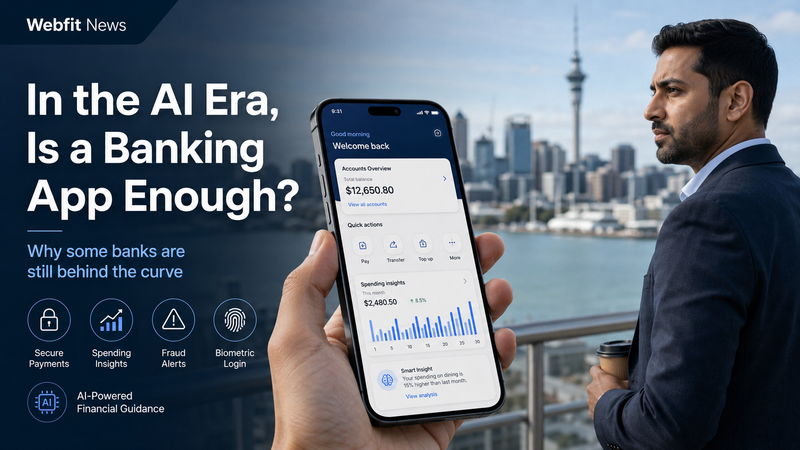
But even within that imperfect market, customer expectations have moved well beyond checking balances and transferring money.
BNZ’s mobile banking platform includes payments, savings goals, card management and notifications. (BNZ) Westpac One allows customers to manage cards, change PINs, block and unblock cards, alter limits and use digital cards, while also supporting Apple Pay and Google Pay. (Westpac NZ)
ANZ New Zealand says its fraud-protection systems analyse customer and device behaviour to identify suspicious activity, alongside continuous threat monitoring. (ANZ)
More importantly, the infrastructure around banking is changing.
New Zealand’s regulated open-banking regime began taking effect from December 2025 under the Customer and Product Data Act 2025, creating mechanisms through which customers can authorise access to banking information and payments by approved third parties. (Payments NZ)
That is where the benchmark is moving.
The Technology Comparison
Capability Traditional Mobile Banking Leading Digital Banking Direction Account balances Standard Expected Money transfers Standard Expected Bill payments Standard Expected Biometric login Increasingly standard Expected Card freeze/unfreeze Common Expected Digital cards Growing Becoming mainstream Behaviour-based fraud detection Limited at basic level Increasingly important AI-assisted fraud monitoring Emerging Strategic priority Personalised financial insights Limited Growing Open banking APIs Early-stage in many markets Major strategic battleground Instant digital onboarding Variable Expected AI customer assistance Basic chatbot to advanced assistant Rapidly evolving Automated lending decisions Emerging Major AI opportunity Third-party financial ecosystem integration Limited Increasingly important
The Reserve Bank of New Zealand has itself recognised that financial institutions are increasingly exploring and adopting AI to improve decision-making and operational efficiency, although it has also warned about risks involving cybersecurity, privacy, model errors and financial stability. (Reserve Bank of New Zealand)
So the technology conversation has already changed.
It is no longer:
“Can customers bank using their phones?”
It is becoming:
“How intelligent, secure, connected and personalised can banking become?”
The Irony: Indian Banking Is Actually Capable of Much More
This is where the criticism becomes more interesting.
Indian banking is not technologically backward.
Quite the opposite.
India has built one of the world’s most significant digital payment ecosystems, and some of its major private and public banks are already experimenting aggressively with AI, automation, digital onboarding and integrated financial platforms.
HDFC Bank, for example, operates its EVA intelligent digital assistant and says its mobile-security architecture uses adaptive authentication backed by AI and machine-learning models for fraud-risk monitoring. (HDFC Bank)
ICICI Bank’s iMobile platform supports payments, investments and wider financial management, and in 2026 the bank introduced biometric authentication for eligible UPI transactions using fingerprint or facial recognition. (ICICI Bank)
SBI’s YONO platform goes considerably beyond traditional mobile banking. It combines banking, payments, investments, insurance, shopping, travel and reward services within one digital ecosystem. (State Bank of India)
Indian banking leaders are also openly talking about AI-powered lending. RBI Governor Sanjay Malhotra recently argued that AI could expand credit access by using broader financial and behavioural data while maintaining human accountability in important decisions. (TechRadar)
So the problem is not that Indian banks cannot innovate.
The real question is why some international operations can appear years behind what their own domestic market is already capable of delivering.
Who Appears Ahead?
There is no responsible way to declare one New Zealand bank the absolute “technology winner” because their strengths differ and many critical AI systems operate behind the scenes rather than inside customer-facing apps.
But broadly:
ANZ appears strong in fraud detection, behavioural analysis and security infrastructure. (ANZ)
Westpac has pushed considerable customer control into its digital platform, including card controls, digital cards, dynamic security capabilities and spending restrictions. (Westpac NZ)
BNZ provides a mature mobile experience spanning payments, savings tools, notifications and card management. (BNZ)
ASB similarly provides mobile payments, transaction management, alerts and card controls. (ASB Bank)
None should become complacent. The Commerce Commission’s banking market study itself concluded that New Zealand’s major banks had not faced sufficiently strong competition and identified technology and open banking as areas where greater disruption was needed. (Commerce Commission)
That matters because Indian banks entering or expanding in New Zealand do not need to imitate Kiwi banks.
They have an opportunity to leapfrog them.
How Indian Banks Could Actually Compete in New Zealand
The wrong strategy would be to recreate an overseas branch digitally and call the job finished.
A stronger strategy would focus on five areas.
1. Build an AI-native customer experience
Customers should eventually be able to ask:
“How much did I spend eating out last month?”
“Can I afford another $600 monthly mortgage payment?”
“Why is my electricity spending higher?”
“Show me subscriptions I haven’t used recently.”
That is fundamentally different from navigating menus in an app.
2. Own the India-New Zealand financial corridor
This is where Indian banks possess a natural strategic advantage.
They could build extremely strong services around:
New Zealand-India remittances multicurrency accounts NRI financial management Indian investment access where regulations permit education payments family transfers travel money SME import and export payments
Instead of being another small bank in New Zealand, an Indian institution could become the digital financial bridge between New Zealand and India.
That is a far more compelling proposition.
3. Make onboarding almost invisible
Opening and operating an account should become a digital workflow rather than a paperwork exercise.
Digital identity verification, biometric authentication, automated compliance checks and secure document verification can dramatically improve that experience when implemented responsibly.
4. Use AI where customers actually feel it
The most valuable AI may not be a chatbot telling customers where to find a form.
It could be AI that:
detects unusual transactions identifies potential scams predicts cash-flow problems simplifies loan assessments alerts businesses about upcoming payment pressure personalises financial recommendations reduces repetitive compliance processes
The Reserve Bank has recognised both the opportunities and risks arising from this kind of AI adoption across financial services. (Reserve Bank of New Zealand)
5. Compete with fintechs, not merely other banks
The future competitor may not be another traditional bank.
It could be Wise, Revolut or another technology-led financial platform.
That distinction matters.
Customers increasingly compare banking experiences with the best digital products they use anywhere, not merely with the bank across the street.
Innovation Should Be Measured Differently
A ribbon cutting, app launch or ceremonial announcement can still have community value.
For migrant communities, access to familiar institutions can also carry considerable emotional and practical importance. That should not be dismissed.
But there is a difference between access and innovation.
Source: Reserve Bank of New Zealand