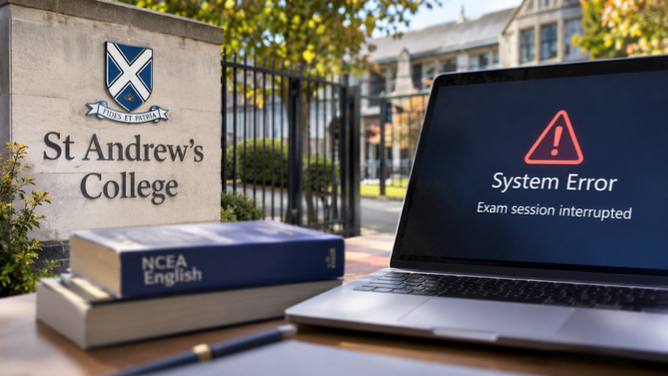
"This was very distressing and disappointing for the approximately 120 students affected, particularly given the preparation they had undertaken for this important examination," Wilson said.
The school has not publicly explained the precise nature of the computer systems issue.
According to RNZ, which first reported the incident, the college declined to answer further questions about what went wrong.
It remains unclear whether the failure involved the examination software, the school's network or another technical problem.
Wilson said the issue had since been resolved and remaining examinations would continue as planned.
Will students lose marks because of the disruption?
The affected students will receive what is known as a derived grade.
Under NZQA's established process, a derived grade may be awarded when circumstances beyond a student's control prevent them from completing an external examination.
The grade is based on existing evidence of their achievement rather than the unfinished examination.
At St Andrew's College, Wilson said students would receive grades based on their internal examination results.
This means students will not simply be left without a result because of the technical failure.
However, the arrangement may create uncertainty for those who believed they were better prepared for Wednesday's examination than they had been for their earlier assessments.
A student who performed poorly in a practice examination but improved significantly through revision may reasonably want to understand how that improvement will be recognised.
There is no evidence at this stage that any particular student will receive an unfair result.
Nevertheless, clear communication about how grades are determined will be important in reassuring affected families.
Why weren't paper exams available?
Perhaps the most significant issue emerging from the incident is the absence of enough printed examination papers to allow students to continue.
Wilson said NZQA did not provide schools with sufficient paper copies for every student when examinations were scheduled to be completed digitally.
As a result, St Andrew's College could not move all affected students to a paper-based examination when the computer system failed.
That raises a practical question about contingency planning.
If digital examinations are vulnerable to technical disruption, should schools have enough printed papers available to ensure students can continue without losing their opportunity to sit the assessment?
The college has already announced a change.
Wilson confirmed that sufficient paper copies would be available for future examinations in case another technical problem occurred.
The decision offers reassurance for upcoming assessments, although it comes too late for the students whose English examination was interrupted.
Are digital exam failures common in New Zealand?
Wilson said NZQA had advised the college that digital examination incidents were not unusual, with multiple issues reported during examination seasons.
However, the information made public does not establish how frequently these problems prevent students from completing examinations.
Nor does it show how many students nationwide have needed derived grades because of computer failures.
That distinction matters.
A temporary technical issue affecting a small number of devices is very different from a disruption that prevents approximately 120 students from finishing an examination.
The Christchurch incident does not, by itself, demonstrate a nationwide failure of digital examinations.
But it does highlight the importance of reliable backup arrangements, particularly when students are sitting assessments that contribute to their final school qualifications.
What should affected students and parents do?
For families at St Andrew's College, the immediate concern is likely to be how the derived-grade process will work.
Students and parents should seek clarification from the college about which earlier assessments will be used, how the results will be determined and what options are available if they have concerns.
The school has acknowledged the impact of the incident and promised support.
Wilson said the college recognised that some students had been significantly affected and was committed to assisting them through the process.
"We are very sorry for the impact today's disruption has had on our affected Year 13 students," he said.
He also thanked students, families and staff for their patience and understanding.
The bigger question: who carries the consequences when technology fails?
Digital examinations are now part of New Zealand's education system, and technology can make assessments more accessible and efficient.
But Wednesday's disruption highlights a fundamental responsibility that comes with that transition.
Students can prepare thoroughly, arrive on time and follow every examination rule. Yet a technical problem outside their control can still prevent them from demonstrating what they know.
The derived-grade system exists to provide an alternative in precisely these kinds of circumstances.
What remains important is ensuring that the alternative is fair, transparent and clearly explained.
For St Andrew's College, the immediate technical issue has been addressed and additional paper backups have been promised.
For the approximately 120 students affected, however, the examination they prepared for is over.
They will now have to trust that earlier assessments provide an accurate measure of their achievement.
The lesson from Christchurch is straightforward: when an examination system fails, students should not be the ones left carrying the uncertainty.
Source and acknowledgement
This article is based on reporting by Anna Sargent of RNZ (Radio New Zealand), including statements from St Andrew's College rector Mark Wilson.
Original reporting credit: RNZ, Anna Sargent.
Webfit News has independently rewritten and contextualised the information for readers. The precise cause of the technical failure and individual students' final grade outcomes have not been publicly confirmed in the supplied reporting.