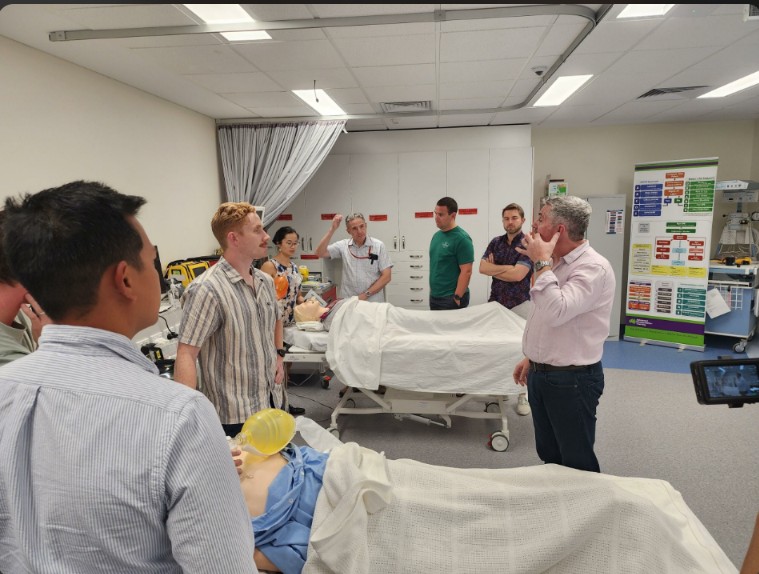
The University of Sydney and Northern NSW Local Health District (NNSWLHD) have renewed their long-running partnership for another three years, locking in continued support for training the next generation of doctors, nurses and allied health professionals across the Northern Rivers region.
The renewed Memorandum of Understanding (MOU) builds on 25 years of collaboration between the two organisations, a partnership that has quietly shaped how regional healthcare workforces get built in one of New South Wales' more remote areas.
What the Agreement Actually Covers
At its core, the MOU is about keeping a steady pipeline of trained health professionals flowing into a region that, like many rural areas, can struggle to attract and retain staff.
The agreement supports:
- Clinical placements for medical, allied health and nursing students
- Medical training pathways
- Workforce development initiatives
- Research collaboration across rural and regional health priorities
- Student placement programs across medicine, dentistry, allied health, nursing and midwifery
Why Training Locally Matters
NNSWLHD Executive Director Medical Services and Clinical Governance, Dr Marco Giuseppin, said the renewed agreement reflects a partnership that has proven its worth over time.
"Training in a real-world, modern healthcare setting is invaluable for students as they prepare for their professional careers," Dr Giuseppin said.
University of Sydney Vice-Chancellor and President Professor Mark Scott echoed that sentiment, describing the relationship with NNSWLHD as one of the university's most significant regional partnerships.
Where Students Are Actually Training
This is not a small-scale arrangement confined to one hospital. Under the MOU, medical students rotate through a wide network of sites across the region, including:
| Placement Site | Type |
|---|---|
| Lismore Base Hospital | Hospital |
| Ballina District Hospital | Hospital |
| Casino and District Memorial Hospital | Hospital |
| Grafton Base Hospital | Hospital |
| Aboriginal medical services | Community health |
| Mental health services | Specialist care |
| General practice networks | Primary care |
The Real Test: Do Students Actually Stay?
The bigger question for any rural workforce program is not just how many students train there, it is how many actually stay once they are qualified.
On that front, there is a genuinely promising early sign. Fifteen University Centre for Rural Health (UCRH) medical students currently on placement at Lismore Base Hospital have indicated they want to remain there to complete their internship, rather than moving back to a metro hospital once their placement ends.
Professor Vicki Flood, Head of Rural Clinical School, Northern Rivers and Director of UCRH, said that outcome is exactly what the partnership was designed to achieve.
"This demonstrates that what we set out to achieve as two institutions is working," Flood said, describing the goal as training students in a rural setting and building a genuine pipeline into the local workforce.
A Wider Regional Network
The agreement also formally recognises UCRH's role in coordinating the North Coast Medical Education Collaboration (NCMEC), a broader partnership involving the University of Wollongong, Western Sydney University and the University of Sydney, all working together on health workforce development across the region.
That kind of coordination matters in rural health specifically, where relying on any single university or hospital to solve workforce shortages alone rarely works. Spreading placements and training pathways across multiple institutions gives the region a wider net for attracting and keeping staff.
Research Is Part of the Package Too
Beyond clinical placements, the partnership has also become a meaningful research engine for issues specific to rural and regional health.
In 2025 alone, UCRH supported 21 Doctor of Medicine research projects involving students from both the University of Sydney and Western Sydney University. Topics ranged from the health impacts of extreme weather events to a clinical audit examining the connection between an eating disorder clinic and emergency department presentations.
One current project of particular interest is the HeLP-R clinical trial, which is testing whether virtual, multidisciplinary pain care can work as effectively as in-person treatment for people living with chronic musculoskeletal pain. The trial is currently running across physiotherapy departments at Port Macquarie, Coffs Harbour, Lismore and Grafton hospitals.
Why This Matters Beyond the University Sector
For patients in rural and regional communities, workforce agreements like this one rarely make headlines, but they directly affect something very practical: whether there is a doctor, nurse or physiotherapist available when someone actually needs one.
Rural health workforce shortages have been a persistent challenge across Australia for years, driven partly by the simple reality that many graduates train in major cities and never move to regional areas afterward. Programs designed specifically to train people locally, with the hope they will stay locally, represent one of the more practical, long-term approaches to closing that gap.
With this MOU locked in for another three years, the partnership between the University of Sydney and NNSWLHD will continue shaping how the next generation of rural health professionals is trained, and hopefully, retained, across the Northern Rivers region.