
By Geet G | Webfit News
Auckland, New Zealand
As New Zealand moves deeper into election year, the political picture has become far tighter, far messier, and far more dangerous for both major blocs than many expected earlier in 2026.
By Geet G | Webfit News
Auckland, New Zealand
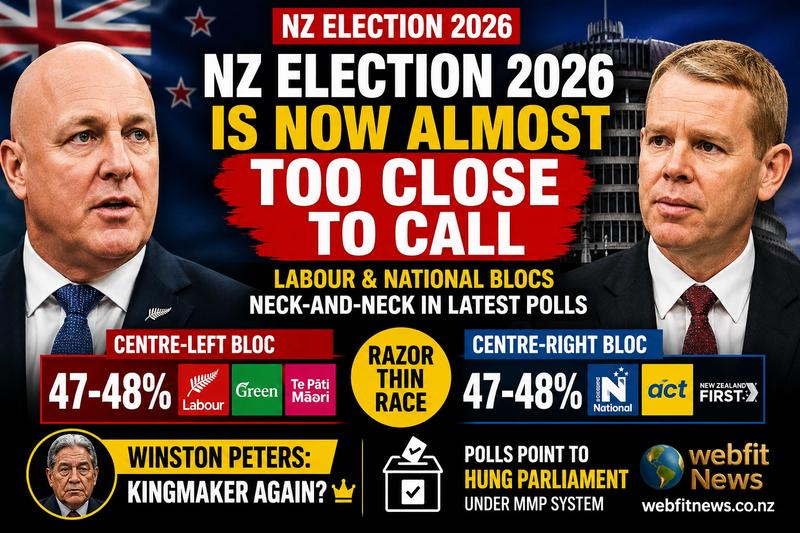
As New Zealand moves deeper into election year, the political picture has become far tighter, far messier, and far more dangerous for both major blocs than many expected earlier in 2026.
If a general election were held today on 13 May 2026, the reality is this:
Nobody can confidently say who would win.
Not Labour.
Not National.
Not even most political analysts anymore.
The latest major polling now points to something New Zealand has not seen in years:
A genuine knife-edge election.
Not a landslide.
Not a collapse.
Not a dominant political wave.
Just survival-level politics under MMP.
Right now, New Zealand politics is divided into two extremely tight blocs.
And according to almost every major poll released through April and May 2026, the gap between those two blocs is now tiny.
Some polls show Labour slightly ahead.
Others show National’s coalition surviving narrowly.
Several polls now point toward a hung parliament scenario.
That means the election is no longer trending clearly toward either side.
It is now becoming a pure coalition mathematics battle.
Earlier narratives claiming Christopher Luxon was politically collapsing now appear overstated.
Yes, National lost momentum earlier in 2026.
Yes, Luxon’s popularity dropped sharply in April.
And yes, internal caucus pressure stories damaged confidence.
But the latest polling now shows the race tightening again dramatically.
The 1News-Verian poll still gave Labour and its allies an advantage.
But the early-May Taxpayers’ Union-Curia poll showed the governing coalition bloc narrowly ahead again.
RNZ-Reid Research projected a near-perfect tie.
Roy Morgan polling also suggested a deadlocked Parliament.
In practical terms, most current polling now points toward outcomes like:
That is not dominance.
That is political trench warfare.
One of the biggest political shifts over the past few weeks is that Christopher Luxon’s personal ratings have partially recovered.
In April, some polls showed Luxon falling to around 16% preferred Prime Minister support, creating panic inside parts of National.
But newer polling now places him back around the low-20% range.
Chris Hipkins remains competitive too.
But importantly, neither leader is truly dominating the country politically.
And that changes the election psychology completely.
Because voters now appear less emotionally attached to leaders and more focused on:
This election increasingly looks less like a personality contest and more like a referendum on which bloc voters trust slightly more during economic uncertainty.
And once again, Winston Peters may become the most important political figure in New Zealand.
NZ First continues polling strongly, often around 10% to 12%.
That matters enormously under MMP.
Because Peters has already publicly ruled out supporting a Labour government.
That means Labour almost certainly needs:
just to survive mathematically.
Meanwhile, National’s path becomes clearer if NZ First remains strong enough to push the right bloc over the line.
But there is another complication.
NZ First’s recent rise may partly be hurting National itself.
Some polling and political commentary now suggest Winston Peters is pulling older and suburban voters away from Luxon’s party.
That creates tension inside the coalition bloc itself.
And under razor-thin MMP numbers, even small shifts become politically explosive.
This election does not resemble:
Instead, New Zealand in 2026 feels politically restless.
Voters appear frustrated.
Trust in politics feels weaker.
Economic anxiety remains high.
And enthusiasm on both sides still looks soft.
The government has not collapsed politically.
But Labour has not fully convinced New Zealanders either.
That is why polling continues moving within a tiny margin.
A huge amount.
This election is still months away.
And several major factors could still shift momentum sharply:
National will likely campaign heavily against:
“Labour + Greens + Te Pāti Māori.”
Labour will likely focus relentlessly on:
cost of living,
public services,
and voter fatigue with the current government.
Both strategies still have political potential.
The most honest answer now is:
Nobody truly knows.
As of 13 May 2026, the election appears almost too close to call.
The centre-right bloc may narrowly survive.
The centre-left bloc may narrowly return to power.
Or New Zealand could end up in a hung parliament situation where Winston Peters effectively decides the government again.
But one thing is now very clear.
The earlier narrative that Christopher Luxon was politically finished no longer matches the latest data.
This election is alive again.
And over the next six months, New Zealand may witness one of the tightest and most unpredictable election campaigns in modern MMP history.











