<p>New Zealand Passes Tough New Law Targeting Illegal Street Racing and Dangerous Driving</p>
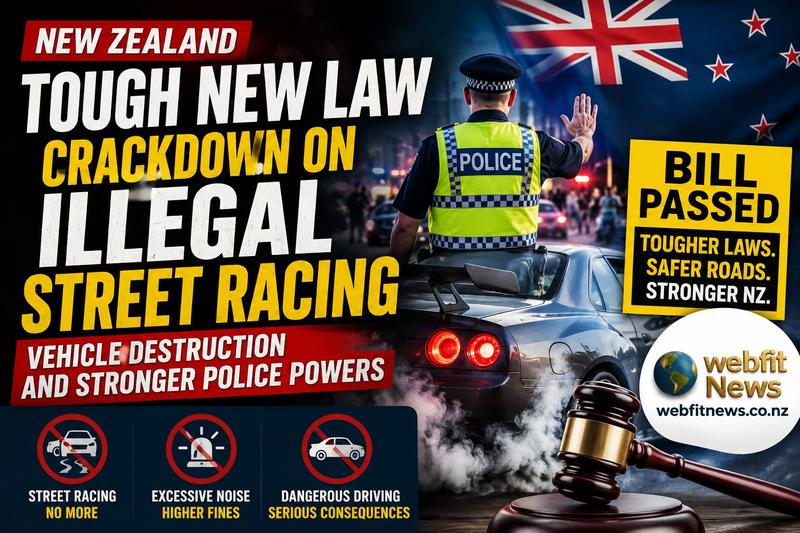
New Zealand has taken one of its strongest steps yet against illegal street racing, dangerous driving and antisocial road use after Parliament passed the Antisocial Road Use Legislation Amendment Bill, introducing significantly tougher penalties, expanded Police powers and the possibility of vehicle destruction for serious offenders.
The legislation, passed on 30 June 2026, delivers on one of the Coalition Government’s law and order commitments and is designed to target illegal street racing, burnouts, fleeing Police, intimidating convoys, dirt bike gatherings, siren battles and excessive vehicle noise that have disrupted communities across the country.
For many Auckland residents and communities across New Zealand, late night gatherings involving modified vehicles, dangerous driving and excessive noise have become an increasing source of frustration. The Government says the new law sends a clear message that roads are for safe travel, not intimidation or illegal racing.
Can apply from the first qualifying offence, subject to court discretion
Excessive vehicle noise fine
$50
$300
Maximum court fine for excessive noise
$1,000
$3,000
Failure to identify driver
Limited penalties
Fine of up to $10,000
Police road closure powers
Limited
Expanded powers to close areas and disperse illegal gatherings
Source: Ministry of Transport summary of the Antisocial Road Use Legislation Amendment Act.
Why the Government Says Change Was Needed
Transport Minister Chris Bishop and Police Minister Mark Mitchell say antisocial road use has become increasingly organised, with offenders using social media to quickly organise large gatherings and move locations before Police can respond.
Authorities say illegal events frequently involve:
Illegal street racing
Burnouts
Dangerous drifting
Vehicles fleeing Police
Intimidating convoys
Excessive exhaust noise
Siren battles
Dirt bike gatherings
According to the Government, these activities intimidate local communities, create significant safety risks and consume substantial Police resources.
The legislation is intended to improve both deterrence and enforcement while restoring confidence for residents affected by recurring illegal gatherings.
Tougher Penalties for Serious Offenders
Perhaps the biggest change introduced by the legislation is the expansion of vehicle forfeiture and destruction.
Previously, vehicle crushing or destruction generally occurred only after multiple convictions for illegal street racing.
Under the new law, courts will generally be expected to order vehicle forfeiture or destruction for qualifying offences, including certain cases involving street racing, burnouts and fleeing Police.
However, judges retain discretion.
A court may decide not to order vehicle forfeiture or destruction if doing so would:
Be manifestly unjust
Cause extreme hardship to the offender
Cause undue hardship to another innocent person
Involve a stolen vehicle under specified circumstances
The Government says these safeguards ensure the law targets serious offenders while allowing judges to consider exceptional circumstances.
Police Receive Stronger Enforcement Powers
The legislation also significantly expands Police powers to deal with illegal gatherings before they escalate.
Police will now be able to:
Require vehicle owners to identify who was driving.
Temporarily close roads or public areas where illegal gatherings are occurring or are likely to occur.
Direct people to leave those areas.
Better investigate organised antisocial road use events.
Seize vehicles linked to qualifying offences.
Anyone refusing to leave a Police-declared closed area could receive:
A $1,000 infringement notice, or
A court fine of up to $3,000.
Vehicle owners who refuse to identify drivers may face fines of up to $10,000.
Major Increase in Vehicle Noise Penalties
Communities affected by modified vehicles and siren battles will also see much tougher financial penalties.
Offence
Previous Penalty
New Penalty
Excessive vehicle noise infringement
$50
$300
Maximum court fine
$1,000
$3,000
The Government says stronger penalties are intended to discourage repeat offending while improving the quality of life for residents affected by persistent vehicle noise.
Recent Police Operations Show the Scale of the Issue
Police operations during 2026 demonstrate why the Government believes stronger legislation was necessary.
Date
Location
Police Action
June 2026
Auckland
More than 200 vehicles attended an illegal gathering. Police conducted 578 breath tests and impounded 10 vehicles.
April 2026
Manawatū
Around 200 vehicles gathered. Police issued 48 infringement notices, impounded several vehicles and two patrol cars were damaged after projectiles were thrown.
June 2026
Canterbury
Police disrupted another planned gathering, issuing around 50 infringement notices, approximately 20 green and pink stickers, and impounding several vehicles.
Officials say these operations often require significant Police resources while exposing officers, spectators and innocent road users to unnecessary danger.
Road Crashes Carry a Heavy Cost
Although the legislation specifically targets antisocial road use, the Government says dangerous driving contributes to wider road safety concerns.
According to Ministry of Transport estimates, the average social cost of road crashes includes:
Crash Type
Estimated Social Cost
Fatal crash
Approximately NZ$4.9 million
Serious injury crash
Approximately NZ$923,000
Minor injury crash
Approximately NZ$104,000
These estimates include medical treatment, emergency response, lost productivity, legal costs and the wider impact on victims, families and communities.
The Bill Was Not Without Critics
While the legislation passed Parliament, it attracted considerable debate during its journey through the House.
The Justice Committee received 63 public submissions before recommending several amendments.
The New Zealand Law Society supported efforts to reduce dangerous road use but raised concerns about some aspects of the legislation, including expanded Police powers and vehicle forfeiture provisions.
Civil liberties groups also questioned whether stronger enforcement powers could affect freedom of movement and peaceful assembly.
Government policy papers further acknowledged that some agencies believed additional evidence would be useful to fully assess the long-term impact of the new measures.
Supporters, however, argue the law provides Police with practical tools to deal with repeat offenders who have disrupted neighbourhoods for years.
Timeline of the Legislation
Date
Milestone
27 July 2025
Bill introduced to Parliament
12 August 2025
First Reading
December 2025
Justice Committee reports back after receiving 63 submissions
3 March 2026
Second Reading
30 June 2026
Parliament passes the Bill
Late 2026
Most provisions expected to come into force after approximately six months
Not Targeting Responsible Car Enthusiasts
The Government has emphasised that the legislation is not aimed at legitimate motorsport or responsible car enthusiasts.
People attending authorised motorsport events, legal track days or recognised car club activities are not the intended focus.
Instead, ministers say the law specifically targets those who deliberately use public roads to intimidate communities or engage in dangerous illegal driving.
What Happens Next?
Although the Bill has now passed Parliament, most provisions will not take effect immediately.
The Government has provided a transition period of approximately six months to allow:
Police training
Court system preparation
Operational guidance
Public education
Administrative implementation
Officials say this will ensure frontline Police officers and the justice system are fully prepared before the new powers become operational.
What It Means for New Zealand
The Antisocial Road Use Legislation Amendment Act represents one of the most significant changes to New Zealand’s road enforcement laws in recent years.
Supporters believe the tougher penalties, expanded Police powers and stronger deterrents will finally address a problem that has frustrated communities for decades.
Critics argue that enforcement, education and community engagement will remain just as important as harsher penalties.
Whether the legislation achieves its intended goal will become clearer once the new powers come into force later this year.
For now, the Government’s message is clear.
If drivers choose to use New Zealand’s roads for illegal racing, dangerous driving or intimidating communities, they should expect far more serious consequences than ever before.