In a Webfit News interview, the New Zealand First minister discussed wool’s recovery, regional investment and his bid to represent Taieri, while questioning whether workplace safety reforms had gone too far.
By Webfit News | 12 October 2026
In a Webfit News interview, the New Zealand First minister discussed wool’s recovery, regional investment and his bid to represent Taieri, while questioning whether workplace...
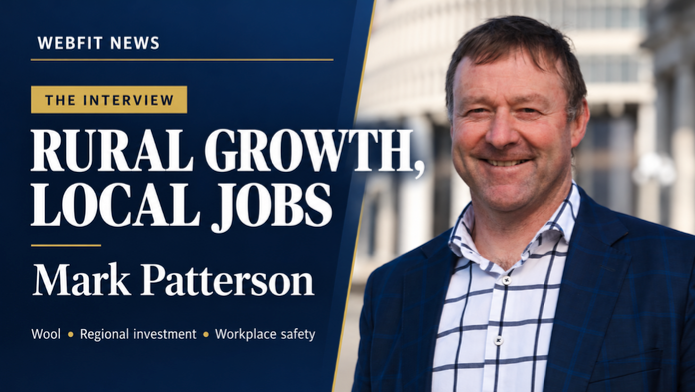
In a Webfit News interview, the New Zealand First minister discussed wool’s recovery, regional investment and his bid to represent Taieri, while questioning whether workplace safety reforms had gone too far.
By Webfit News | 12 October 2026
New Zealand needs to keep more of the value from its primary industries at home, Mark Patterson says, arguing that exporting raw products leaves opportunities for local jobs and manufacturing untapped.
Speaking to Webfit News, the Minister for Rural Communities said stronger regional economies depended on more than good commodity prices. Processing, infrastructure and investment in people were also essential.
Patterson, an Otago sheep and beef farmer with more than 30 years of farming experience, also holds the associate agriculture and regional development portfolios. He is standing for New Zealand First in Taieri at the 2026 General Election. Beehive.govt.nz
The interview covered his journey into politics, the future of wool, opportunities for young people and concerns about South Dunedin’s flood response. It also included an acknowledgement of disagreement within the governing coalition over workplace safety changes.
Patterson said New Zealand should do more processing and manufacturing locally rather than sending raw commodities overseas for other countries to develop.
He pointed to unprocessed log exports and wool as areas where more value could be retained domestically.
While exporting raw products generated income, he argued that processing them in New Zealand could support additional employment and strengthen regional businesses.
He said retaining and growing those jobs required proactive policy, particularly when some manufacturers were reducing their local operations.
For rural communities, his argument was that success should be measured beyond what leaves the farm gate. The wider benefit comes from the businesses, skills and employment built around that production.
Wool remains one of Patterson’s strongest interests.
He recalled his frustration as a farmer when wool returns fell to levels that made little sense for a natural product with a wide range of uses.
Patterson said prices had improved substantially over the past couple of years, but stressed that the recovery had started from a very low base.
Farmers still needed better returns before wool could become reliably profitable, he said.
He attributed part of the improvement to renewed consumer interest in natural fibres and concern about synthetic materials and microplastics.
Patterson described contributing to the industry’s revival as one of the most satisfying parts of his political work, while acknowledging that the progress involved many people beyond himself.
Asked whether farmers were receiving a fair return, Patterson described a positive period for several export-focused industries.
He said dairy, meat, kiwifruit and apples were benefiting from strong international demand for New Zealand food.
However, he drew a distinction between those sectors and producers more exposed to the domestic market.
Arable and vegetable growers were still facing difficulties, he said, while wool remained an example of an industry where improved prices had not yet resolved the profitability problem.
His assessment highlighted an important distinction: an encouraging outlook for agricultural exports does not mean every farmer or grower is experiencing the same recovery.
Patterson identified water storage and irrigation as priorities for regional development.
He said such projects could help existing farms withstand dry conditions while creating opportunities for higher-value horticulture.
His argument for public investment centred on the wider economic activity that could follow, including employment, exports and tax revenue.
Government support could help viable projects overcome the substantial upfront investment needed to proceed, he said.
Patterson indicated that he wanted more emphasis on water infrastructure in another parliamentary term, should New Zealand First return to government.
One of the interview’s clearest points of disagreement came when Patterson was asked which government decision he had challenged.
He identified workplace health and safety changes, saying New Zealand First had concerns about the extent to which requirements were being relaxed.
“There’s still too many people that are getting injured at work,” he said.
Patterson said provisions affecting smaller businesses had been a particular concern. He described attempts to secure changes following select committee feedback and said a delay in implementation had created an opportunity for further consideration.
He argued that reducing unnecessary compliance should not leave workers exposed to greater risk.
His comments outlined New Zealand First’s concerns about the reforms, rather than suggesting that all coalition partners agreed on how those concerns should be addressed.
Turning to local issues, Patterson said the cost of living remained a major pressure for people in Taieri.
He also raised concerns about South Dunedin residents facing uncertainty over the future of their homes as flood and climate adaptation options are considered.
Patterson argued that drainage infrastructure, including pipes and pumps, deserved greater attention. He questioned approaches involving substantial relocation and said residents needed a fair outcome.
He highlighted the pressure on households already facing financial difficulties and described South Dunedin as a proud, multicultural community where many migrants settle.
His criticism represents his position on the response. Council documents describe a broader adaptation programme weighing flood risk, affordability and different possible futures, with community feedback informing the assessment of options. Thursday, 25 June 2026
Patterson also identified traffic pressures around Mosgiel as a local priority.
Patterson urged young New Zealanders to look beyond traditional images of agricultural work.
The sector increasingly needed people with technology, data and analytical skills, he said.
He pointed to drones, virtual fencing and livestock monitoring as examples of how farming was changing.
These technologies allow farmers to collect more detailed information about animal behaviour and performance, creating work that extends well beyond manual labour.
For young people weighing their options, Patterson’s message was that a career connected to agriculture could involve IT, analysis and innovation as readily as tractors or livestock handling.
Patterson challenged the suggestion that young people had to leave Otago because opportunities were limited.
He pointed to construction, industrial development, the new Dunedin hospital and an inland port development around Mosgiel as sources of potential employment.
He also argued that regional industries could offer alternatives to young New Zealanders heading to Australia for work.
The challenge, he said, was to explain those opportunities more clearly, both to people already living in the South Island and to those considering moving there.
These were opportunities he identified in the interview, rather than guarantees of employment for every applicant.
Patterson said his campaign for Taieri would rest on his record of advocacy and his desire to work more directly with local residents.
He cited his involvement in supporting Telford agricultural training, promoting wool and raising community concerns.
Although he is currently a list MP, he said he had remained engaged in local issues and wanted the opportunity to serve as Taieri’s electorate MP.
He also reflected on the difference between running a farm and working in Parliament. On a farm, a decision can be acted on immediately. In politics, change requires navigating institutions and bringing other people along.
For Patterson, that slower process remains a challenge. His pitch to voters is that practical experience can help shape better decisions, but the interview also exposed the questions against which that pitch will be judged: whether regional investment creates lasting jobs, whether farmers receive sustainable returns and whether communities and workers remain protected.
Source: Mark Patterson’s interview with Webfit News. Interview responses have been paraphrased for clarity.