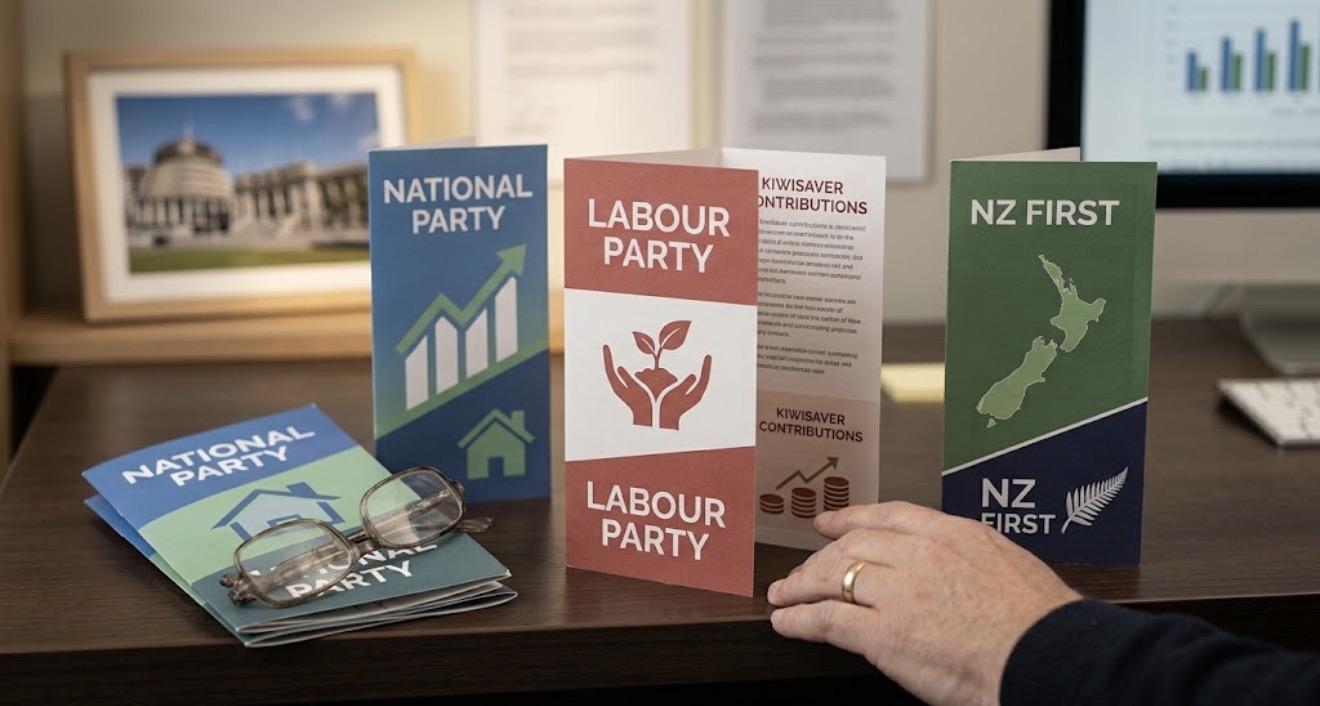
Labour has revealed its KiwiSaver policy for the upcoming election, raising employer contributions to 6 percent in line with National's plan, but stopping short of making employee contributions compulsory. The announcement has split opinion sharply, with reactions ranging from genuine praise to accusations that Labour has simply copied its rivals.
What Labour Is Actually Proposing
The core of the policy is straightforward: employer contributions would rise to 6 percent, matching what National has already put forward. Where Labour differs is on compulsion, the party has chosen not to require employees to contribute, citing pressure on households during the current cost of living crisis.
Labour leader Chris Hipkins confirmed the party is also not considering automatic KiwiSaver enrolment for children at this stage.
"Right now we have to make different choices, and we made different choices," Hipkins said.
A "Perfect Solution," According to Someone Who Would Know
One of the most striking reactions came from Anne Collins, wife of the late Sir Michael Cullen, the architect of the original KiwiSaver scheme, and a lifelong Labour member.
Collins described herself as "absolutely delighted" with the policy, calling it "a perfect solution" precisely because it avoids full compulsion during a difficult economic period.
She argued that current wage pressures, which she linked to public sector job cuts and a minimum wage that hasn't kept pace with inflation, make it genuinely difficult for people to save, and that mandating employee contributions right now would be "too ideological" rather than practical.
Collins also offered some insight into how her late husband originally designed the scheme, noting it relied on incentives rather than pure compulsion when it launched.
"Everyone got given $1000, and then they got a good tax rebate, and the employers got a good tax rebate," she said. "So there was a lot of incentive, not just straight compulsion."
A Very Different View From the KiwiSaver Industry
Simplicity KiwiSaver managing director Sam Stubbs offered a far more critical assessment, arguing National had effectively outmanoeuvred Labour on a policy Labour itself originally created.
"This is the policy that Michael Cullen invented," Stubbs said, adding that National currently appears to have "a slightly more comprehensive set of policies for Kiwis rather than Labour do."
Here's how Stubbs broke down what he liked and didn't like about Labour's approach:
|
What Stubbs Praised |
What Stubbs Criticised |
|
Move toward compulsion generally |
Overall contribution levels "not going to be nearly enough" |
|
Employer-only contribution increases |
No policy for enrolling children at birth |
|
Ending total remuneration contracts |
Falls short of National's fuller package |
On the children's savings gap specifically, Stubbs was blunt.
"They need to seriously look at kids. We should be having KiwiSaver accounts at birth," he said.
National Calls It a Copy, Not an Original
Finance Minister Nicola Willis dismissed Labour's policy as derivative of National's own plan, announced back in June.
"While imitation is a sincere form of flattery, their attempt falls short," Willis said, arguing the policy is less ambitious than National's and would do less to help Kiwis build long-term savings.
A Familiar Line, Recycled
Interestingly, this isn't the first time this exact argument has been used in this campaign. Back in June, New Zealand First accused National of copying its own KiwiSaver policy using almost identical language.
At the time, Winston Peters pointed to the specific numbers to make his case, noting New Zealand First had proposed a $1000 payment per child at birth, while National's later policy offered $1500.
"Imitation is the most sincere form of flattery. It is New Zealand First's policy," Peters said in June.
Where the Parties Now Stand
With Labour's announcement, KiwiSaver policy positioning across the major parties looks like this:
|
Party |
Compulsory Contributions |
Automatic Enrolment for Children |
|
Labour |
No |
No |
|
National |
Yes |
Yes |
|
New Zealand First |
Yes |
Yes |
That leaves Labour as the clear outlier on both compulsion and children's accounts, a distinction that is already shaping how rival parties and industry figures are framing the announcement.
Why This Debate Matters
Beyond the political point-scoring, the substance of this disagreement touches something genuinely significant for everyday New Zealanders: how much support people get to build retirement savings, and whether that support should be optional or built into the system from birth.
With multiple parties now converging around similar 6 percent employer contribution figures, the real dividing line in this election appears to be less about the general direction of KiwiSaver reform, and more about how far, and how fast, any given party is willing to push toward compulsion.
This article draws on reporting from RNZ.