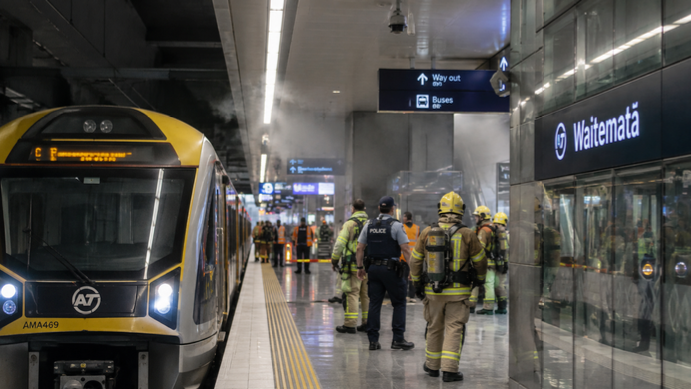
Auckland’s long-awaited City Rail Link has suffered an early opening-day disruption after a fire at Waitematā Station forced an evacuation and temporarily stopped trains from running through the new underground network, leading to delays and cancellations across the city.
Auckland, 13 September 2026: Auckland’s $5.5 billion City Rail Link began carrying passengers on Sunday morning in one of the biggest changes to the city’s public transport network in generations, but celebrations were interrupted within hours by a fire at Waitematā Station.
RNZ reported that a small electrical fire broke out in the ceiling area at Waitematā, formerly known as Britomart, forcing the station to be evacuated and disrupting services through the newly opened CRL.
Trains were prevented from travelling through the CRL tunnels while Fire and Emergency New Zealand responded to the incident.
The disruption resulted in delays and cancellations across Auckland’s rail network on what had been expected to be a landmark day for public transport in the city.
Fire at Waitematā Station
The incident occurred early on Sunday morning as passengers were experiencing the new network for the first time.
Waitematā Station was evacuated while emergency crews attended.
The incident affected more than just trains immediately approaching the downtown station. Because Waitematā is a crucial part of the newly connected network, trains elsewhere were stopped, delayed or redirected while the emergency was dealt with.
Passengers reported being held on trains and at stations while operators worked out how services could safely continue.
RNZ reported that Fire and Emergency responded to the incident and the fire was brought under control.
There were no immediate reports of injuries.
Electrical fault linked to small fire
The fire was reported to have involved an electrical fault in the ceiling area of Waitematā Station.
The incident prompted a genuine emergency response rather than simply being a false alarm.
That distinction is significant because Waitematā has previously experienced fire-alarm disruptions, including an incident earlier this year that affected train services.
Authorities had not, at the time of the initial reports, released a detailed technical explanation of exactly what failed or what caused the electrical fault.
The incident will therefore require further assessment before conclusions can be drawn about whether it was related to new or existing station infrastructure.
Delays and cancellations spread across the network
The City Rail Link fundamentally changes the way Auckland’s trains operate.
Before the CRL, trains arriving at Britomart terminated there.
Under the new network, Waitematā has become a through-station, allowing trains to continue beneath central Auckland through the new underground link.
That means an incident at one of the central stations can potentially have consequences beyond the immediate location.
During Sunday morning’s disruption, trains were unable to operate normally through the CRL while emergency services dealt with the fire.
Passengers experienced delays and cancellations as operators attempted to manage trains already moving around the network.
Services were able to resume after emergency authorities gave clearance, although passengers were warned that delays and cancellations could continue while the timetable recovered.
An unfortunate start to a historic day
The timing could hardly have been more unfortunate.
Sunday, 13 September was the first day Aucklanders could use the City Rail Link as part of normal passenger services.
The first trains began operating from around 5am, with additional services scheduled because authorities expected strong public interest.
Thousands of Aucklanders were expected to travel specifically to experience the new tunnels and stations.
The CRL includes 3.45 kilometres of twin underground rail tunnels connecting Waitematā Station with the redeveloped Maungawhau Station.
It also introduces two major new underground stations, Te Waihorotiu in midtown and Karanga-a-Hape near Karangahape Road.
The project turns Auckland’s downtown rail station from a terminus into part of a connected cross-city railway.
Auckland had prepared extensively for opening day problems
Transport authorities knew the first days of operation could bring challenges.
Auckland Transport, KiwiRail and Auckland One Rail had deployed additional staff and resources across the network for the opening period.
All 40 passenger stations were expected to be staffed on opening day, while spare trains and crews were positioned to respond to operational problems.
Auckland Transport had also warned passengers that demand would be high and asked people to be patient as the new system bedded in.
Only weeks before opening, Auckland councillors had questioned officials about what would happen if an incident occurred inside one of the CRL stations.
Officials acknowledged that while the redesigned network provides greater resilience in normal operations, an incident inside the shared central tunnel and station environment could cause widespread disruption.
Sunday morning provided an immediate real-world test of those contingency plans.
Fire emergencies had been rehearsed before opening
There is another striking element to the incident.
Emergency services had specifically practised responding to fires inside the City Rail Link before passengers were allowed onto the network.
In August, Fire and Emergency New Zealand, Police and Hato Hone St John joined train and station staff for a major emergency exercise involving a simulated fire on a train near Te Waihorotiu Station.
That was part of an extensive emergency testing programme involving more than 1,400 volunteer passengers.
Scenarios included station fires, smoke-filled train carriages, derailments, train failures, medical emergencies and mass evacuations.
Authorities also tested ventilation and smoke extraction systems, alarms, CCTV, communications, lighting and control-room responses.
The preparation became unexpectedly relevant on the very first morning of passenger operation when emergency procedures had to be used for a real incident.
Why the City Rail Link is such a major change
Despite Sunday’s disruption, the opening of the CRL remains one of the most significant changes Auckland’s transport system has experienced.
The project is designed to remove the bottleneck created by Britomart operating as a terminating station.
With trains now able to travel through the central city, rail capacity into Auckland’s centre is expected to increase significantly.
Authorities say train frequencies through the central CRL stations can increase from around 18 trains an hour to 32 trains an hour.
The project is also expected to cut journey times substantially for some passengers.
For example, Auckland Transport says journeys between Maungawhau and Waitematā should take less than 10 minutes, while the trip between Henderson and the city centre is expected to be considerably faster under the redesigned network.
The number of Aucklanders living within a 30-minute train journey of the central city is also expected to approximately double.
A $5.5 billion project years in the making
The City Rail Link has taken years to design and construct and has cost approximately $5.5 billion.
It is jointly funded by Auckland Council and the Government.
The project involved constructing underground tunnels beneath central Auckland, building new stations, redeveloping existing stations and carrying out substantial upgrades across the wider rail network.
Its opening was formally celebrated on Friday, 11 September, when Prime Minister Christopher Luxon, Auckland Mayor Wayne Brown, ministers, councillors and mana whenua gathered ahead of passenger services beginning on Sunday.
Mayor Brown has previously described the CRL as a “game changer” for Auckland while also acknowledging that it cost too much and took too long.
First-day disruption does not determine long-term reliability
A fire and widespread disruption on the first day will inevitably attract attention, particularly given the scale and cost of the project.
But a single incident does not establish whether the CRL itself will prove reliable or unreliable over the longer term.
The key questions will be what caused the electrical fire, whether it was connected to CRL infrastructure, how effectively emergency systems responded and how quickly Auckland’s wider rail network recovered.
Sunday’s incident also demonstrates the complexity of operating a highly interconnected railway.
The CRL has been designed to make Auckland’s rail system faster and more connected. That connectivity brings significant benefits, but incidents inside critical central sections of the network can also have wider consequences.
A rough beginning to a new era for Auckland rail
For Auckland, 13 September 2026 will still be remembered as the day the City Rail Link finally began carrying passengers.
After years of construction, disruption and anticipation, Aucklanders can now travel through an underground rail connection beneath the central city.
But the first morning also delivered an immediate reminder of the operational challenges that come with a much larger and more interconnected rail system.
The fire was dealt with, the station reopened and trains began moving through the network again.
For Auckland Transport and its rail partners, attention will now turn to understanding what happened, preventing a repeat and demonstrating that Sunday’s disruption was an opening-day setback rather than an indication of how the new network will perform in everyday operation.
Source: This article is based primarily on reporting by RNZ, with additional background information from Auckland Transport and City Rail Link Ltd. Original reporting on the opening-day fire and resulting delays and cancellations is credited to RNZ.