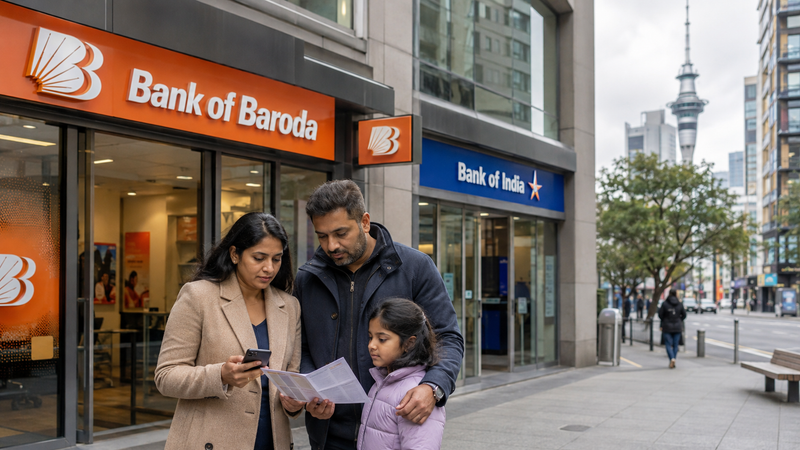
For New Zealand's rapidly established Indian community, banking is about much more than simply having somewhere to receive a salary.
Families send money to India.
Parents support relatives overseas.
New migrants need savings and transaction accounts.
Home buyers need mortgages.
Students need banking facilities.
Business owners need access to credit and reliable international payments.
And for many Indian New Zealanders, there is a natural attraction in dealing with a bank whose parent institution they already know from India.
There are currently two Indian-origin registered banks operating in New Zealand: Bank of Baroda New Zealand and Bank of India New Zealand.
Both are connected to major Indian public-sector banking institutions.
Both are regulated as registered banks in New Zealand.
Both provide retail banking, deposits, lending and India-focused remittance services.
But when their current New Zealand offerings are placed side by side, the differences become surprisingly clear.
On several of the services most relevant to ordinary households and the Indian diaspora, Bank of Baroda currently appears to have the stronger overall proposition.
That does not mean Bank of India has no advantages.
It does.
But the numbers deserve a closer look.
First, how many Indian banks actually operate in New Zealand?
The answer is two.
The Reserve Bank of New Zealand's register, updated on 10 August 2026, lists:
- Bank of Baroda (New Zealand) Limited
- Bank of India (New Zealand) Limited
Bank of Baroda was registered on 1 September 2009.
Bank of India was registered on 31 March 2011.
Bank of Baroda describes itself as the first Indian bank to enter New Zealand. Its New Zealand subsidiary was incorporated in 2008 and began its registered banking presence the following year.
So despite the size of New Zealand's Indian community and the enormous Indian banking sector, customers looking specifically for an Indian-origin registered bank here effectively have a choice between two institutions.
Bank of Baroda and Bank of India at a glance
| Category | Bank of Baroda NZ | Bank of India NZ |
|---|---|---|
| Registered in NZ | 2009 | 2011 |
| Indian parent | Bank of Baroda | Bank of India |
| NZ branches identified | Auckland, Wellington | Auckland, Papatoetoe |
| Savings account minimum balance | No minimum balance on standard savings account | $500 minimum on Star Savings account |
| India remittance fees | Zero transaction fees, unlimited personal remittances | Up to 4 remittances per month with no fees |
| India transfer speed advertised | Instant to BoB branches, same day or within 24 hours to other Indian banks | Instant to BOI accounts, same-day credit to other Indian banks |
| 6-month fixed home loan | 4.79% | 6.80% |
| 1-year fixed home loan | 4.99% | 7.00% |
| 2-year fixed home loan | 5.49% | 7.20% |
| Floating home loan | 7.24% | 7.80% |
| Mobile banking | bob World NZ app plus internet banking | Internet banking publicly promoted |
| NZ regional footprint | Auckland and Wellington | Two Auckland-area branches |
Rates and product conditions change, and customers should always confirm current pricing before making financial decisions. The figures above are based on the banks' published material available around 20 August 2026.
Home loans produce the biggest difference
For anyone considering a mortgage, this is currently the most striking part of the comparison.
Bank of Baroda's published New Zealand home-loan rates, effective from 6 August 2026, include:
| Term | Bank of Baroda |
|---|---|
| Floating | 7.24% |
| 6 months fixed | 4.79% |
| 1 year fixed | 4.99% |
| 18 months fixed | 5.39% |
| 2 years fixed | 5.49% |
| 3 years fixed | 5.59% |
Bank of India, by comparison, is advertising:
| Term | Bank of India |
|---|---|
| Floating | 7.80% |
| 6 months fixed | 6.80% |
| 1 year fixed | 7.00% |
| 2 years fixed | 7.20% |
On the published headline rates alone, Bank of Baroda has a substantial advantage at present.
Take the one-year fixed rate.
Bank of Baroda is advertising 4.99 percent.
Bank of India is advertising 7.00 percent.
That is not a small difference.
On a large mortgage, a two-percentage-point gap can translate into many thousands of dollars in interest over a year, although actual customer repayments depend on loan size, structure, equity, fees and individual lending decisions.
This is the area where Bank of Baroda currently makes its strongest case.
Remittances to India matter enormously
For the Indian diaspora, international remittance services can be just as important as mortgage pricing.
Many households regularly send money to parents, relatives, property accounts or other financial commitments in India.
Bank of Baroda currently advertises:
- zero transaction fees with unlimited transactions for eligible personal remittances to India
- instant transfers to Bank of Baroda branches in India
- same-day or within 24-hour transfers to accounts at other Indian banks
- internet banking
- mobile banking
- direct support for remittance queries
Its New Zealand operation also provides SWIFT arrangements for a number of other currencies and countries.
Bank of India also offers a strong India-remittance product.
It advertises:
- no fees on up to four remittances to India each month
- instant transfers to Bank of India accounts
- same-day credit to accounts with other Indian banks.
Both are clearly designed around the needs of the Indian diaspora.
But for a customer who sends money frequently, Bank of Baroda's unlimited zero-fee personal remittance proposition is currently more generous on paper.
Everyday banking also shows some differences
Bank of Baroda's standard savings account advertises:
No minimum balance and no transaction fees.
That is a simple proposition and may be particularly useful for newer migrants, students or customers who do not want to keep a fixed balance sitting in a transaction account.
Bank of India lists a $500 minimum balance for its Star Savings Account, while its published fee schedule provides various free services depending on conditions.
Bank of Baroda also offers a broader-looking range of specialised savings products in New Zealand, including:
- standard savings
- Super Savings
- Freedom60 accounts for customers aged 60 and over
- international student savings accounts
- Golden Savings
- recurring deposits
- fixed deposits.
This is one of the areas where its New Zealand product menu appears more developed.
Term deposits are more mixed
Bank of Baroda does not win every comparison.
Its term deposit rates published from June 2026 range from 2.00 percent for 30 to 59 days through to 4.80 percent for five years, with slightly higher rates for eligible Freedom60 customers.
Bank of India's published term-deposit table includes rates such as:
- 3.70 percent for one year to under 18 months
- 3.90 percent for 18 months to under two years
- 4.25 percent for two years
- 4.25 percent for three years
- 4.30 percent for four years
- 4.35 percent for five years.
That means neither bank is universally ahead.
For example, Bank of India appears stronger at some medium-term maturities, while Bank of Baroda's longer five-year rate is higher.
This is exactly why customers should compare the term they actually want rather than simply choosing a bank by brand.
Branches tell another interesting story
Bank of Baroda currently identifies branches in:
Auckland
114 Dominion Road, Mount Eden
Wellington
55 Featherston Street
It also advertises Saturday banking at its Auckland branch for limited hours.
Bank of India identifies two branches:
Auckland
10 Manukau Road, Epsom
Papatoetoe
South Auckland.
So each bank has two identified branches.
But Bank of Baroda has the wider geographic spread because it has a physical presence in both Auckland and Wellington.
Bank of India's New Zealand branch footprint remains concentrated in Auckland.
For customers elsewhere in the country, that means digital capability becomes particularly important.
Digital banking is becoming a bigger battleground
This is where Indian banks in New Zealand have historically faced a difficult challenge.
Customers increasingly compare them not with traditional Indian public-sector banking experiences, but with ANZ, ASB, BNZ, Westpac and Kiwibank.
That means expectations are much higher.
Customers want:
- smooth mobile apps
- immediate notifications
- easy account opening
- simple card management
- fast support
- strong fraud protection
- straightforward international transfers
- modern online interfaces
Bank of Baroda now promotes its bob World New Zealand mobile app, along with internet banking and mobile remittance functionality.
Bank of India currently prominently promotes internet banking and electronic service channels through its New Zealand website.
This is an area both banks need to keep investing in.
Being familiar to Indian customers may bring someone through the door once.
A good digital experience is what keeps them there.
What about customer service?
This is the hardest category to score responsibly.
Bank of Baroda publishes a toll-free New Zealand number, direct Auckland and Wellington contacts, dedicated operational and remittance email addresses, and a customer grievance process. It also has Saturday branch availability in Auckland.
Bank of India also publishes separate Auckland and Papatoetoe contacts and a formal feedback facility.
Those are facts.
What cannot be proven from official banking data is a claim that every Bank of Baroda customer receives better service than every Bank of India customer.
Customer experience is personal.
Some customers will have excellent experiences with Bank of India.
Others may prefer Bank of Baroda.
Some will choose neither.
Anecdotally, there are people within the Indian community who speak positively about the responsiveness and personal support they receive from Bank of Baroda.
That feedback is worth listening to, but it should not be confused with a scientific customer-satisfaction survey.
A serious comparison has to distinguish between verifiable service infrastructure and individual customer experience.
Why do Indian banks matter to the diaspora at all?
This is perhaps the bigger story.
An Indian-origin bank operating in New Zealand can provide something that a mainstream New Zealand bank cannot always replicate easily.
It understands the financial connection between two countries.
A newly arrived migrant may still have:
- parents in India
- property in India
- loans or deposits in India
- business relationships in India
- recurring family remittances
- investment obligations
- an NRI banking relationship
For those customers, dealing with an institution whose parent bank already operates across India can be useful.
Bank of Baroda says its parent bank has more than 8,000 Indian branches and an international presence across 15 countries.
Bank of India says its parent has more than 5,100 branches in India and a longstanding international banking operation.
Both therefore offer something culturally and commercially different from a standard New Zealand retail bank.
But Indian banks cannot rely on nostalgia
This is equally important.
A customer should not choose an Indian bank simply because the logo is familiar from home.
New Zealand customers should expect New Zealand standards.
They should compare:
- rates
- fees
- digital capability
- fraud protection
- service response
- deposit returns
- mortgage pricing
- complaint handling
- branch access
If an Indian-origin bank cannot compete in those areas, heritage alone will not protect it.
That is particularly important for the second generation of Indian New Zealanders.
Someone who grew up in Auckland or Wellington may feel little emotional attachment to a bank their parents used in Delhi, Mumbai, Gujarat or Punjab.
That customer will simply ask:
Is this bank giving me a better deal?
The Webfit News scorecard
Based only on publicly verifiable New Zealand product information available on 20 August 2026, here is how the two currently compare.
| Category | Edge |
|---|---|
| NZ operating history | Bank of Baroda |
| Geographic branch reach | Bank of Baroda |
| Standard savings minimum balance | Bank of Baroda |
| Frequent remittances to India | Bank of Baroda |
| 6-month home-loan rate | Bank of Baroda |
| 1-year home-loan rate | Bank of Baroda |
| 2-year home-loan rate | Bank of Baroda |
| Floating home-loan rate | Bank of Baroda |
| Certain medium-term deposits | Bank of India |
| Five-year term deposit | Bank of Baroda |
| India-linked banking capability | Both |
| Physical presence in South Auckland | Bank of India |
| Customer satisfaction | No reliable national dataset to declare a winner |
So which one comes out ahead?
On the publicly available data we reviewed, Bank of Baroda is currently the stronger overall proposition.
That conclusion is driven mainly by measurable factors rather than sentiment.
Its advertised home-loan rates are materially lower across the comparable terms examined.
Its standard savings account has no minimum balance.
Its India remittance proposition advertises unlimited zero-fee transactions for qualifying personal accounts.
It has branches in two different New Zealand cities rather than being concentrated entirely in Auckland.
It offers mobile banking and a fairly broad local product range.
And it has been operating in the New Zealand registered banking market for longer.
Bank of India still has strengths, particularly for customers who already have a relationship with the bank, live near its Auckland branches or find a particular deposit product more attractive.
But on the current product and pricing data, Bank of Baroda comes out ahead in this Webfit News comparison.
That is not an endorsement telling every reader where to bank.
It is a snapshot based on the information available today.
Banks change rates.
Products change.
Service changes.
Individual offers can differ.
And that is exactly why competition matters.
Sources
Reserve Bank of New Zealand registered banks register, updated 10 August 2026.
Bank of Baroda New Zealand official product, rate, remittance, branch and disclosure information.
Bank of India New Zealand official product, rate, remittance, branch and disclosure information.
Bank of Baroda parent-bank corporate information.
Bank of India parent-bank corporate information.