
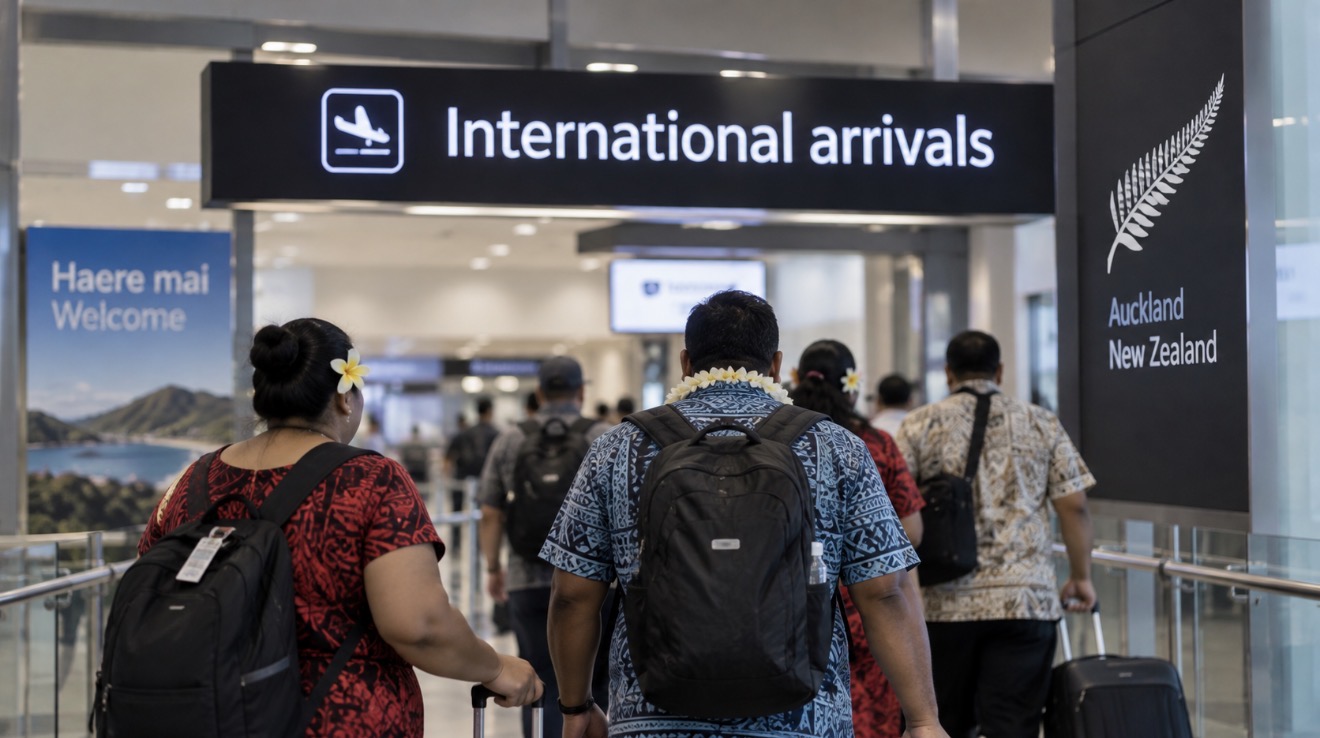
Labour has announced it would introduce visa-free travel to New Zealand for Pacific Island Forum countries if elected, adding significant political weight to a campaign that has been building for months.
Deputy Leader Carmel Sepuloni said Pacific visitors would be able to enter on an NZeTA for three months at a time, the same electronic travel authority system already used by 61 other countries.
What Labour Is Actually Proposing
Sepuloni framed the policy as overdue recognition of how closely connected New Zealand and the Pacific already are.
"We're talking about seamless travel between Pacific countries and New Zealand, and a recognition of the cost and burden that the current system puts on New Zealand Pacific families," Sepuloni said. "Our relationship has matured enough for us to be able to move to a place that they have access to the same electronic system that 60 other countries have. It's the right thing to do."
A Crowded Field of Support
Labour isn't the first party to move on this issue. New Zealand First promised a two-year clemency period for Pacific overstayers just last week, and Deputy Prime Minister Winston Peters has previously accepted a petition from Samoan activist Arthur Anae pushing for visa-free travel to become reality.
Peters described the concept in characteristically direct terms.
"The first thing you've got to do is regularise what it means, you leave at the end of that specific time, or before," he said. "Cousins don't rip off cousins."
The Green Party has also signalled support for a visa waiver, while National has declined to state a position, saying its immigration policy will be announced in due course.
Why This Is Happening Now
The timing of Labour's announcement isn't coincidental. New Immigration New Zealand (INZ) figures released this week show a notable shift in overstayer demographics.
|
Measure |
This Year |
Last Year |
|
Overall overstayer population |
Down 8.7% |
— |
|
Share of overstayers from Pacific Island countries |
26% |
25% |
Within that overstayer population of 19,153 people, 2,541 are Tongan and 1,462 are Samoan. Looking specifically at recent arrivals between June 2023 and 2026, 2.14 percent of Tongans and 1.25 percent of Samoans overstayed, both well above the overall average of 0.13 percent across all nationalities.
A History Worth Understanding
To understand why this policy carries such significance, it helps to know the history behind it. No Pacific Island country has had visa-free access to New Zealand since 2003, when a waiver for Tuvaluans, i-Kiribati and Nauruans was removed.
Before that, Tonga, Samoa and Fiji were removed from a visa waiver in 1987, just three months after being added, following more than 5,200 arrivals of which fewer than half departed once their visas expired.
Since then, INZ has treated Pacific nationals as high-risk overstayers, even though countries including the US, China, India and the UK have had comparable overstayer numbers, their overall overstay rates simply appeared lower because their total legal arrival numbers were much higher.
Does This Risk Making Overstaying Worse?
When asked whether easier entry could increase overstaying rates, Sepuloni was clear the policy isn't designed to address that issue directly, and pushed back on the framing itself.
"The expectation is that the rules still apply, and our expectation is that people will follow them," she said. "By and large, our Pacific people follow the rules. It's not like we have our people coming from the Pacific, and they are overwhelmingly choosing to break the rules. It's the complete opposite, actually."
Labour's Concerns About NZ First's Alternative
While broadly supportive of the overall direction, Sepuloni raised specific concerns about NZ First's clemency proposal, drawing on her own experience handling immigration cases as an electorate MP.
"I've dealt with a lot of immigration cases as an electorate MP, and there are always individual circumstances that don't fit in a box," she said. "It worries me that they're saying they'll give this two years clemency, and at that point, if you are not regulated, they will deport you, and you will never be allowed to come back."
A Long-Time Campaigner Reacts
Former National MP Anae Arthur Anae, who has campaigned on this issue for years and was separately planning to submit a petition to Parliament today, welcomed the growing political momentum, even while continuing to back NZ First specifically.
"What New Zealand First has said is something that we've been raising for some time: the unfairness on the overstaying numbers," Anae said, though he noted some frustration with Labour's timing. "I've always treated Labour equally as everybody else. I think the problem that I've had with them is their lateness in making a statement."
Anae now sees a genuine path toward political consensus.
"We know Winston's going to support us. Now we know Labour is there and I'm sure the Greens and Te Pāti Māori will support us, which means we have the numbers," he said.
He framed the issue in deeply personal terms for many Pacific families.
"For Pacific people seeking to attend weddings and funerals whose visas were not processed in time, or for those wrongly deported due to administrative errors by INZ, this could bring closure," Anae said. "We are asking for justice. We want to be treated equally as anybody else. Nothing more, just to be the same."
Why This Matters Heading Into the Election
With Labour, New Zealand First, the Greens, and likely Te Pāti Māori now aligned in some form of support for improved Pacific travel access, and only National yet to declare a clear position, this issue appears to be building toward genuine cross-party momentum ahead of the election, a notable shift after more than two decades without visa-free access for any Pacific nation.
This article is based on reporting by Kaya Selby for RNZ Pacific.