While investigating equipment and facilities, they discovered 15 bikes donated to the school years earlier, stored in a locked container.
Hawke’s Bay Regional Council Enviroschools facilitator Helen Howard said the project stood out because the students looked beyond simply telling people to cycle.
“They asked why people weren’t biking, listened to the answers, and then started working through the barriers one by one,” she said.
Repairs, raffles and a schoolwide campaign
The team promoted the project through posters, an Instagram page and presentations at junior and senior assemblies.
They ran daily cycling raffles, sourced vouchers and accessories, and held a sustainability Kahoot quiz.
Local cyclist Harry van der Zanden visited the school to help repair bikes. The students also volunteered as marshals at the Illuminati Night Ride.
Their investigation covered helmets, locks, spare bikes and the possibility of installing a fixed pump and repair station.
The project’s approach was to make cycling easier and more appealing while identifying the equipment and support people needed.
Prize money puts repair station within reach
The students’ next priority is a permanent bike repair station, estimated to cost about $2,500.
Their $1,000 prize provides a start towards that goal, although further funding would be needed.
The team also hopes to establish a shelter, spare helmet supply, loan-bike scheme and cycling club. Longer-term ideas include bike scholarships and a “cycling school bus”, allowing students to ride together.
These remain ambitions for the project rather than facilities already in place.
Clothing swaps and biodiversity projects also recognised
Te Mata School and Sacred Heart College were named joint runners-up, receiving $500 each.
The challenge asked students to develop lasting school projects addressing sustainable transport, biodiversity, water or climate-change awareness.
Across the seven entries, students proposed ways to improve their surroundings and reduce waste.
| School or team | Project |
|---|
| Karamū High School, Project Paihikara | Encouraging cycling by identifying barriers and improving access to equipment and support |
| Te Mata School | Five biodiversity projects, including a bug hotel, rainwater capture and a birdhouse |
| Sacred Heart College | A second-hand clothing swap addressing the environmental impact of fast fashion |
| Karamū High School senior students | Project Kaitiaki Kākahu Repair Café, focused on repair, reuse, kaitiakitanga and manaakitanga |
| Henry Hill School | Garden Pickles Unite, a sensory garden designed for neurodiverse tamariki |
| Central Hawke’s Bay College | Technicolour, replacing grass strips with native planting |
| Hastings Intermediate | Bird Corridor, combining planting with 100 birdhouses |
Turning large problems into local action
Howard said the entries showed students could make environmental issues manageable by starting with their own schools.
“Environmental challenges can feel massive, even overwhelming,” she said. “What impressed us was how the students made them local and manageable – they found something in their own school they could change, then got on with it.”
She said the students developed the ideas and carried out the work, with support and advice available along the way.
Teachers and schools interested in next year’s challenge are encouraged to contact Hawke’s Bay Regional Council’s Environmental Education team.
Schools and early childhood centres can also participate in Enviroschools, which supports young people to investigate environmental issues and take action locally.
Hawke’s Bay has 75 participating Enviroschools, comprising 44 schools and 31 early childhood centres, involving approximately 10,400 tamariki and students.
For the Karamū team, the immediate task is to turn their winning idea into lasting cycling facilities at school.
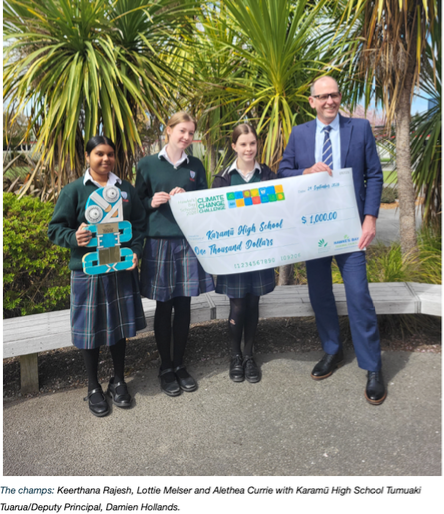
Photo caption: From left, Keerthana Rajesh, Lottie Melser and Alethea Currie with Karamū High School Deputy Principal Damien Hollands.
Source: Hawke’s Bay Regional Council media release, 12 October 2026.