With just weeks to go before New Zealand's general election, a wave of vandalism targeting political hoardings has been reported in cities and towns across the country, from arson attacks in Auckland to racist graffiti in Gisborne and a mass "vandalism spree" in Tauranga.
Police have made clear they're treating the behaviour seriously, but the pattern raises a genuine question worth sitting with as the campaign heads into its final stretch: why does damaging a piece of cardboard and timber keep happening, election after election, and what does it actually cost?
Where It's Happened
The reports span a wide geographic spread, suggesting this isn't isolated to one city or one party.
|
Location |
What Happened |
|
Mt Albert, Auckland |
A National Party hoarding deliberately set on fire overnight; police treating it as suspicious |
|
Papamoa, Tauranga |
Around 30 hoardings damaged in a two-hour spree; a 43-year-old man arrested and charged with wilful damage |
|
Gisborne |
National MP Dana Kirkpatrick reports five or six of her hoardings defaced |
|
Auckland (Maungakiekie) |
Councillor Josephine Bartley's billboard defaced with racist and abusive language |
|
Multiple electorates |
Te Pāti Māori co-leader Debbie Ngarewa-Packer and National MP Ryan Hamilton both report racist graffiti scrawled on their signs |
What the Damage Actually Looks Like
According to those affected and reporting from The Spinoff, vandalism to hoardings tends to fall into two broad categories: outright structural damage, hoardings torn down, burned, or physically destroyed, and image alteration, defacing a candidate's photo with graffiti, cut-out faces, or written slurs.
For Auckland Councillor Josephine Bartley, the experience went well beyond mischief. She described one of her signs being covered in explicit, racist abuse, and said she's chosen not to replace some damaged boards specifically because of the financial cost involved.
"They'd written all over the sign, calling me a 'fat, useless, plastic poly,'" Bartley said.
First-time candidate Malaina Taufa described a similar experience, one made more painful by the personal significance the hoardings carried for her family.
"It was my first time putting up hoardings and it was a proud moment for my family, because they all came out to help," Taufa said. "By Monday, just a few days later, somebody had vandalised it."
The Cost Isn't Just Emotional
Beyond the personal impact, there's a very real financial and practical cost. Candidates and volunteers, many of them unpaid, spend real time and money replacing damaged signage, resources that could otherwise go toward actually campaigning.
In Tauranga, Senior Sergeant Shannon Clifford was direct about this point following the Papamoa incident.
"The damage in some cases is significant, and unfortunately, that's an unnecessary cost for the people who own them," Clifford said. "We won't tolerate this illegal and destructive behaviour in our community."
How Candidates Themselves Are Responding
Reactions from those targeted have varied, but a common thread runs through most of them: a preference for open disagreement over anonymous destruction.
National MP Ryan Hamilton posted a video directly inviting whoever vandalised his sign to reach out instead.
"Why don't you give me a call or an email and we'll talk about it instead of being a coward and going on to private property and vandalising it?" Hamilton said.
Gisborne MP Dana Kirkpatrick struck a similar tone, acknowledging that disagreement itself is entirely legitimate, just not the method being used to express it.
"Obviously, people have their own political views and they are well within their rights to disagree with any party's policies or approach to what they're doing," Kirkpatrick said. "It's just disappointing. I think people have other ways that they can have their voice."
A Reminder of the Rules Around Hoardings
For context, election hoardings in New Zealand are governed by a mix of local council rules and the Electoral Act. While councils set their own timing and size limits generally, the Electoral Act imposes a nationwide 3-square-metre size cap once a campaign enters its final nine weeks before polling day, a threshold most areas, including Auckland and Wellington, crossed on 5 September this year.
Why This Story Matters
New Zealand's election hoardings exist for a simple democratic purpose: to help voters see who's standing, learn what they represent, and make an informed choice. Whatever a person's political views, and however strongly they may disagree with any particular candidate or party, that disagreement has legitimate outlets, a conversation, a letter, a vote at the ballot box in November, none of which require damaging property or subjecting candidates to racist abuse.
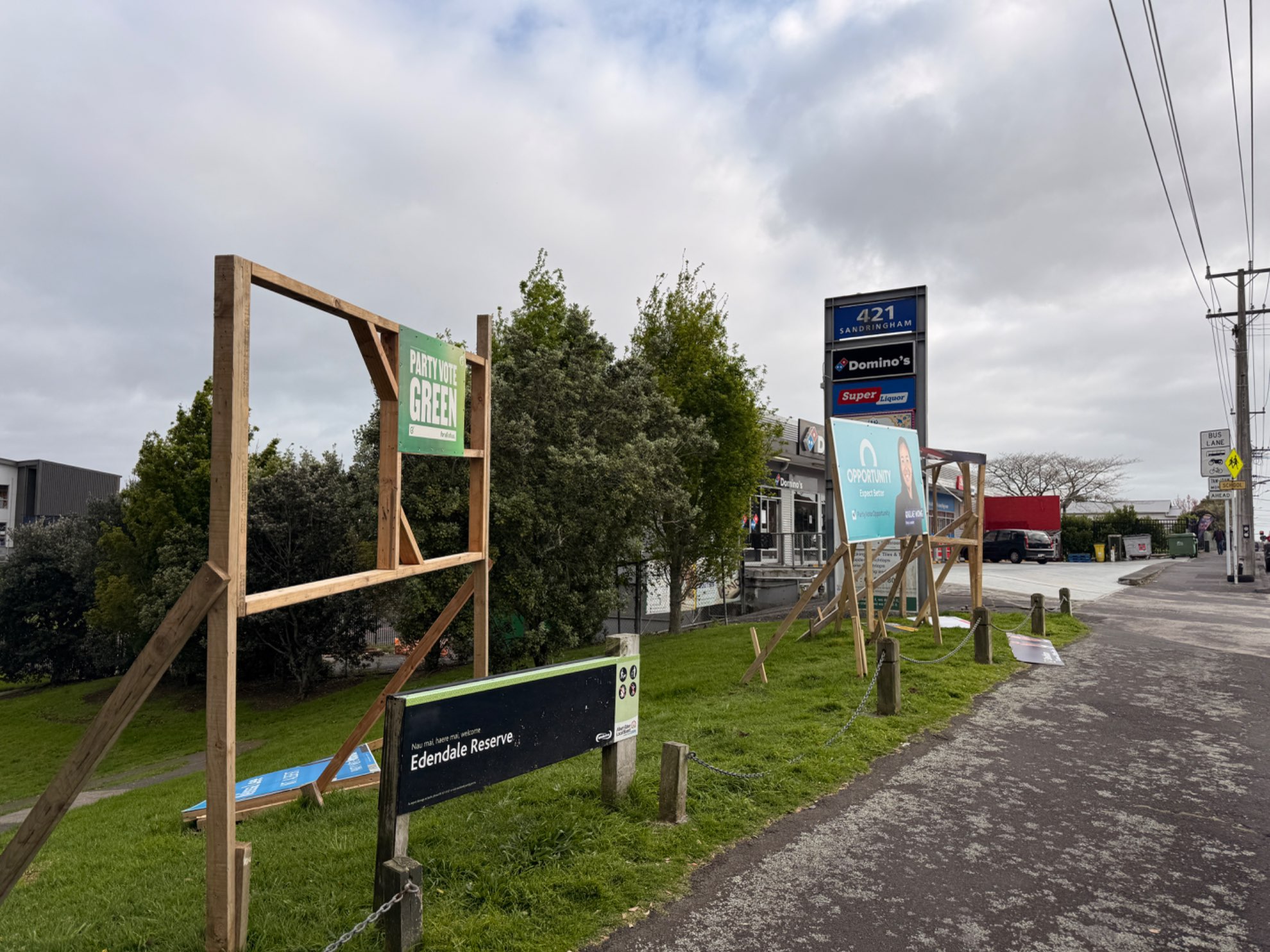
Vandalism of this kind doesn't silence any one party or perspective specifically; it lands across the political spectrum, from National and Te Pāti Māori to Green Party and Opportunities Party signage, as seen in these images taken in Auckland. If anything, the pattern suggests a broader erosion of the basic tolerance democratic participation depends on, regardless of who happens to be on the receiving end this week.
With police in multiple regions actively investigating, and at least one arrest already made in Tauranga, authorities are treating this as more than harmless election-season mischief. As New Zealanders head toward the polls in November, how the country's political process is publicly conducted, and respected, remains just as much a measure of its democratic health as the result on election night itself.
This article draws on reporting from NZ Herald, Stuff, RNZ, 1News and The Spinoff.