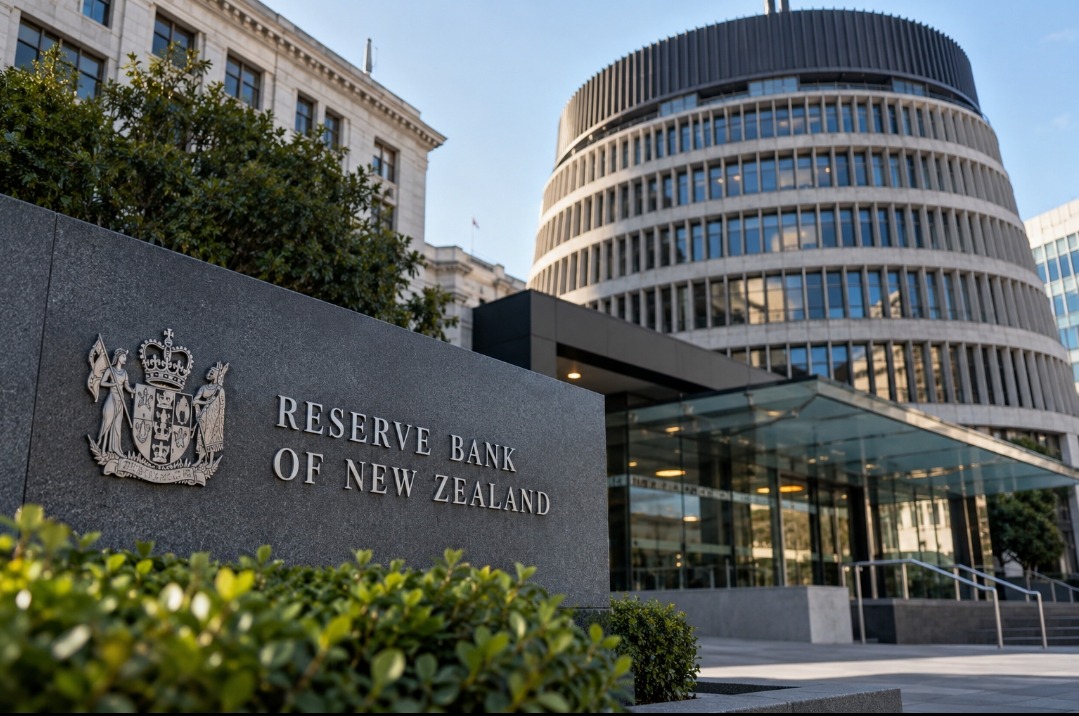
The Reserve Bank of New Zealand says it will carefully examine the findings of an independent review into the extraordinary monetary policy decisions made during the Covid-19 pandemic, a period that saw interest rates slashed, billions of dollars of government bonds purchased and inflation subsequently rise well above target.
WELLINGTON, 22 September 2026: The Reserve Bank has welcomed the release of an independent review examining New Zealand's monetary policy response during the Covid-19 pandemic and says lessons from the report will help shape how it responds to future economic shocks.
The review examines decisions made between 1 January 2020 and 31 December 2022, when the Reserve Bank deployed monetary policy measures on a scale not previously seen in New Zealand.
Reserve Bank Board Chair Rodger Finlay said the Bank would now work through the findings.
“On behalf of the Board, I welcome the findings of the independent review. The Governor and wider Reserve Bank team will carefully consider the review report and use its insights to help inform future practice,” Finlay said.
Governor Dr Anna Breman said officials would carefully analyse the findings.
“We will consider the findings of the report, and its insights will contribute to our thinking,” Breman said.
“I am proud to lead an institution that learns from the past in order to benefit New Zealanders.”
Why was the Reserve Bank's Covid response reviewed?
When Covid-19 reached New Zealand in 2020, policymakers were confronting the possibility of a severe economic collapse.
The Reserve Bank responded aggressively.
Its actions included cutting the Official Cash Rate to 0.25 percent and introducing unconventional monetary policy measures, including the Large Scale Asset Purchase programme, commonly known as LSAP, and the Funding for Lending Programme.
Covid-era measure| What it involved
Official Cash Rate| Cut to 0.25%
LSAP programme| Reserve Bank purchased large quantities of government bonds
Funding for Lending| Provided banks with access to lower-cost funding
Period reviewed| 1 January 2020 to 31 December 2022
Purpose of review| Identify lessons for future major economic shocks
The measures were intended to lower borrowing costs, support employment and economic activity, and prevent an already serious health crisis from developing into a much deeper economic crisis.
But what happened afterwards generated years of debate.
Inflation and billions in LSAP losses
New Zealand's economy recovered much more strongly than initially feared.
Inflation subsequently accelerated and remained above the Reserve Bank's target until the September 2024 quarter.
When announcing the independent review in February, Finance Minister Nicola Willis said the extraordinary monetary policy actions helped preserve jobs and keep businesses operating during the pandemic.
However, she also pointed to significant consequences that followed.
These included decades-high inflation, a sharp increase in asset values and losses of around $10.3 billion associated with the LSAP programme.
House prices also increased dramatically during the period, including an increase of about 30 percent in one year, according to the Government when announcing the review.
The extent to which monetary policy, government fiscal stimulus, international supply disruption and other Covid-related factors individually contributed to those outcomes has been the subject of substantial economic debate.
What was the independent review looking at?
The Government commissioned monetary policy experts Athanasios Orphanides and David Archer to conduct the review.
Orphanides is a former Governor of the Central Bank of Cyprus, former member of the European Central Bank's Governing Council and professor at the Massachusetts Institute of Technology.
Archer is a former Reserve Bank Assistant Governor and former head of the Central Banking Studies Unit at the Bank for International Settlements.
The review was established to examine areas including:
- Monetary Policy Committee decision-making during 2020 to 2022;
- analysis provided by the Reserve Bank to support those decisions;
- the use of additional monetary policy tools;
- communication surrounding monetary policy decisions; and
- coordination between monetary and fiscal policy.
The stated objective was not simply to revisit decisions with the benefit of hindsight, but to identify lessons that could improve New Zealand's response when another major economic shock occurs.
Why does this matter to ordinary New Zealanders?
Monetary policy can sound distant from everyday household finances, but the consequences are very real.
Reserve Bank interest-rate decisions influence mortgage rates, term deposits, business borrowing, consumer spending, employment and eventually inflation.
When inflation surged following the pandemic, the Reserve Bank subsequently had to increase interest rates substantially to bring price pressures under control.
For households with mortgages, that meant moving from an era of exceptionally cheap borrowing into much higher repayments as fixed-rate loans rolled over.
For renters and businesses, higher interest rates also flowed through different parts of the economy.
Understanding whether the extraordinary measures used during Covid were appropriately designed, timed and withdrawn therefore has implications well beyond the Reserve Bank itself.
Reserve Bank says changes have already been made
The Bank says it has not waited for today's independent review before examining what happened.
Its own 2022 Review and Assessment of the Formulation and Implementation of Monetary Policy, known as RAFIMP, examined monetary policy over the five years from 2017 to 2022.
The Reserve Bank says it has subsequently taken a number of actions in response to lessons from the pandemic period, with further work outlined in a September 2025 Bulletin article.
Breman said the new independent review provides another source of information for that process.
“The independent review offers additional insights that we will carefully consider alongside this work,” she said.
Future monetary policy could change
The findings could feed into several areas of the Reserve Bank's future work.
Breman specifically pointed to efforts to strengthen the Bank's economic modelling infrastructure.
The review could also contribute to work supporting the Reserve Bank's 2028 advice on the Monetary Policy Committee Remit.
That matters because economic models and forecasts help policymakers decide whether interest rates should rise, fall or remain unchanged.
During an event as unusual as Covid-19, forecasting became particularly difficult because policymakers were dealing with lockdowns, closed borders, disrupted supply chains and dramatic changes in consumer behaviour for which there was little modern precedent.
Fiscal policy was part of the equation too
The Reserve Bank was not acting alone during Covid.
The Government simultaneously introduced substantial fiscal support to protect households, jobs and businesses.
Treasury analysis has subsequently noted that the economy turned out to be considerably stronger than initially expected from late 2020.
It has also found indications that fiscal policy became pro-cyclical during 2021 to 2024 as significant government spending coincided with an economy operating above capacity.
That broader context matters when assessing the inflation that followed because monetary policy was only one of several forces affecting demand and prices.
Global supply-chain disruption and Russia's invasion of Ukraine also contributed to inflation internationally.
Learning from an extraordinary period
The central question now is what New Zealand should do differently when the next major economic crisis arrives.
In early 2020, policymakers were making decisions while facing enormous uncertainty about how severe the pandemic would become, how long restrictions would last and how deeply the economy would contract.
The interventions helped cushion the initial economic shock.
But the years that followed brought another set of problems: rapidly rising prices, soaring asset values, higher interest rates and substantial financial losses associated with unconventional monetary policy.
The independent review is intended to examine those trade-offs and determine what lessons can be carried into the next crisis.
For the Reserve Bank, the focus now shifts from defending or revisiting individual decisions to determining what should change before it is required to make decisions under that kind of pressure again.
Sources: Reserve Bank of New Zealand, New Zealand Government and New Zealand Treasury. Reporting and additional context by Webfit News.