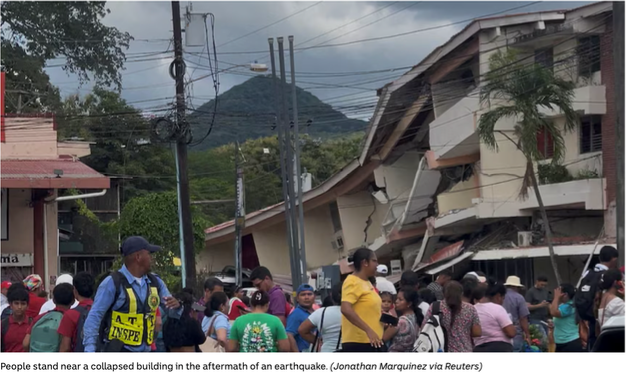
Authorities’ preliminary assessment identified roughly 420 damaged homes and a similar number of public schools.
Costa Rica’s National Seismological Network described the main event as a shallow earthquake beneath the Azuero Peninsula, with estimated shaking intensities of VIII to IX near the epicentre, indicating potentially destructive ground movement.
The network said the Soná-Azuero fault zone was among the possible sources being investigated. Its preliminary assessment indicated predominantly sideways movement along the fault.
Tsunami threat passes
The earthquake prompted tsunami alerts, but the US Tsunami Warning System subsequently said the threat had passed, according to Reuters reporting published by ABC.
That update concerns the tsunami risk. It does not remove the disruption caused by earthquake damage and continuing aftershocks.
ABC reported that power supplies were interrupted across six provinces, while residents in affected areas described cracked homes and fears of further shaking.
Panama Canal continues operating
The Panama Canal remained operational following the earthquake, with shipping through the waterway unaffected, The National reported.
The canal’s continued operation is significant because of its role in international trade, although communities elsewhere in the country are dealing with the immediate effects of the disaster.
Updated information changes the picture
Social media posts describing an “8.0 earthquake” reflect an early estimate rather than the revised magnitude used in subsequent reporting.
The event also occurred on 9 October in Panama, although it was already 10 October in New Zealand.
With inspections and assessments continuing, the full extent of the damage remains uncertain. The emergency declaration follows a disaster whose impact extends beyond the initial shaking, as repeated aftershocks complicate the recovery.
Sources: Associated Press, Reuters reporting via ABC, The National, Costa Rica’s National Seismological Network and GDACS.