
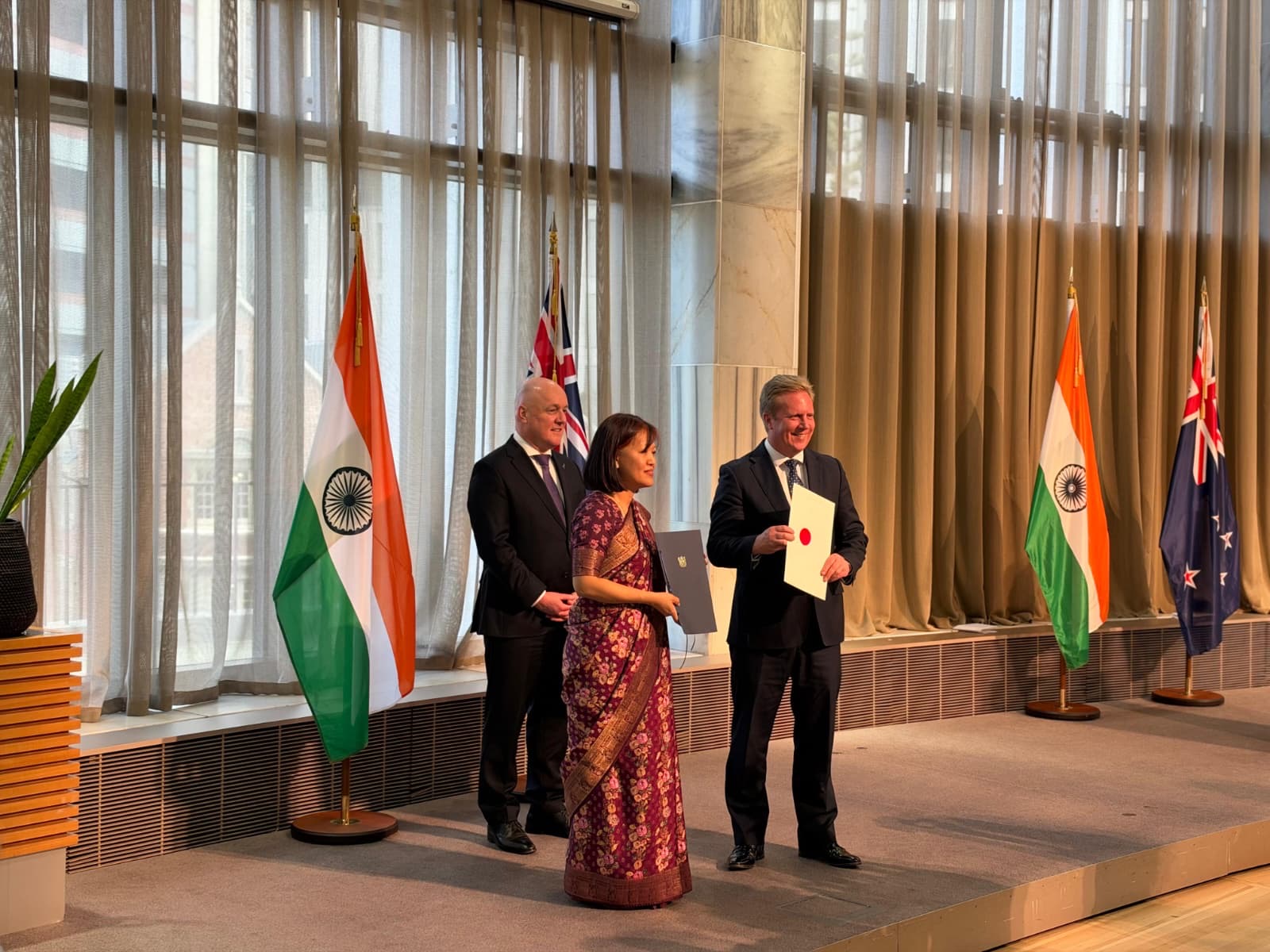
The India-New Zealand Free Trade Agreement will officially come into force on 20 October 2026, opening a new chapter in economic relations between the two countries and creating wider opportunities for exporters, businesses and investors.
WELLINGTON, 22 September 2026: India and New Zealand are preparing for a significant change in their trading relationship, with the landmark Free Trade Agreement between the two countries set to take effect from 20 October 2026.
The agreement has now completed the required ratification process, clearing the way for businesses in both countries to begin benefiting from lower tariffs and improved market access.
For India, the agreement provides duty-free access across all New Zealand tariff lines from the day it enters into force.
For New Zealand exporters, the arrangement is more targeted. Around 57 percent of current New Zealand exports to India will become tariff-free immediately, while wider tariff reductions will be progressively introduced.
Over time, around 95 percent of New Zealand's current exports to India are expected to receive either tariff-free access or substantially reduced tariffs.
What changes from 20 October?
The FTA will affect everything from agricultural exports and manufactured products to services and investment.
| Key area | What the FTA means |
|---|---|
| FTA begins | 20 October 2026 |
| Indian exports to NZ | Duty-free access across all NZ tariff lines from day one |
| NZ exports to India | 57% of current exports become tariff-free immediately |
| Longer-term NZ access | Around 95% of current exports receive tariff-free or substantially reduced access |
| NZ exports fully tariff-free over time | More than 80% |
| Current two-way trade | Around NZ$3.95 billion annually |
| NZ exports to India | Around NZ$2.03 billion in the year ended December 2025 |
The agreement is expected to create opportunities across sectors including food and agriculture, forestry, technology, education, professional services, textiles, pharmaceuticals, engineering and manufacturing.
Indian products get duty-free access to New Zealand
One of the most significant elements of the agreement is the access being provided to Indian exporters.
From 20 October, New Zealand will remove tariffs across all tariff lines for qualifying Indian goods.
That creates opportunities for Indian businesses exporting products including textiles and apparel, engineering goods, pharmaceuticals, machinery, leather products, footwear, marine products and processed foods.
For New Zealand consumers, the changes could eventually mean greater choice and potentially lower prices on some imported Indian products.
However, removing a tariff does not automatically mean the full saving will appear on shop shelves.
Retail prices are also influenced by freight costs, exchange rates, wholesale margins, competition and decisions made by individual importers and retailers.
What does New Zealand gain in India?
India represents a considerably larger potential consumer market for New Zealand businesses.
With a population of more than 1.4 billion people, India has long been regarded as a major opportunity for Kiwi exporters, although trade between the two countries remains relatively modest compared with New Zealand's largest trading partners.
The FTA significantly improves access for a range of New Zealand products.
| New Zealand sector | FTA outcome |
|---|---|
| Sheep meat | Tariffs removed immediately |
| Wool | Tariffs removed immediately |
| Forestry and wood | More than 95% of exports tariff-free immediately |
| Fish and seafood | Tariffs phased out over seven years on key exports |
| Kiwifruit | Preferential quota access |
| Apples | Preferential quota access |
| Wine | Tariffs substantially reduced over 10 years |
| Mānuka honey | Tariffs reduced by 75% over five years |
| Some dairy-based preparations | Tariffs phased out over seven years |
| Services | Improved access across several professional and commercial sectors |
Kiwifruit and apples are among the areas where New Zealand has secured notable new access.
New Zealand becomes the first country to receive preferential access for apples under an Indian free trade agreement, while New Zealand kiwifruit exporters gain tariff-free quota access alongside reduced tariffs outside the quota.
Dairy remains a sensitive area
Dairy was one of the most challenging areas during negotiations.
The agreement does not provide unrestricted access for New Zealand's major dairy products into India.
India has retained protections around sensitive products including milk, cream, yoghurt and cheese.
There are nevertheless targeted opportunities for some dairy-related products.
Tariffs on certain dairy-based preparations will be progressively removed, while specific arrangements apply to other products and ingredients.
The agreement also contains provisions allowing qualifying New Zealand dairy ingredients to enter India duty-free when used in manufacturing products that are subsequently exported.
This means the FTA represents a substantial improvement in overall market access without completely opening every sector.
Historic ceremony at New Zealand Parliament
The agreement reached another important milestone at the New Zealand Parliament in Wellington, where formalities surrounding the FTA brought together government, diplomatic and business representatives.
Among those attending was Sandeep Khetan, Managing Director of Bank of Baroda (New Zealand), who described being present for the occasion as a privilege.
Khetan said he had attended and witnessed what he regarded as a significant milestone and a new chapter in the economic and trade relationship between India and New Zealand.
During the occasion, he also met and interacted with Prime Minister Christopher Luxon, Trade and Investment Minister Todd McClay, India's High Commissioner to New Zealand Muanpuii Saiawi, and Consul General of India Dr Madan Mohan Sethi.
Khetan said the agreement's commencement on 20 October was expected to further strengthen trade, investment and business opportunities between the two countries.
His attendance also reflected the interest in the agreement among organisations with established commercial connections between India and New Zealand.
Faster movement of goods
The FTA is about more than reducing tariffs.
It also introduces measures intended to make customs procedures more efficient and provide businesses with greater certainty when moving products between the two countries.
Under the agreement, Indian Customs will release goods within 48 hours, while authorities will endeavour to clear perishable goods and express consignments within 24 hours.
For New Zealand exporters dealing in food and other time-sensitive products, faster and more predictable clearance could be particularly valuable.
Millions of dollars in tariff savings
New Zealand officials estimate the agreement could generate approximately NZ$43 million in tariff savings from day one, based on existing trade.
That figure is expected to rise to around NZ$62 million as additional tariff reductions are progressively introduced, even before taking into account any increase in trade resulting from the agreement.
New Zealand's kiwifruit industry is among those expecting substantial benefits, with an estimated $125 million in tariff savings over five years.
The timing also gives New Zealand exporters an early additional benefit.
The first tariff reductions take effect when the FTA begins on 20 October 2026, followed by another scheduled round of reductions on 1 January 2027.
FTA extends beyond physical goods
The agreement also covers services, investment and the movement of people.
New Zealand businesses are expected to receive improved opportunities across areas including:
- financial technology;
- tertiary and private education;
- professional services;
- engineering;
- environmental services; and
- audiovisual services.
The agreement contains provisions covering telecommunications, financial services, professional services, investment, temporary movement of people and student mobility.
It also contains a Treaty of Waitangi exception, preserving New Zealand's ability to adopt measures it considers necessary to meet its obligations to Māori.
Strong connection through New Zealand's Indian community
The FTA carries significance beyond trade statistics.
New Zealand is home to a large and well-established Indian community, creating extensive family, cultural, educational and commercial connections between the two countries.
Those connections have grown alongside increasing tourism, migration, education and business activity.
For Indian businesses already operating in New Zealand, and Kiwi companies looking towards India, the agreement provides a more formal framework for expanding those relationships.
Financial institutions and professional service providers with links to both markets could also play an important role as businesses explore new opportunities created by the agreement.
From negotiations to implementation
The agreement has progressed rapidly.
Formal negotiations between India and New Zealand were launched in March 2025.
The two governments announced the conclusion of negotiations in December 2025 before the agreement was formally signed in New Delhi on 27 April 2026.
New Zealand's implementing legislation subsequently passed Parliament by 93 votes to 29.
Following completion of the necessary domestic processes, the two countries confirmed ratification, clearing the way for the agreement to enter into force on 20 October 2026.
The real test begins on 20 October
The FTA removes or reduces many of the barriers that have made trade between India and New Zealand more difficult.
But lower tariffs alone do not guarantee greater trade.
New Zealand companies wanting to expand into India will still need to understand a large and highly diverse market, establish distribution networks, build local relationships and compete with businesses from around the world.
Indian exporters will similarly need to convert New Zealand's duty-free access into actual business growth.
Current two-way trade between India and New Zealand stands at approximately NZ$3.95 billion annually, leaving considerable room for expansion.
For businesses, investors and communities with connections between the two countries, 20 October will therefore be more than another date on the trade calendar.
It will mark the point when years of negotiations move from agreements and ceremonies into actual commerce.