It sounds like the plot of a movie: families held hostage, bank employees forced to empty a vault, millions disguised as rubbish and moved through Belfast while Christmas carollers performed nearby. But the extraordinary robbery behind the new film Chasing Millions actually happened.
SYDNEY, 22 September 2026: More than two decades after one of the most extraordinary bank robberies in British and Irish history, the unsolved crime is finding a new audience through an Irish-Australian film starring Christopher Eccleston and Madeleine Madden.
Chasing Millions is inspired by the infamous 2004 Northern Bank robbery in Belfast, when thieves escaped with approximately £26.5 million.
The amount has been described as equivalent to roughly A$120 million today, and despite the enormous scale of the operation, the case remains unresolved.
Now that extraordinary story has become the basis of a black comedy heist film bringing together Irish and Australian filmmakers, actors and characters.
A robbery that sounds almost impossible
The real story began just before Christmas in December 2004.
Rather than storming into the bank with weapons and attempting a conventional robbery, the gang targeted people who already had access to the money.
Relatives of two employees of the Northern Bank in Belfast were kidnapped and held hostage.
The employees were then instructed to continue going about their normal work while following the gang’s directions.
According to reporting on the robbery, the criminals initially ordered the workers to remove more than £1 million from the bank as a test.
When that succeeded, the operation became dramatically bigger.
The employees were instructed to remove cash from the bank’s underground vault.
There was so much money that it had to be transported using trolleys, with the cash disguised to appear like rubbish to avoid attracting the attention of security staff.
The transfer reportedly took more than two hours.
Outside, Belfast was going about its Christmas routine.
People were gathering in the city, Christmas carollers were performing and temperatures were below freezing.
Inside the operation, millions of pounds were quietly disappearing.
The numbers behind the extraordinary heist
|
The Northern Bank robbery |
Details |
|
Location |
Belfast, Northern Ireland |
|
Year |
2004 |
|
Amount stolen |
About £26.5 million |
|
Approximate present-day Australian value |
Around A$120 million |
|
Method |
Families of bank employees held hostage |
|
Target |
Northern Bank |
|
Owner at the time |
National Australia Bank |
|
Case status |
Robbery remains unsolved |
The connection with Australia goes deeper than the new movie.
At the time of the robbery, Northern Bank was owned by National Australia Bank.
The Age reports that the robbery cost NAB about A$67 million at the time.
But who actually did it?
That question has followed the robbery for more than 20 years.
The IRA was widely suspected of involvement, but responsibility for the robbery was disputed and the case has never been definitively solved.
That uncertainty has helped the crime retain an almost mythical status.
Unlike many famous heists where investigators eventually establish exactly who planned the operation and how it unfolded, major questions surrounding the Northern Bank robbery remain.
And that makes it particularly attractive material for filmmakers.
Enter
Chasing Millions
The new movie does not simply recreate the robbery as a documentary.
Instead, Chasing Millions uses the extraordinary real event as the foundation for a character-driven comedy, crime and drama film.
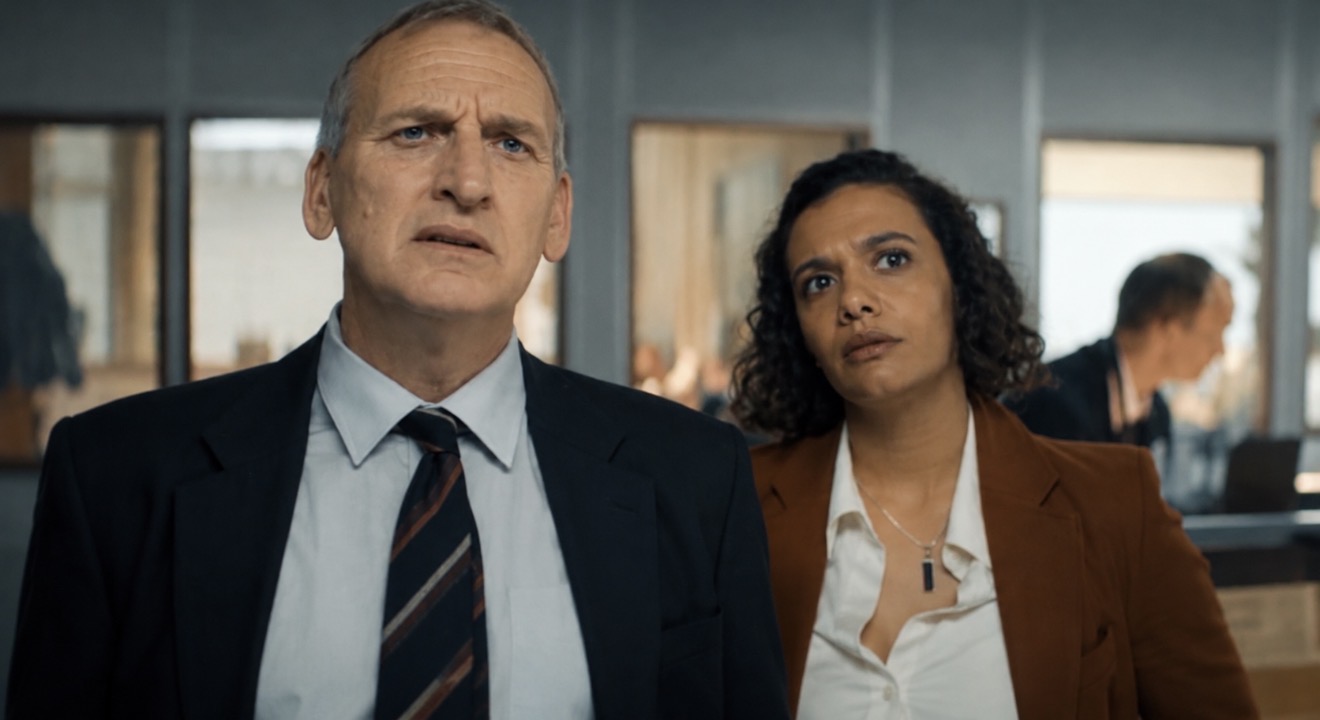
The story follows veteran Belfast detective Crayford, played by Christopher Eccleston, and ambitious Australian police officer Diana, played by Madeleine Madden, as they become involved in the investigation of the huge bank robbery.
|
Chasing Millions |
Details |
|
Genre |
Comedy, Crime, Drama |
|
Runtime |
100 minutes |
|
Christopher Eccleston |
Crayford |
|
Madeleine Madden |
Diana |
|
Director |
Stephen Burke |
|
Writers |
Stephen Burke and Katherine Thomson |
|
Producers |
Jane Doolan and Michael Wrenn |
|
Composer |
Jim Moginie |
|
Production |
Irish-Australian co-production |
The film is written and directed by Stephen Burke, with Australian playwright and screenwriter Katherine Thomson also credited as a writer.
Its Australian connection is central rather than incidental.
Madeleine Madden brings an Australian perspective
Madden plays Diana, an Australian police officer with Aboriginal and Irish heritage who becomes caught up in the investigation while also trying to trace her own Irish family.
It is a role with some interesting parallels to Madden’s own background.
The Sydney-born actor has both Aboriginal and Irish heritage and is the granddaughter of prominent Aboriginal activist Charles Perkins, who played a major role in Australia’s civil rights movement.
Speaking to The Age, Madden reflected on the responsibility she feels towards that family history and the influence her grandfather’s legacy continues to have on her.
She also spoke about discovering similarities between Australian and Irish humour while making the film.
That cultural overlap is important because Chasing Millions is not being presented as a conventional dark crime thriller.
There is comedy running through the story.
For Madden, that presented a different challenge as a performer, particularly because comedy can be unforgiving when the timing does not work.
Christopher Eccleston leads the Belfast investigation
Opposite Madden is veteran British actor Christopher Eccleston.
Eccleston plays Crayford, the experienced Belfast detective investigating the robbery alongside Diana.
The pairing gives the film its central dynamic: an established local detective and a younger Australian officer approaching an extraordinary crime from different perspectives.
Eccleston is known internationally for a long career across television and film, including Doctor Who, The Leftovers and numerous British productions.
The filmmakers use that experience alongside Madden’s Australian character to give the Belfast story a distinctly Irish-Australian identity.
Australian music is part of the film too
Another familiar Australian name is involved behind the scenes.
The soundtrack was composed by Jim Moginie, best known as a founding member, guitarist and keyboard player of Midnight Oil.
His involvement strengthens the Australian side of a production already built around connections between the two countries.
The film is produced by Jane Doolan and Michael Wrenn, with cinematography by Owen McPolin and editing by Chris Plummer.
Australian premiere in October
Chasing Millions will open the 2026 Irish Film Festival Australia, becoming the first official Irish-Australian feature co-production to open the festival.
Its Australian premiere will take place in Sydney on 8 October, before travelling through several cities.
|
City |
Festival screening |
|
Sydney |
8 October |
|
Brisbane |
16 October |
|
Melbourne |
22 October |
|
Perth |
30 October |
|
Canberra |
6 November |
The Canberra screening also coincides with celebrations marking 80 years of diplomatic relations between Ireland and Australia.
A wider Australian cinema release is scheduled to follow in November.
Why this story still works more than 20 years later
There is something particularly compelling about crimes where the known facts already sound fictional.
The Northern Bank robbery has almost every ingredient filmmakers normally have to invent: hostages, insiders being forced to cooperate, an underground vault, huge quantities of cash, an elaborate disguise and an escape that left investigators with questions lasting decades.
Then there is the setting.
While millions were being quietly removed from a Belfast bank, ordinary people outside were preparing for Christmas.
That contrast makes the story even stranger.
But perhaps the biggest reason it continues to fascinate is the simplest one.
More than two decades later, one of the biggest bank robberies in British and Irish history remains unsolved.
Webfit News perspective
For audiences in New Zealand, Chasing Millions is interesting for reasons beyond the scale of the robbery.
New Zealand regularly receives Australian, British and Irish film and television productions, and many Kiwi households have family and cultural connections stretching across Australia, Ireland and the United Kingdom.
The film is also a reminder of how increasingly international screen storytelling has become.
An extraordinary crime committed in Belfast, involving a bank then owned by an Australian financial institution, has now been transformed into an Irish-Australian production led by performers from different cultural backgrounds.
There is also a broader reason true-crime stories such as this continue to attract audiences.
People are often fascinated not simply by the amount of money stolen, but by the unanswered question at the centre of the story: how could something this enormous happen and still leave so much unresolved?
That question survived the robbery.
More than 20 years later, it is now helping drive the story onto cinema screens.
Source credit: This article draws on original reporting by Garry Maddox for The Age, published 21 September 2026, with film and screening details independently checked against the Irish Film Festival Australia programme. Additional context, structure and New Zealand perspective by Webfit News.