
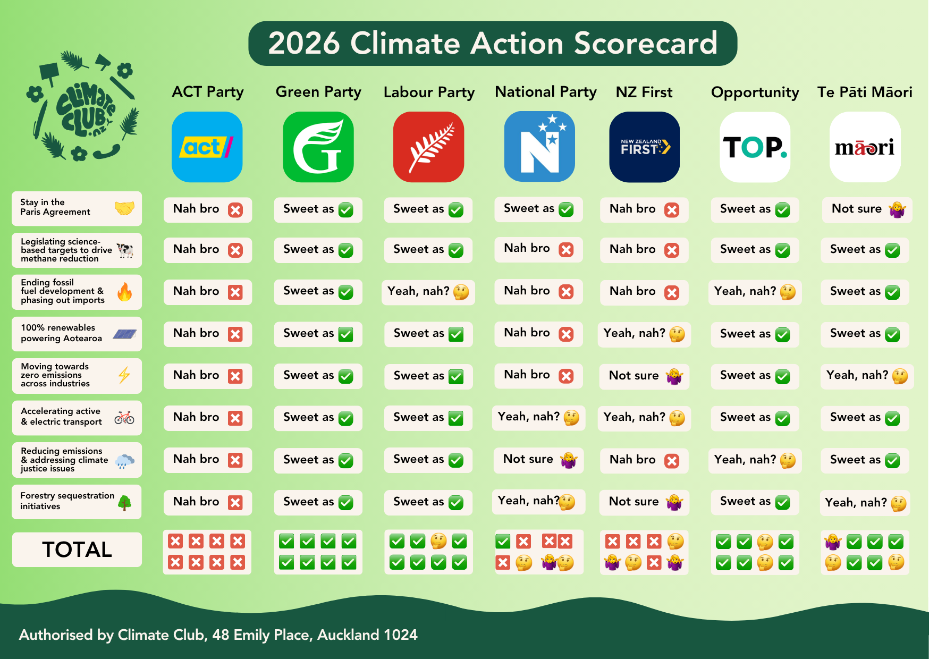
Advocacy group Climate Club Aotearoa has published a scorecard assessing where New Zealand's seven main political parties stand on climate policy ahead of November's General Election, rating each against eight specific climate policy areas.
The scorecard, released this week, benchmarks party positions against what Climate Club says is needed to meet New Zealand's Paris Agreement obligations, keeping global warming to 1.5°C, or well below 2°C.
How the Assessment Was Put Together
According to Climate Club, ratings were compiled using a mix of sources: public statements from each party, direct responses to the organisation's requests for comment, each party's past track record on delivery, and, where current policy wasn't available, previous policy positions.
The group has said the scorecard will be updated as parties announce new policies in the lead-up to the election.
The Eight Areas Assessed
Each party was rated across the following categories:
- Staying in the Paris Agreement
- Legislating science-based targets to drive methane reduction
- Ending fossil fuel development and phasing out imports
- 100% renewables powering Aotearoa
- Moving towards zero emissions across industries
- Accelerating active and electric transport
- Reducing emissions and addressing climate justice issues
- Forestry sequestration initiatives
A Snapshot of the Results
According to Climate Club's assessment, the Green Party and Labour scored consistently well across most categories, while ACT scored negatively across all eight. Results for National, NZ First, Te Pāti Māori and The Opportunities Party (TOP) were more mixed, with several "uncertain" or partial ratings alongside clearer positions in specific areas.
It's worth being clear about what this scorecard actually represents: it is one advocacy organisation's assessment, based on its own methodology and its own benchmark of what "meeting Paris Agreement obligations" requires. Parties may dispute individual ratings, particularly where Climate Club has drawn on past policy or track record rather than a current, explicitly stated position. Climate Club itself has invited feedback and says it will revise scores as parties clarify or announce new policy.
Why This Matters Ahead of the Election
Climate policy has become one of several contested issues in this year's campaign, alongside immigration, tax and cost of living. Scorecards like this one are a common tool used by advocacy groups during election periods to help voters compare party positions on a single issue at a glance, though they inevitably reflect the priorities and framework of the organisation producing them rather than a neutral, universally agreed standard.
Readers wanting to see the full breakdown, including exactly how each party was assessed on each of the eight categories, can view the complete scorecard on Climate Club's website.
What Happens Next
With the scorecard set to be updated as the campaign progresses, it's likely we'll see revised ratings if parties release new climate policy detail before polling day on 7 November. Voters interested in climate policy specifically may find it a useful starting point for comparison, alongside checking each party's own published policy directly.
This article is based on a scorecard and media release issued by Climate Club Aotearoa.