
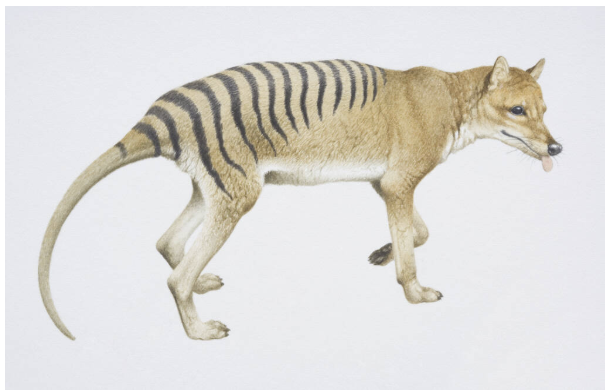
The Tasmanian tiger may have been badly named in more ways than one.
Despite its striped back and fearsome reputation, new biomechanics research suggests the extinct thylacine probably hunted more like a fox, jackal or coyote than a tiger or wolf.
The University of the Sunshine Coast-led study compared the movement of 48 living and extinct predatory mammal species and found the thylacine was most consistent with what researchers describe as an “opportunistic pouncer”.
Rather than overpowering prey through prolonged grappling or relying on long-distance pursuit, the animal likely used short bursts of movement, timing and surprise.
That changes the way scientists understand one of Australia’s most famous extinct predators.
What the researchers found
The study examined posture, movement and locomotion across dozens of carnivorous mammals, using archival footage and modern biomechanical analysis.
Researchers then grouped the animals into five broad hunting styles, ranging from social pursuit hunters to predators that grappled with prey or pounced opportunistically.
Associate Professor Christofer Clemente said the thylacine’s movement patterns placed it closer to foxes, jackals and coyotes than to large grappling predators.
“It was fascinating to find the Tasmanian tiger was more likely an opportunistic pouncer, similar to a fox, jackal or coyote, rather than a grappler like a tiger or a wolf,” he said.
That finding matters because the thylacine has long been interpreted through its appearance.
Its stripes helped give rise to the name “Tasmanian tiger”.
Its dog-like body also led to comparisons with wolves and other canids.
But the new research suggests appearance alone does not tell the full story.
A predator built for bursts, not battles
The thylacine was a carnivorous marsupial that once lived across Australia and New Guinea before surviving into modern times only in Tasmania.
It preyed on animals including wallabies, possums and rodents.
The species became extinct in the 20th century, with the last known captive thylacine dying in Hobart Zoo in 1936.
Because no living animals remain, scientists have had to reconstruct its behaviour from museum specimens, historical descriptions, photographs and archival film.
This study adds another layer by focusing on how the animal actually moved.
The researchers found that hunting ecology was reflected particularly clearly in faster, high-performance movements used for acceleration, manoeuvring and prey capture.
In the thylacine’s case, those movements fit a predator that likely relied on short, opportunistic attacks.
That is very different from a predator such as a wolf, which can chase prey over distance, or a big cat that may use strength and forelimb control to grapple with larger animals.
How do you study the movement of an extinct animal?
That is one of the more interesting parts of the research.
The team used archival footage of animals and tracked anatomical markers through their stride.
According to lead author Dr Joshua Gaschk, the technique allowed researchers to analyse animal locomotion in four dimensions, through space and time.
The approach tracked how the forelimbs, hind limbs, spine and head changed position throughout natural movement.
“What made this technique so powerful was that we were able to track animal movement in 4D, through both space and time,” Gaschk said.
That allowed the researchers to compare not simply whether animals walked or ran similarly, but how their entire bodies changed shape and posture throughout each gait.
Why movement can reveal hunting strategy
At first glance, walking and hunting may seem like separate things.
But a predator’s body is shaped by what it needs to do.
A species that chases prey over long distances faces different biomechanical demands from one that ambushes, pounces or grapples.
A pursuit hunter benefits from endurance and efficient forward movement.
A pouncing predator needs acceleration, agility and control over short distances.
A grappling predator may need strength and stability to restrain prey.
The study found that these ecological differences can be detected in locomotion.
Clemente said faster gaits were particularly informative because they are closely linked with the moments when predators accelerate, turn and capture prey.
Walking patterns, by contrast, were more strongly influenced by evolutionary history.
Even so, the researchers found that walking still contained clues about hunting behaviour.
The thylacine’s walk also pointed to pouncing
One of the more striking findings was that the thylacine’s ordinary walking movement also aligned most consistently with opportunistic pouncers.
That means the conclusion was not based on a single dramatic burst of movement captured on old film.
The broader mechanics of the animal’s locomotion pointed in the same direction.
According to Clemente, the animal appeared less like a highly specialised pursuit hunter and more like a predator that would take advantage of nearby prey with sudden, efficient attacks.
That could fit well with an animal hunting smaller and medium-sized marsupials in environments where cover and surprise were useful.
Why the fox comparison is important
Calling the thylacine fox-like does not mean it was biologically similar to a fox.
The two animals are from completely different evolutionary lineages.
The thylacine was a marsupial.
Foxes are placental mammals.
What the study highlights is what scientists call convergent evolution.
Different animals can evolve similar functional solutions when they face similar ecological problems.
If two predators rely on short bursts, manoeuvrability and opportunistic prey capture, their movement patterns may begin to resemble one another even if they are not closely related.
The thylacine therefore provides another example of how evolution can produce similar behaviour and biomechanics in very different branches of the mammalian family tree.
The name may have shaped public perception
The research also serves as a reminder of how common names can influence the way people imagine extinct animals.
“Tasmanian tiger” suggests a powerful cat-like hunter.
“Thylacine” does not carry the same mental image.
The animal’s striped body certainly made the tiger comparison understandable.
But the new evidence suggests its hunting behaviour was likely much less tiger-like than the name implies.
Its body shape may have been more dog-like.
Its hunting strategy may have been more fox-like.
And biologically, it belonged to neither group.
That makes the thylacine a particularly unusual predator.
What the study says about extinct animal research
The significance of the work goes beyond the thylacine.
Researchers often face a major problem when studying extinct animals: bones can reveal anatomy, but behaviour is much harder to reconstruct.
Historical footage provides a rare opportunity.
When enough movement can be captured and analysed, scientists can begin asking functional questions.
How did an extinct animal move?
How quickly could it accelerate?
How did it turn?
Was its body suited to pursuit, pouncing or grappling?
By comparing extinct species with living ones, researchers can then infer likely behaviour.
This approach may become increasingly useful as biomechanics, computer vision and motion-tracking methods improve.
The research may also help living species
Clemente said the techniques developed for the study could have applications beyond understanding extinct animals.
They may also help conservationists study endangered species that are difficult to observe in the wild.
If movement patterns reveal how an animal hunts or uses its environment, researchers may be able to better understand what kinds of habitat and prey it needs.
That could improve conservation planning.
The same approach might also help identify whether captive or threatened animals are moving normally, adapting to changing environments or experiencing physical limitations.
In that sense, the thylacine research is not only about looking backwards.
It may also help researchers protect species that still have a chance of survival.
A more complicated predator than its nickname suggests
The Tasmanian tiger has become one of the most recognisable symbols of extinction in the Southern Hemisphere.
Its image appears in museums, documentaries, conservation campaigns and debates over de-extinction.
But the animal itself is still being understood.
This latest research suggests one of the most basic assumptions about it may have been wrong.
The thylacine probably did not hunt like a tiger.
It may not have behaved much like a wolf either.
Instead, it appears to have occupied a more agile, opportunistic niche, using short bursts of movement to seize opportunities when prey came within range.
That does not make the animal less formidable.
It makes it more interesting.
The thylacine may have looked like something assembled from several different predators, but its movement tells a clearer story.
It was a uniquely Australian marsupial hunter that appears to have solved the problem of catching prey in much the same way as a fox.
Source: University of the Sunshine Coast research published in BMC Ecology and Evolution.