
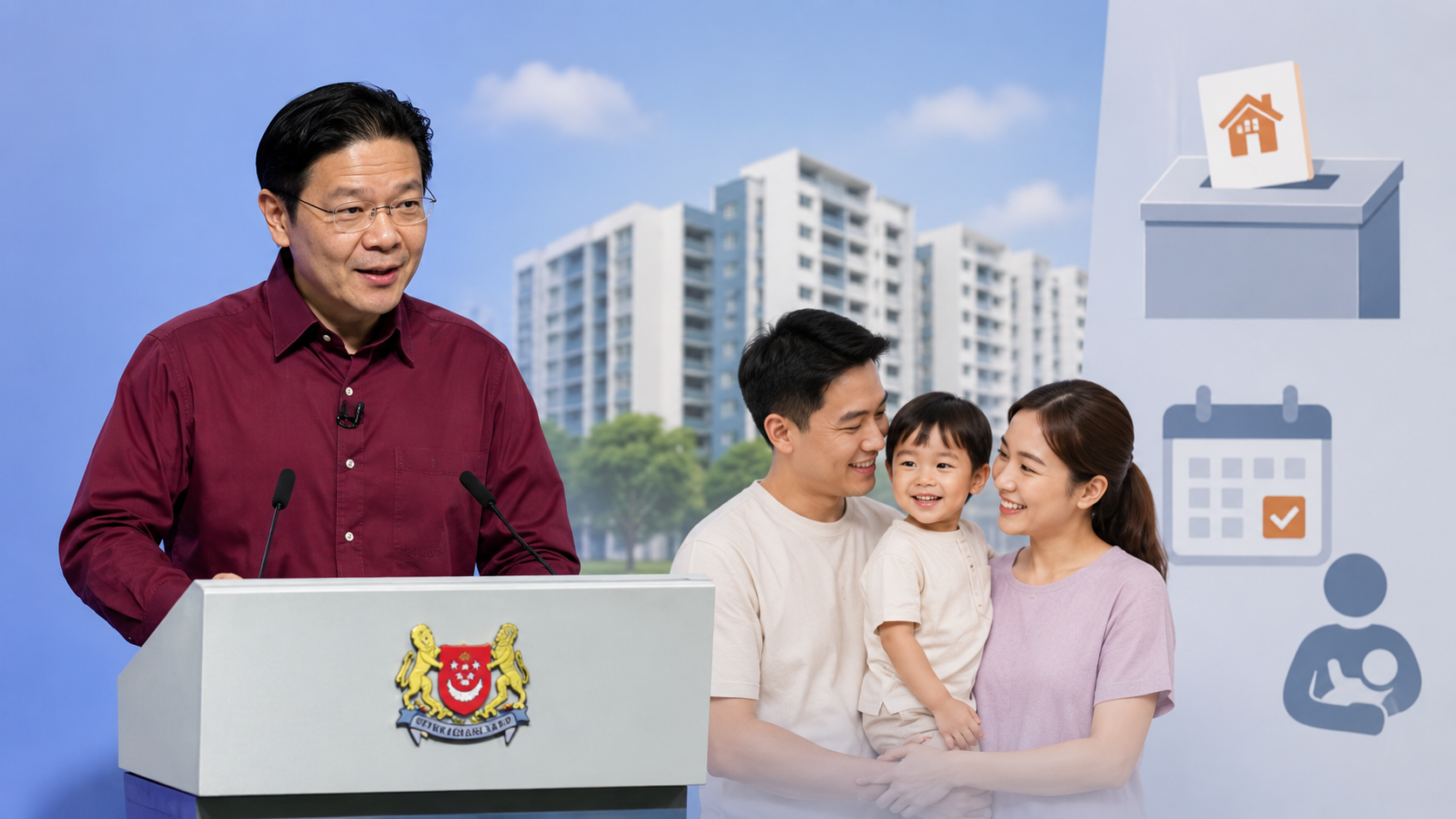
Singapore has unveiled one of its most substantial packages of family and housing measures in recent years, raising income limits for subsidised public housing and giving working parents more childcare leave as the Government tries to make raising children easier and home ownership accessible to a wider group of households.
Prime Minister Lawrence Wong announced the changes during Singapore’s National Day Rally, with some of the housing measures already taking effect this week.
The changes come as Singapore confronts a long-term demographic challenge, with young couples marrying later, household incomes rising and the country’s fertility rate remaining exceptionally low.
For Singaporeans living overseas, including those in New Zealand, the announcements are significant because they show how aggressively the city-state is reshaping housing, childcare and family support around a new generation of parents.
BTO income ceiling rises to S$16,000
One of the most immediate changes is to Singapore’s Build-To-Order public housing system.
The monthly household income ceiling for eligible households seeking subsidised HDB flats has increased from S$14,000 to S$16,000.
For eligible singles aged 35 and above, the income ceiling has risen from S$7,000 to S$8,000.
The limit for purchasing a new Executive Condominium has also increased, from S$16,000 to S$18,000.
The revised HDB limits apply to people applying for an HDB Flat Eligibility letter from 24 August 2026.
The Executive Condominium limit applies to new units on eligible sites with land sale tender closing dates from 24 August.
The policy responds to a practical problem created by Singapore’s own economic development.
As people marry later and progress further in their careers before buying a home, more couples have been crossing the existing income thresholds and losing access to subsidised housing even though they may still face significant housing costs.
Wong said the Government wanted the vast majority of Singaporean couples to continue having access to public housing.
Families with children get more chances for a flat
Singapore is also changing the BTO ballot system to give families with children greater priority.
From the February 2027 sales exercise, first-time families will receive an additional ballot chance for every child they have or are expecting.
That means a family expecting its first child will receive additional priority, while families with two or three children will receive progressively more ballot chances.
The policy represents a clear attempt to connect housing availability with the Government’s wider effort to encourage marriage and parenthood.
Housing has long been central to Singapore’s family policy, but the latest change makes the connection even more explicit.
The message is that couples who are starting or expanding a family should have a better chance of securing a home sooner.
Childcare leave to rise sharply
Housing is only one part of the package.
Working parents will also receive more statutory childcare leave, with the amount tied to how many children aged 12 or below they have.
Under the new arrangement, each working parent will receive:
| Children aged 12 and below | Childcare leave per working parent |
|---|---|
| One child | 8 days a year |
| Two children | 10 days a year |
| Three or more children | 12 days a year |
The change is particularly significant for parents of primary-school-aged children.
Under the existing system, leave entitlement falls considerably once a child passes the age of six.
The Government’s new approach recognises that childcare responsibilities do not end when children start primary school.
Wong gave the example of a working couple with three primary-school children.
Under the current arrangement, the couple together could receive just four days of childcare leave. Under the new system, they would receive 24 days between them.
There is another important change for employers.
The Singapore Government will cover the cost of all statutory child-related leave up to the applicable reimbursement limit.
That is designed to reduce the financial burden on companies while making it easier for parents to take the leave to which they are entitled.
Singapore’s 2026 family changes at a glance
| Measure | New position |
|---|---|
| BTO household income ceiling | S$16,000 a month |
| Eligible singles HDB income ceiling | S$8,000 a month |
| New Executive Condominium ceiling | S$18,000 a month |
| Childcare leave, one child | 8 days per parent |
| Childcare leave, two children | 10 days per parent |
| Childcare leave, three or more children | 12 days per parent |
| BTO priority for first-time families | Extra ballot chance for every child or pregnancy |
| Government-paid child support | Almost S$70,000 in direct support over childhood under the wider announced package |
Bigger change in how Singapore supports families
The latest measures are part of a broader shift in Singapore’s family policy.
Instead of concentrating most Government assistance around the birth of a baby, the country plans to spread support across more of a child’s upbringing.
Every Singaporean newborn under the new approach is expected to receive a S$10,000 Baby Gift, a S$5,000 MediSave grant and Child Development Account support.
Children are also expected to receive annual credits through their growing years and a later contribution towards post-secondary education.
Taken together, Wong said direct financial support for each Singaporean child would approach S$70,000 over the first 17 years.
Preschool costs are also targeted for substantial reductions, with the Government aiming eventually to bring full-day childcare at supported centres down to about S$150 a month and infant care to S$300.
Why this matters beyond Singapore
For Singaporeans living in New Zealand, Australia and other countries, these policies are worth watching because they show the choices Singapore is making in response to falling birth rates and the pressures faced by young families.
Housing, childcare costs, time away from work and the financial cost of raising children are challenges across many developed countries.
Singapore’s response is increasingly direct: subsidise housing, reduce childcare costs, provide more paid caregiving time and give families financial support over a much longer period.
Whether those policies ultimately persuade more couples to have children remains uncertain.
The Government itself has acknowledged that decisions about parenthood are deeply personal and cannot be determined by policy alone.
But Singapore is clearly making the financial equation easier.
For a country worried about an ageing population and an extremely low fertility rate, that represents more than another round of benefits.
It is becoming a long-term demographic strategy.
Sources: Prime Minister’s Office Singapore, Housing and Development Board, National Day Rally 2026, The Straits Times and CNA.