By Webfit News Desk | Auckland
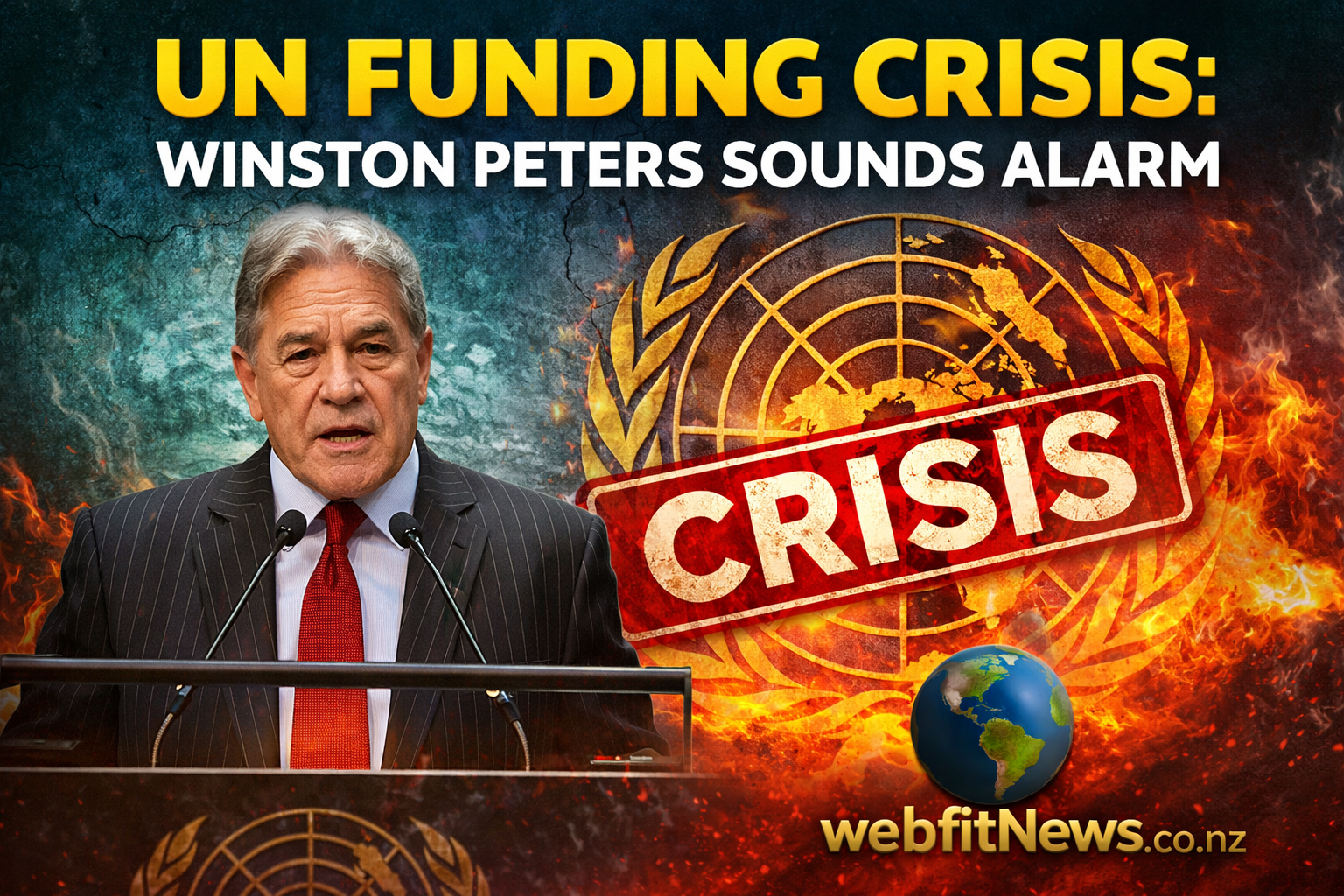
New Zealand’s Foreign Minister Winston Peters has issued a blunt warning to the international community, calling on United Nations member states to meet their financial obligations as the organisation confronts one of the most serious funding shortfalls in its history.
Speaking as concerns mount within diplomatic circles, Peters said the UN risks operational paralysis unless countries that are behind on their payments “pull their weight” and pay what they owe.
His comments come as the United Nations confirms it is heading towards the end of the year with unpaid contributions exceeding US$2.7 billion, placing core peacekeeping, humanitarian, and development work under severe strain.
A Funding Crisis Years in the Making
The United Nations operates on a system of assessed contributions, with each member state required to pay a share based on its economic capacity. In theory, the model spreads responsibility fairly. In practice, it has become increasingly fragile.
UN Secretary-General António Guterres has acknowledged that chronic late payments and arrears are now threatening the organisation’s ability to function day to day.
According to UN figures:
- Total unpaid dues now exceed US$2.7 billion
- The proposed 2026 UN budget has been cut to US$5.579 billion
- That represents a reduction of nearly US$1 billion compared with 2025
The impact of these cuts would be significant.
Internal planning documents show:
- Staff numbers could be reduced by almost 19 percent
- Special political missions may be cut by more than 21 percent
- Peacekeeping and mediation efforts would face serious constraints
For an organisation already stretched by conflicts in Ukraine, Gaza, Sudan, and beyond, the timing could not be worse.
New Zealand’s Position: Pay Up or Risk Collapse
From Wellington’s perspective, this is not an abstract budget problem.
New Zealand relies on a functioning UN system to amplify its voice on global issues, from climate change and nuclear disarmament to Pacific security and humanitarian law.
Peters’ message reflects a long-standing Kiwi frustration that countries willing to criticise the UN are often the same ones failing to fund it properly.
In diplomatic language, his warning was firm but unmistakable: global cooperation cannot survive on goodwill alone.
For a country like New Zealand, which consistently pays its dues on time despite its small size, the situation raises questions of fairness and credibility.
Why the UN’s Finances Matter to New Zealanders
For many Kiwis, UN funding debates can feel distant. In reality, the consequences land closer to home than many realise.
UN-backed programmes help support:
- Disaster response in the Pacific
- Refugee protection and resettlement
- International law enforcement cooperation
- Climate adaptation funding for vulnerable nations
If the UN is forced to scale back, smaller countries like New Zealand lose an essential platform for collective action and influence.
The alternative is a world increasingly shaped by raw power, where rules matter less and small nations matter even less.
Who Is Not Paying
While the UN does not publicly shame individual countries in detail, it is widely known that several large member states are among those with substantial arrears.
Political disagreements, domestic budget pressures, and strategic withholding of funds have all contributed to the growing shortfall.
The result is an organisation forced to delay payments to staff, freeze hiring, and contemplate cuts that undermine its core mission.
For Peters, this is not just poor management. It is a test of international responsibility.
A Moment of Reckoning for Global Cooperation
The funding crisis has also sparked a broader debate about whether the UN’s current model is sustainable.
Some critics argue the organisation has grown too large and inefficient. Others counter that chronic underfunding has made reform nearly impossible.
What is clear is that without reliable funding, even the best-designed institutions struggle to deliver results.
As Peters’ comments underline, the UN cannot function if member states treat contributions as optional.
The Bigger Picture
New Zealand’s stance reflects a wider concern among mid-sized and smaller nations that the global system is fraying.
At a time when wars are intensifying and climate pressures are rising, the world’s primary multilateral body is being asked to do more with less.
That contradiction, Peters suggests, is no longer sustainable.
Webfit News Perspective
At WebfitNews.co.nz, we see this moment as more than a budget dispute. It is a reminder that international institutions only work when countries choose cooperation over convenience.
For New Zealand, supporting a strong and credible United Nations is not charity. It is self-interest grounded in fairness, stability, and rules that apply to everyone.
Whether the world listens now may determine how effective global diplomacy remains in the years ahead.
Published by WebfitNews.co.nz
Explaining the story, not the noise.