
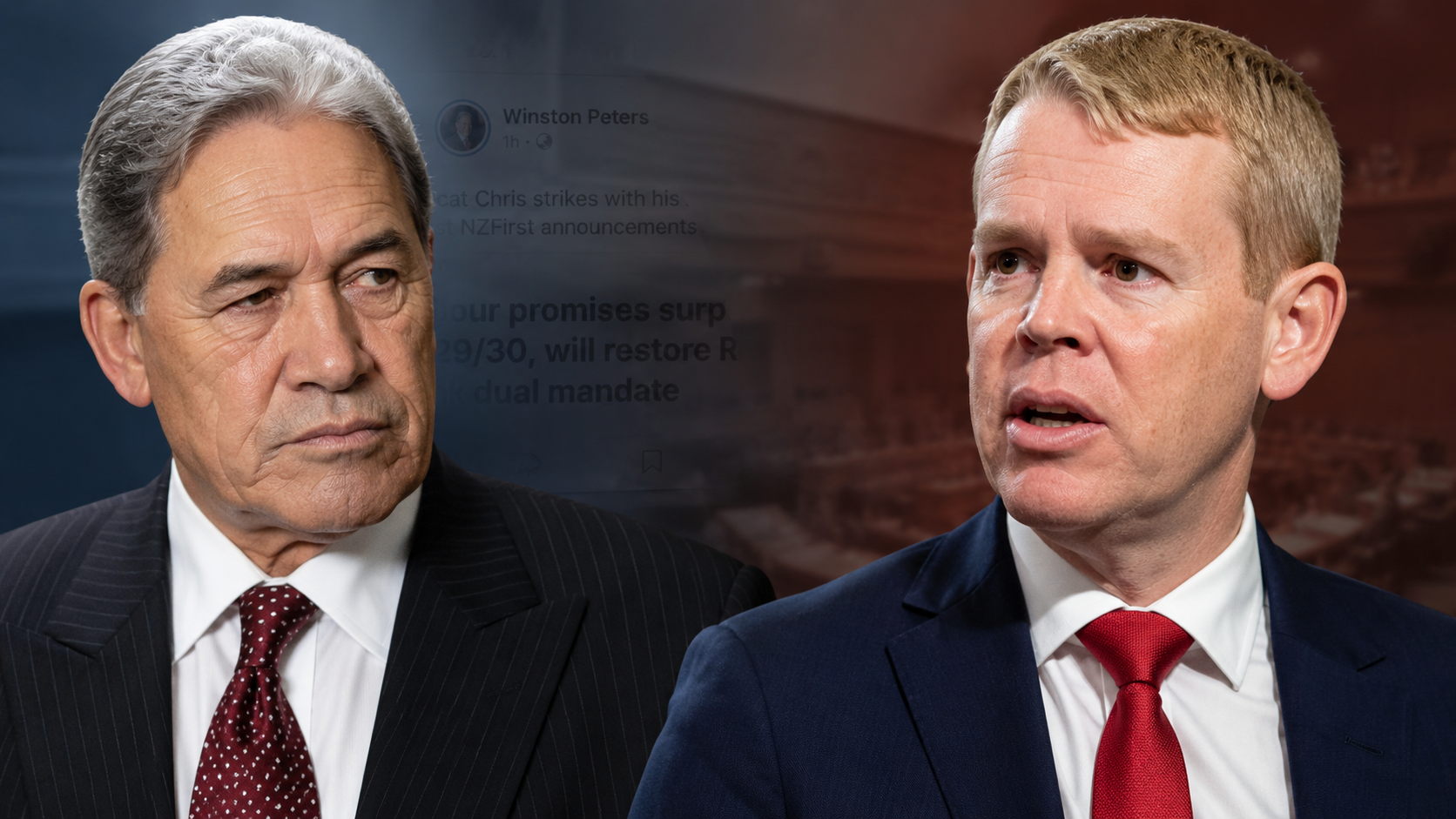
Winston Peters has accused Labour leader Chris Hipkins of copying New Zealand First after Labour announced plans to restore an employment objective to the Reserve Bank and return the Government books to surplus by 2029/30.
The accusation makes for a sharp political attack.
But the history behind it is far less simple.
Labour and New Zealand First were actually partners in the Government that introduced the Reserve Bank’s dual mandate after the 2017 election. NZ First later voted with National and ACT to remove that employment objective in 2023, and Peters is now campaigning to bring it back.
Labour wants to bring it back too.
So is Hipkins copying Peters?
On the recent political timeline, Peters has a point.
On the longer historical record, both parties can claim ownership.
What Labour is proposing
Labour’s new fiscal strategy, presented by Hipkins and finance spokesperson Barbara Edmonds, includes several major commitments.
The party says it would:
- return the Government books to surplus by 2029/30
- reduce net debt over time
- restore maximum sustainable employment as a Reserve Bank objective
- establish an independent Parliamentary Budget Office
- restore wellbeing reporting requirements
- keep Crown spending and revenue controlled over the longer term
Hipkins’ argument is that New Zealand cannot simply cut public services in the hope that economic growth follows.
Labour instead says its approach would combine controlled spending, economic growth and additional revenue.
That is where the ideological difference with National starts to become clearer.
Why Peters says Labour is copying NZ First
Peters has been publicly advocating a return of the Reserve Bank employment mandate.
In July, he said removing it had been one of the political compromises NZ First accepted during coalition negotiations with National and ACT.
He has indicated that restoring it could become an issue in future coalition negotiations.
Then Labour announced that it wanted essentially the same change.
From Peters’ perspective, the political sequence is straightforward.
He raised the issue publicly.
Labour followed with a formal policy.
That gives him enough material for the “copycat Chris” attack.
But it does not tell the full story.
Labour and NZ First have both been here before
The dual mandate was introduced by the Labour-NZ First Government.
It required the Reserve Bank to consider both price stability and maximum sustainable employment when setting monetary policy.
That framework took effect in 2019.
The current National-led Government removed employment as a primary Reserve Bank objective in 2023, returning the Bank to a stronger single focus on price stability.
NZ First MPs voted for that change as members of the governing coalition.
That produces an unusual timeline:
Labour and NZ First helped create the dual mandate.
National, ACT and NZ First removed it.
NZ First now wants it restored.
Labour wants it restored too.
Calling Labour a copycat therefore works better as political theatre than as a complete account of the policy’s history.
What does a dual mandate actually mean?
The Reserve Bank’s job is currently centred on keeping inflation under control.
Its inflation target is 1 to 3 percent over the medium term.
When inflation becomes too high, the Reserve Bank can raise the Official Cash Rate.
Higher interest rates usually reduce borrowing, spending and investment.
That can bring inflation down.
But there is a cost.
Higher rates can also weaken hiring, slow businesses and increase unemployment.
A dual mandate formally requires the Reserve Bank to consider employment as well as inflation.
It does not mean ignoring inflation to create jobs.
It means recognising that monetary policy can affect both prices and people’s employment.
Why this argument matters now
The timing is important because New Zealand is facing problems on both fronts.
Annual inflation reached 4.1 percent in the June 2026 quarter, above the Reserve Bank’s target range.
Unemployment has also climbed to 5.6 percent.
Around 171,000 people were unemployed, while the broader underutilisation rate reached 13.8 percent.
That creates a difficult policy environment.
Raise interest rates too aggressively and unemployment could worsen.
Ease too quickly and inflation could remain too high.
That tension is exactly why Labour and Peters say employment should have a formal place in Reserve Bank decision-making.
National’s counterargument is equally simple.
If inflation is above target, the Reserve Bank should have one clear primary responsibility: getting prices under control.
Labour’s other big promise: surplus by 2029/30
Labour has also promised to return the Government books to surplus by 2029/30.
But this is not dramatically earlier than the existing fiscal track.
Treasury currently forecasts the Government’s preferred OBEGALx measure returning to surplus in 2028/29.
Labour proposes using the traditional OBEGAL measure instead.
That distinction matters because the two measures are not exactly the same.
So a simple claim that National reaches surplus in 2028/29 while Labour reaches it in 2029/30 does not give voters the whole picture.
The bigger issue for Labour is how it will get there.
Its fiscal strategy establishes the destination, but voters will still need to see how election spending, tax changes, debt and capital investment fit together.
Where each party is strongest and weakest
| Party | Strongest argument | Biggest weakness |
|---|---|---|
| Labour | High unemployment strengthens the case for employment being considered in monetary policy | Full fiscal costings still need to show how all promises fit together |
| National | Inflation is above target, supporting the case for a clear Reserve Bank focus on price stability | Unemployment remains high and the fiscal recovery has taken longer than originally hoped |
| NZ First | Peters publicly pushed restoration of the employment mandate before Labour’s latest announcement | NZ First also voted to remove that mandate in 2023 |
So who has the stronger argument?
On recent political timing, Peters can legitimately say he was loudly pushing this issue before Labour’s latest announcement.
But he cannot convincingly claim that Labour has simply stolen an idea belonging exclusively to NZ First.
Labour has a long history with the dual mandate and helped introduce it.
NZ First helped introduce it too.
Then NZ First helped remove it.
The argument is therefore less about who invented the idea and more about whether restoring it is the right decision for New Zealand now.
That is where voters should focus.
The real election choice
Behind the “copycat” insult are three different economic philosophies.
Labour is arguing that employment, public services and fiscal repair need to be balanced.
National wants the Reserve Bank firmly focused on inflation while Government spending remains constrained.
NZ First is positioning itself as more interventionist, arguing that employment and wider national economic interests deserve greater weight.
The numbers facing whoever governs after the election are uncomfortable.
Inflation is 4.1 percent.
Unemployment is 5.6 percent.
The Government is still running substantial deficits.
Debt remains elevated.
Those problems will not be solved by a Facebook nickname.
Peters may have won attention with “copycat Chris”.
The much harder question is which party can turn its economic argument into numbers that actually work.
Source: Labour fiscal policy announcements, New Zealand First statements, Reserve Bank of New Zealand, Stats NZ, New Zealand Parliament and Treasury Budget 2026 data.