
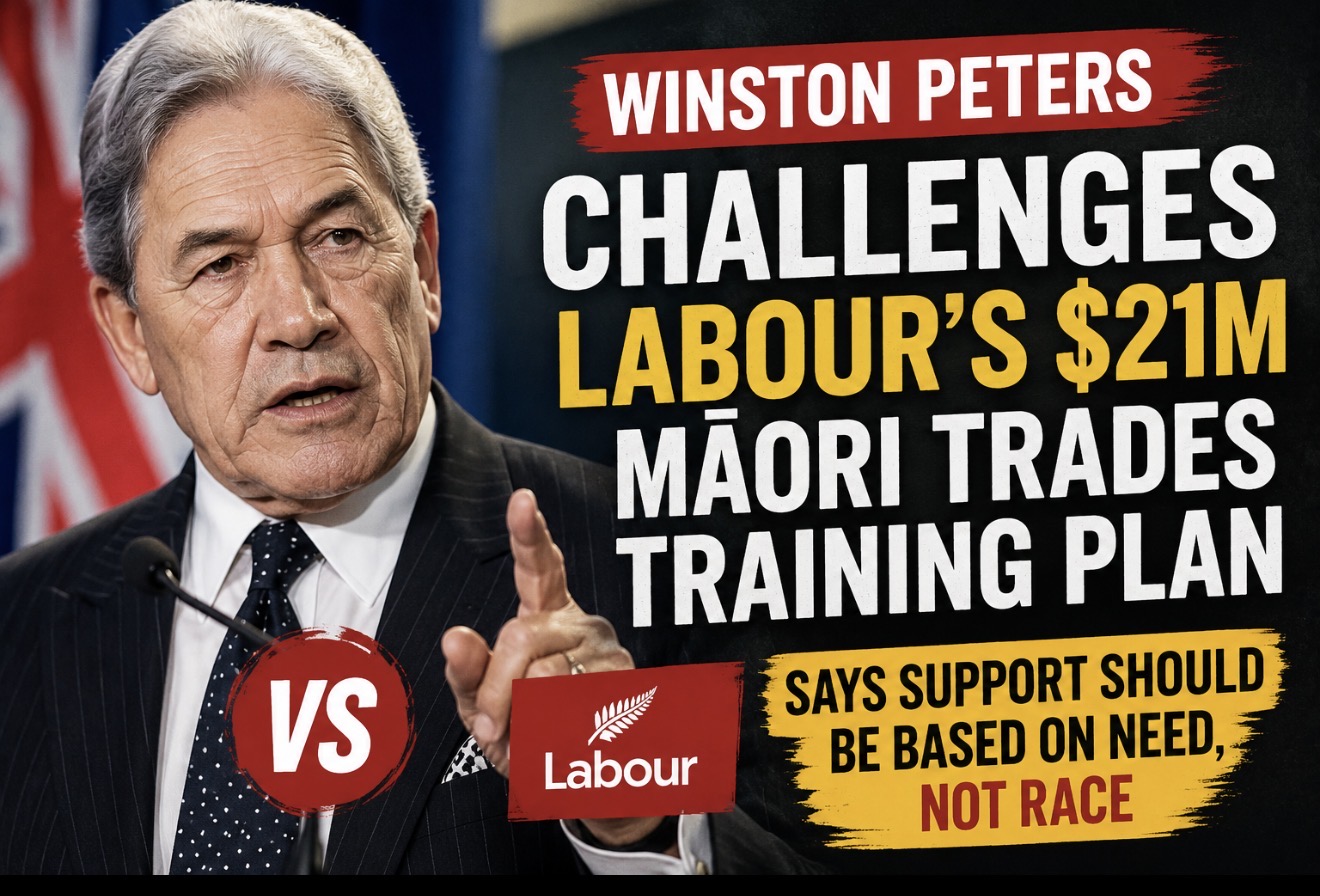
New Zealand First leader Winston Peters has launched a direct attack on Labour’s newly announced $21 million-a-year Māori-led trades training policy, arguing that government-funded skills programmes should be available to all struggling New Zealanders rather than targeted by ethnicity.
Peters responded on social media shortly after Labour promoted its plan to fund kaupapa Māori training through marae, iwi trusts and Māori providers.
He questioned why assistance should be restricted to Māori and argued that trades training should instead be directed towards anyone who needs help getting the skills required for employment.
The intervention has quickly turned Labour’s employment announcement into a wider election debate about one of the most contested questions in New Zealand politics: should government programmes target groups experiencing worse outcomes, or should assistance be allocated purely according to individual need?
What Winston Peters said
In his response, Peters accused Labour of returning to what he described as race-based politics.
He wrote that Labour was joining the Greens, Te Pāti Māori and The Opportunities Party in what he called a “separatist race to the bottom”.
Peters then challenged the central premise of Labour’s announcement, asking why funding should be specifically directed towards Māori who are struggling rather than all New Zealanders who are struggling.
He argued that funding for trades training should focus on every New Zealander who needs skills and training to enter employment.
Peters said Māori ultimately want the same basic opportunities as other New Zealanders trying to find work, improve their qualifications or build a better future.
His conclusion was consistent with a long-standing New Zealand First position that social and economic policy should be based on need rather than ethnicity.
Labour’s policy
Labour announced this weekend that it would invest $21 million each year in Māori-led employment and trades training if it forms the next government.
The proposal would establish a contestable fund allowing Māori providers, including marae and iwi trusts, to develop training programmes in partnership with local employers.
Labour says the programme could support up to 3,000 Māori and would be available to people of all ages.
Training could cover industries ranging from construction, electrical work and plumbing to agriculture, forestry, healthcare and personal services.
Labour says participants would receive practical training as well as mentoring and additional support aimed at helping them complete qualifications, enter employment and stay in work.
The party argues that Māori-specific delivery is justified because Māori unemployment remains substantially above the national rate and because previous Māori-led programmes have produced strong employment outcomes.
Labour’s official policy says 72 percent of 2,978 participants in the previous programme were in work by September 2024, with nearly three-quarters of those workers in permanent employment.
Labour leader Chris Hipkins has also said that among people who completed the previous programme, 81 percent entered employment and 76 percent achieved a training outcome.
The programme would cost $21 million annually and Labour says it would be funded through reprioritisation and existing government spending baselines from Budget 2027.
Peters is challenging the targeting, not trades training itself
An important distinction in Peters’ criticism is that he is not arguing against spending money on vocational or trades education.
His objection is to selecting recipients on the basis of ethnicity.
That position is consistent with New Zealand First’s broader policy philosophy.
In its 2026 State of the Nation speech, New Zealand First described itself as supporting a “colourblind state” and said New Zealanders should be treated equally regardless of race, culture or background.
Peters has made similar arguments for years.
In an earlier speech on government policy, he said New Zealand First supported programmes based on need rather than race, arguing that disadvantage can affect people from every ethnic community.
His latest response to Labour therefore represents an established political position rather than a new argument created specifically for this policy.
New Zealand First also backs substantial trades funding
The debate becomes more complicated because New Zealand First itself supports major government spending on vocational education.
The party highlighted several employment and training initiatives secured through Budget 2026.
These included $69 million to double Trades Academy places from 10,000 to 20,000 and $87 million for another 1,000 Youth Guarantee places.
The Youth Guarantee programme targets young people with low or no qualifications, while the expanded Trades Academy places provide practical training opportunities for Year 11 to Year 13 students.
New Zealand First said its objective was to ensure young people had the education and skills required to move into employment.
That creates a clearer dividing line between the parties.
Both Labour and New Zealand First support government investment in skills and employment programmes.
The disagreement is primarily over how those programmes should be targeted and delivered.
Labour argues Māori face a specific disadvantage
Labour’s counterargument rests heavily on employment outcomes.
Māori unemployment remains significantly higher than the overall New Zealand unemployment rate.
Labour says that gap provides justification for a targeted programme and argues that Māori organisations can often provide culturally appropriate mentoring and support that helps participants remain engaged with training.
The party is also presenting the programme as more than simply paying course fees.
Its model would allow Māori providers to design programmes around the needs of local employers, while providing participants with practical support during their transition into work.
In Labour’s view, treating everyone identically does not necessarily produce equal outcomes when different groups face different barriers.
Peters rejects that policy logic, arguing that governments should identify the people experiencing disadvantage and assist them regardless of their ethnicity.
That is the fundamental political disagreement now emerging.
A wider argument about equality versus targeted support
There are effectively two competing principles behind the debate.
Labour’s approach says that where measurable disparities exist, targeted intervention can be justified to close those gaps.
New Zealand First’s approach says government support should follow economic or social need and that ethnicity should not determine eligibility.
Both approaches lead to difficult questions.
If assistance is based entirely on financial or employment need, will Māori who face additional cultural, geographic or historical barriers receive sufficient support?
But if funding is specifically reserved for one ethnic group, what happens to another unemployed New Zealander experiencing the same financial hardship and struggling to access training?
Those are legitimate policy questions, and reducing the discussion to accusations from either side would miss the substance of the argument.
Existing Māori training adds another layer
There is also an important practical point.
New Zealand already operates Māori and Pasifika Trades Training through the Tertiary Education Commission.
That programme provides fees-free pre-trades training and helps participants move into employment, apprenticeships or further education.
Labour is therefore proposing an expansion and different delivery model rather than introducing Māori-focused trades training for the first time.
Its proposal would create a separate contestable fund with more programme design controlled by Māori organisations and would remove the upper age restriction associated with parts of the existing system.
This means voters will ultimately need to compare not only the philosophy behind the competing positions, but also their effectiveness.
The question that matters is what produces better results
Political language around race is likely to become increasingly sharp as the election approaches.
But there is a more practical test available.
How many people complete the training?
How many obtain recognised qualifications?
How many move into employment?
How many are still working a year later?
And how much does each successful employment outcome cost taxpayers?
Labour now has to demonstrate that specifically Māori-led delivery produces outcomes strong enough to justify targeted funding.
Peters and New Zealand First face the opposite challenge.
If programmes are funded purely according to need, they need to demonstrate that such a system can close the substantial employment gap experienced by Māori without targeted intervention.
That is a much more useful debate than simply deciding which political slogan sounds better.
Labour’s announcement began as a policy about trades training.
Within hours, Winston Peters had turned it into something much larger: a debate about how New Zealand defines fairness, equality and need.
With the general election approaching, it is unlikely to be the last time voters hear that argument.