
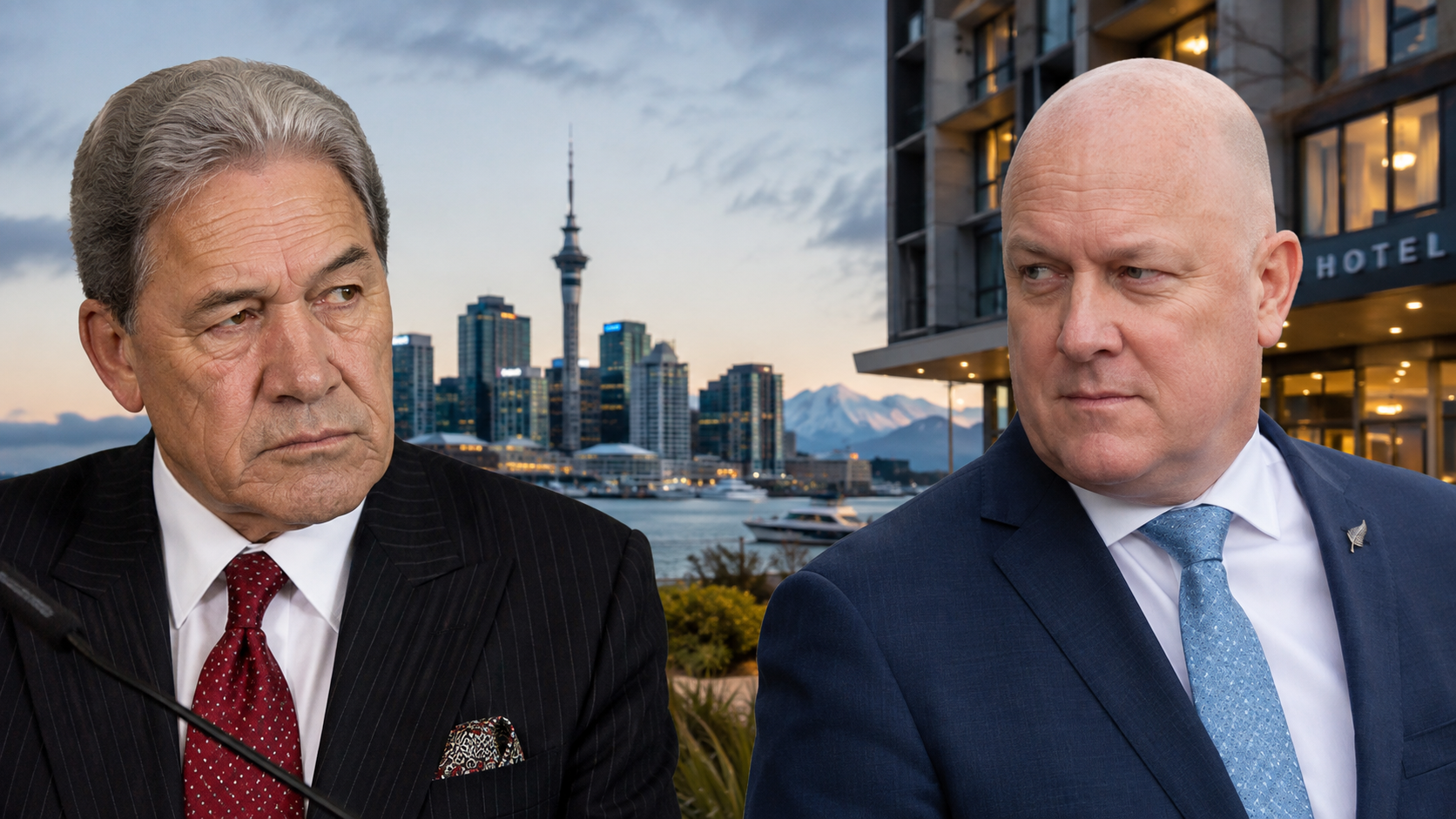
New Zealand First leader Winston Peters says proposed bed levies for Auckland and Queenstown remain Government policy, despite National ruling out introducing a bed tax if it is re-elected.
Peters said the coalition Government had already agreed to consider visitor levies in 2027 as part of regional deals, and that National could not simply treat that commitment as if it no longer existed.
RNZ first reported Peters’ comments on Tuesday.
“The signed deal with Auckland states that these levies will be considered by the Government in 2027. Nothing has changed,” Peters said.
He said the agreement had been made by the coalition Government, rather than the National Party alone.
“If other parties want to campaign on reneging on the deal to even consider the levy, that’s up to them. But in NZ First we believe a deal is a deal.”
National has ruled out a bed tax as part of its “no new taxes” position ahead of the election.
The move has frustrated Auckland Mayor Wayne Brown and leaders in Queenstown, where councils have been seeking new ways to fund infrastructure used heavily by visitors.
Brown said the Auckland Regional Deal would be undermined if the Government did not honour its commitment to explore the proposal.
“The deal is meaningless if the Government cannot honour even a relatively modest commitment to explore an agreed proposal,” he said.
Peters also accused Prime Minister Christopher Luxon of going back on a commitment made on behalf of the Government.
“When he made that statement, he was talking on behalf of the Government, and we’re going to make sure the Government keeps its word,” Peters said.
| Key player | Current position | Key data point / commitment |
|---|---|---|
| New Zealand First | Says bed levies remain Government policy for consideration | Auckland deal says levies are to be considered in 2027 |
| National | Rules out a bed tax if re-elected | Part of its “no new taxes” election position |
| ACT | Opposes the levy | Says it was never going to support a new tax |
| Labour | Attacks Luxon over the signed agreement | Argues the Prime Minister’s signature is on the deal |
| Auckland Council | Wants the proposal explored | Visitor levy was included as an option in the Auckland Regional Deal |
| Queenstown | Supports greater visitor contribution | Council concern centres on tourism-related infrastructure pressure |
| International visitor model | Supported in principle by Peters | He wants overseas visitors targeted rather than New Zealand domestic travellers |
| Existing precedent | Differential charging has been used before | DOC trialled different Great Walk pricing for international visitors from 2018 to 2020 |
“The National Party may not keep theirs, but we’re keeping ours.”
New Zealand First’s preference is for any levy to apply to international visitors and help pay for tourism infrastructure.
Peters said he believed a system could be designed so New Zealanders were not charged.
He compared the idea with places where domestic and international visitors can face different charges.
National, however, remains concerned that New Zealanders could end up paying more when travelling within the country.
Finance spokesperson Nicola Willis said the Government had agreed to explore a bed tax, but National had concluded there were problems with the proposal and other options should be considered.
“We don’t think it’s viable to make every Kiwi pay more for their holiday,” Willis said.
She said National would announce other policies aimed at supporting councils in areas with high tourism demand.
The issue has also drawn Labour into the dispute.
Labour leader Chris Hipkins said Luxon had signed the Auckland agreement as Prime Minister and questioned what the disagreement meant for the credibility of Government commitments.
“If the mayors across the country can’t trust Christopher Luxon’s signature, why should any New Zealanders?” Hipkins said.
ACT leader David Seymour said it was technically correct that the Government had not yet ruled out considering a bed tax, but ACT remained opposed to introducing new taxes.
He said National had changed its position.
“We were never going to agree to it, but the National Party was going to support it. Now they’re not, and I think that’s great,” Seymour said.
Infrastructure Minister Chris Bishop also acknowledged there was “a bit of friction” between what the Government had previously signed up to and what National was now saying.
The debate comes as councils in tourism-heavy areas continue to push for ways to make visitors contribute more directly towards infrastructure costs.
The Department of Conservation has previously trialled differential pricing for Great Walks, and the Government has also looked at charging overseas visitors at high-use conservation sites while keeping access free for New Zealanders.
No bed levy has yet been introduced.
Under the Auckland agreement, the proposal was to be considered in 2027.
Peters says that commitment still stands.
Source credit: RNZ first reported the latest comments from Winston Peters and the coalition disagreement on 25 August 2026.