
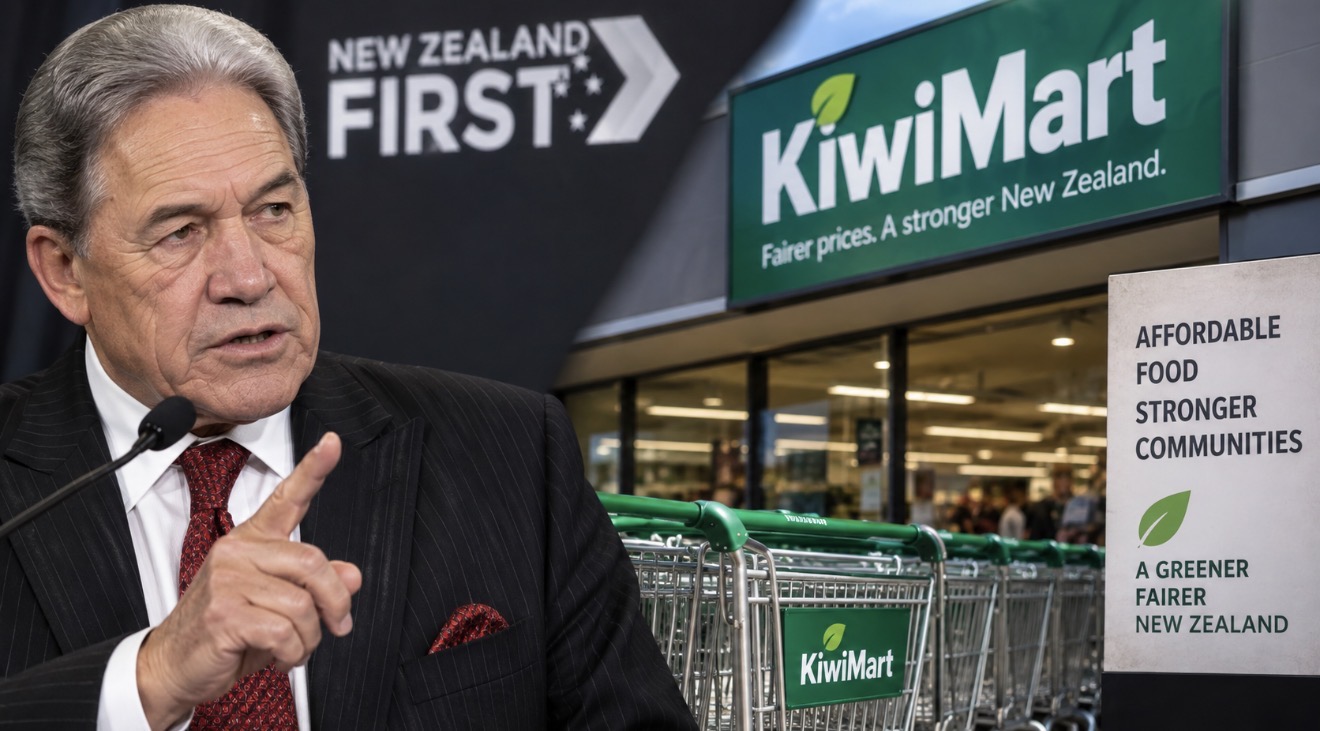
NZ First leader Winston Peters has launched a fierce attack on the Green Party’s proposal to create a publicly owned supermarket chain, comparing the plan with communism and warning it would lead New Zealand down the wrong economic path. But behind the political language is a genuine debate over a grocery market the Commerce Commission says still lacks strong competition.
Auckland, 7 September 2026: New Zealand’s election campaign has taken another sharp turn after NZ First leader Winston Peters attacked the Green Party’s newly announced KiwiMart supermarket policy.
In a social media post promoted by New Zealand First, Peters described the Greens’ proposal to bring 120 existing supermarkets into public ownership as “textbook communism by stealth”.
He also accused the Greens of having “gone full Mamdani”, a reference to New York politician Zohran Mamdani, and claimed supermarket queues could become “kilometres long”, invoking Venezuela as a warning.
Peters then targeted Green Party co-leader Chlöe Swarbrick personally over her economic credentials and her ambitions for a senior economic portfolio.
The comments are among the strongest political reactions so far to a policy that could fundamentally reshape New Zealand’s supermarket sector.
But what exactly are the Greens proposing, and does Peters’ description match the policy?
What is KiwiMart?
The Green Party announced its Affordable Kai policy on Sunday, 6 September.
At its centre is KiwiMart, a proposed publicly owned supermarket chain designed to compete directly with Foodstuffs and Woolworths.
Under the proposal, at least 120 existing supermarket stores, along with distribution centre capacity, would be transferred into public ownership through a divestment process.
The Greens estimate around $1.3 billion would be required to acquire 120 stores and two distribution centres, with another $1.5 billion to capitalise the new business.
That puts the estimated initial investment at approximately $2.8 billion.
The Greens say KiwiMart would operate as a commercially viable and self-sustaining supermarket business, but unlike conventional supermarket operators, it would have an explicit mandate to prioritise affordability.
The party has compared the concept with Kiwibank, arguing that a publicly owned competitor could put pressure on existing supermarket operators while remaining a commercial enterprise.
Would the Government simply seize supermarkets?
This is one area where the political rhetoric needs some context.
The Greens are proposing compulsory divestment, meaning Foodstuffs and Woolworths would be required to sell stores and distribution capacity selected for the new competitor.
However, the policy does not say those assets would simply be confiscated without payment.
The Greens say the Commerce Commission would work with the existing supermarket groups to determine which stores should be divested, taking local market share into account, and determine fair compensation.
That distinction is important.
Compelling a private business to sell assets to the state is a major government intervention in the market and would almost certainly be controversial.
But it is not the same thing as taking businesses without compensation.
Why are the Greens proposing such a dramatic intervention?
Because New Zealand’s grocery competition problem is real.
This is not simply a claim made by the Green Party.
The Commerce Commission’s latest annual grocery report, released in June, found that the major supermarkets continued to control more than 80 percent of the national grocery retail market.
The Commission said margins and profitability were relatively flat but retail prices had increased, and significant improvements in competition had yet to emerge.
It has also identified problems for smaller competitors trying to obtain groceries at competitive wholesale prices.
In July, the Commission said rebates, discounts and other payments between suppliers and major supermarkets could reinforce the competitive advantage of the dominant chains.
The regulator identified more than 50 different types of supplier payments accounting for around $6 billion annually.
The Commission’s concern is that major supermarket groups can use their enormous purchasing scale to secure terms that smaller competitors cannot match.
So while politicians disagree dramatically over the solution, there is strong regulatory evidence that New Zealand’s supermarket sector has a competition problem.
Is Peters right to call it ‘communism’?
That is political characterisation rather than an objective description of the policy.
KiwiMart would involve substantial state ownership and intervention in a private market.
But the Greens are proposing that KiwiMart operate commercially alongside privately owned supermarkets, not that the Government take ownership of New Zealand’s entire food production and retail system.
Foodstuffs, Woolworths and other private retailers would continue operating.
New Zealand also already has commercially operating entities with significant or complete government ownership.
Whether KiwiMart represents sensible public investment or excessive government intervention is a legitimate political argument.
Calling it “communism”, however, is Peters’ political assessment of the proposal rather than a neutral economic classification.
What about the Venezuela comparison?
Peters’ warning about kilometre-long queues and Venezuela is also political rhetoric rather than a demonstrated consequence of the KiwiMart proposal.
Venezuela experienced severe food shortages and economic disruption during a much broader economic crisis involving inflation, currency collapse, extensive price controls, falling oil revenue, political instability and other factors.
There is currently no evidence demonstrating that establishing one publicly owned supermarket competitor in New Zealand would itself produce Venezuela-style shortages or queues.
That does not mean KiwiMart is guaranteed to work.
It means the comparison does not establish whether this particular proposal would succeed or fail.
The more useful questions are whether KiwiMart could operate efficiently, whether $2.8 billion is a realistic establishment cost, whether compulsory divestment could survive legal and commercial challenges, and whether the new competitor would actually reduce grocery prices.
The biggest unanswered question: how much cheaper would groceries become?
This is where the Greens also face scrutiny.
The policy promises greater competition and affordability, but it does not provide a simple figure showing what an average Kiwi household could expect to save on its weekly grocery bill.
That is a significant limitation.
Spending approximately $2.8 billion of public capital would be a substantial intervention.
Voters therefore have every right to ask what measurable return they would receive.
Would a $250 weekly grocery shop become $240?
Would it become $220?
Or would prices remain broadly similar while KiwiMart simply becomes another supermarket operator?
Those questions cannot yet be answered confidently from the policy information released.
KiwiMart is only one part of the Greens’ plan
The supermarket chain is the headline-grabbing component, but the Affordable Kai policy goes much further.
The Greens also want to ban what they describe as supermarket price gouging, strengthen the Commerce Commission, increase penalties for anti-competitive conduct and introduce a mandatory supermarket pricing accuracy code.
Under that proposal, shoppers who are overcharged could receive automatic compensation.
The party also wants a $150 million-a-year Fair Food Fund, increased support for food banks, higher Work and Income food grant limits and expanded school lunch provision.
Taken together, the wider Affordable Kai programme would involve billions of dollars of government spending over several years.
Why this debate matters beyond Peters versus Swarbrick
It would be easy for the argument to become another election fight between Winston Peters and Chlöe Swarbrick.
The bigger issue is more important.
Successive governments have struggled to create significantly stronger supermarket competition.
The Commerce Commission’s June 2026 assessment found the