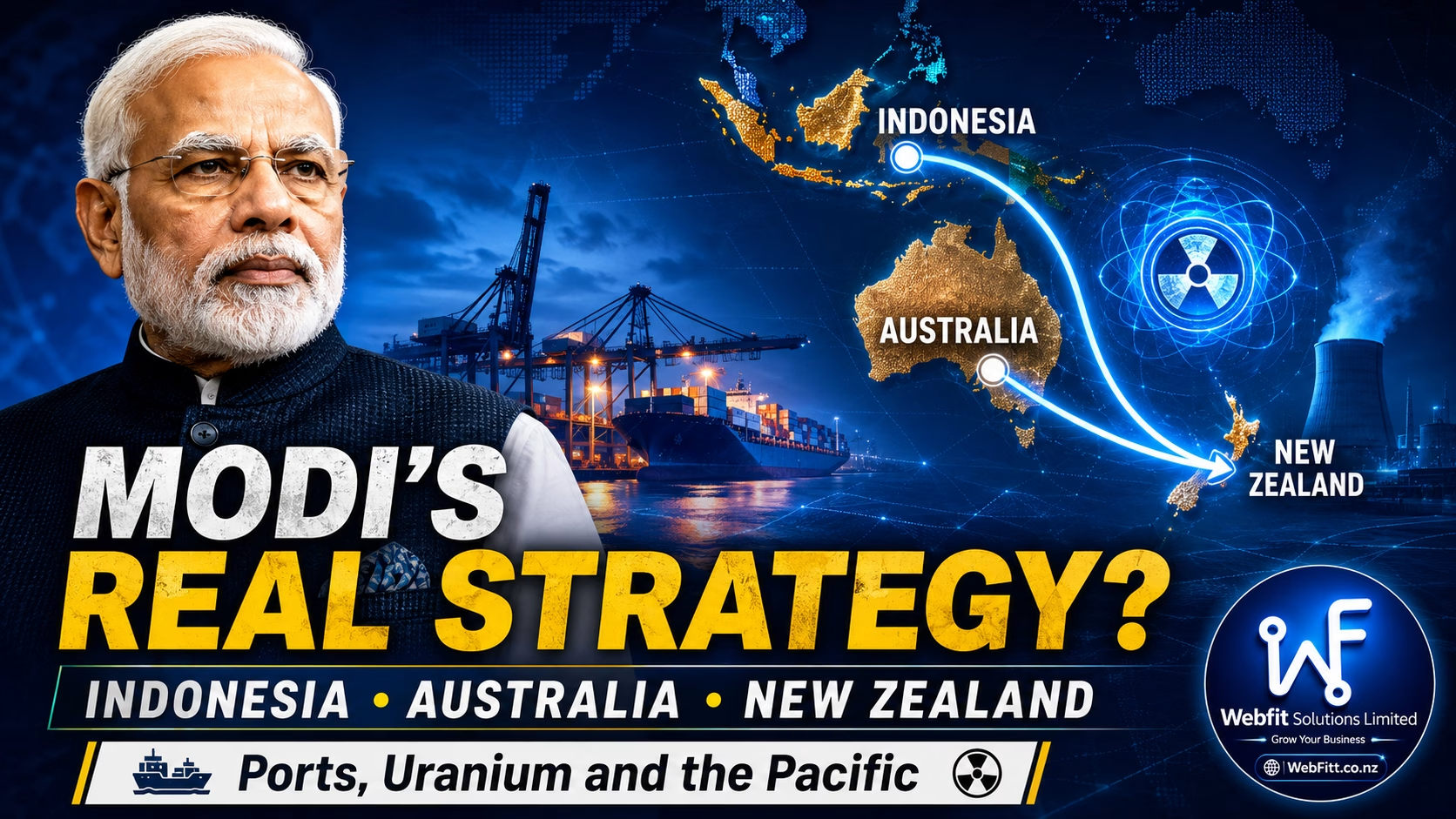
Ports, uranium, maritime security and the Pacific: Webfit News examines the deeper strategic pattern behind Prime Minister Narendra Modi’s six-day journey across the Indo-Pacific.
By Webfit News | Analysis
Prime Minister Narendra Modi’s visit to Indonesia, Australia and New Zealand from 6 to 11 July 2026 produced dozens of headlines.
In Indonesia, the focus was on defence, maritime cooperation and Sabang Port.
In Australia, one of the biggest announcements was an agreement enabling Australian uranium exports to India for peaceful nuclear energy use.
Then, in New Zealand, India and New Zealand elevated their relationship to a Strategic Partnership, backed by a Roadmap to 2030 and new maritime cooperation between their defence forces.
Most of these developments were reported separately.
But was there a bigger strategic logic behind the sequence of the three countries?
Was Modi simply attending three bilateral meetings conveniently arranged into one overseas tour?
Or did the route from Indonesia to Australia and then New Zealand reflect India’s larger strategic priorities in the Indo-Pacific?
After examining official joint statements, government briefings, energy policy documents and the agreements announced during the tour, Webfit News found no evidence of a secret plan linking every announcement into one classified strategy.
However, the official documents reveal something arguably more important.
The three visits repeatedly return to the same strategic themes: maritime security, freedom of navigation, secure energy supplies, critical minerals, resilient supply chains and a stronger Indian role across the Indo-Pacific.
And there is one crucial piece of evidence.
Before leaving India on 6 July, Modi himself connected the three-country journey to India’s wider regional strategy.
Referring specifically to Indonesia and Australia in the eastern and southern Indian Ocean, followed by New Zealand, Modi said the visit would strengthen India’s Act East Policy, its MAHASAGAR vision and its outlook towards a free and open Indo-Pacific.
That statement is significant.
It means the three countries should not be viewed only as isolated diplomatic stops.
India itself placed the journey inside a broader Indo-Pacific framework.
Modi Promises New Era in India-New Zealand Relations During Major Auckland Address – WebfitNews
First Stop: Why Indonesia Matters to India’s Maritime Strategy
Modi began his visit in Indonesia from 6 to 8 July.
Indonesia is one of the most important countries in India’s eastern maritime environment.
The reason is geography.
Indonesia sits across sea routes connecting the Indian and Pacific oceans. The Strait of Malacca is one of the world’s most important maritime shipping corridors, connecting the Andaman Sea and Indian Ocean with the South China Sea and wider Pacific.
For a growing economic power such as India, commercial access through these waters has direct implications for trade, shipping and national security.
This is where Sabang enters the story.
Sabang is located in Indonesia’s Aceh province, close to the northern approaches of the Strait of Malacca and facing the Andaman Sea.
But an important correction is necessary.
Some social media commentary following Modi’s visit claimed that India had suddenly “secured access to Sabang Port” during the July 2026 trip.
The official record does not support that simplified claim.
India-Indonesia cooperation involving Sabang is not new.
In May 2018, the two countries adopted a Shared Vision of India-Indonesia Maritime Cooperation in the Indo-Pacific.
That document specifically referred to improving connectivity between Sabang Island and India’s Andaman and Nicobar Islands, including Port Blair.
The two countries have continued working on Aceh and Andaman and Nicobar connectivity since then.
During Modi’s July 2026 visit, the issue of Sabang was again discussed.
An Indian Ministry of External Affairs briefing confirmed that the two sides maintained interest in the development of Sabang Port.
Therefore, the verified position is not that India suddenly obtained a new port in Indonesia.
It is that India and Indonesia renewed and advanced a maritime relationship that has been developing for years.
That distinction matters.
India does not own Sabang Port.
There is also no publicly confirmed agreement turning Sabang into an Indian military base.
Claims presenting the port as an Indian-controlled naval facility go beyond the available official evidence.
What can be confirmed is that Sabang forms part of a longer India-Indonesia maritime connectivity agenda in a strategically important location.
The Indonesia Agreement Goes Far Beyond One Port
Focusing only on Sabang may actually miss the bigger story.
The joint statement issued after Modi’s talks with Indonesian President Prabowo Subianto covers maritime domain awareness, coastal surveillance, information sharing, search and rescue cooperation, naval engagement and broader defence cooperation.
The two sides also supported further engagement through the India-Indonesia-Australia trilateral mechanism.
That trilateral framework is especially important when the next stop on Modi’s journey is considered.
Australia.
In other words, Australia unexpectedly appears inside the official Indonesia document before Modi even reaches Melbourne.
The themes proposed for trilateral cooperation include maritime domain awareness, the blue economy and other regional maritime issues.
Maritime domain awareness may sound like diplomatic language.
In practical terms, it means understanding what is happening at sea.
Which ships are moving through an area?
Where are they travelling?
Are commercial routes secure?
Are there suspicious vessels or illegal activities?
Are countries able to share information during an emergency?
For countries economically dependent on shipping, information about the maritime environment is a strategic asset.
Then the Strait of Hormuz Appears in the Indonesia Statement
There is another detail in the India-Indonesia joint statement that deserves far more attention.
The two leaders discussed escalating tensions in the Middle East.
They stressed the importance of freedom of navigation and transit through the Strait of Hormuz and called for the uninterrupted flow of energy supplies and commerce.
Why is Hormuz being discussed during a meeting between India and Indonesia?
Because the security of maritime trade routes has become an economic issue as much as a military one.
The Strait of Hormuz is one of the world’s most important energy chokepoints.
According to the US Energy Information Administration, oil flows through Hormuz during 2024 and the first quarter of 2025 accounted for more than one-quarter of global seaborne oil trade. About one-fifth of global liquefied natural gas trade also passed through the strait in 2024.
The EIA has also identified India among the major Asian destinations for crude oil and condensate moving through Hormuz.
India has been working to diversify its crude oil supply.
Indian government energy data shows the country expanded its crude sourcing network from 27 countries to 41 countries.
That diversification matters.
But India’s wider dependence on imported crude remains a major economic vulnerability.
A conflict does not need to completely close the Strait of Hormuz to create problems.
Higher insurance premiums, tanker shortages, production disruptions, shipping delays and higher oil prices can all place pressure on an import-dependent economy.
This is where the next stop on Modi’s journey becomes particularly interesting.
From a maritime discussion involving Hormuz, Sabang and secure sea routes, Modi travelled to Australia.
And in Australia, uranium moved to centre stage.
Australia: Why the Uranium Agreement Matters
During the third Australia-India Annual Summit in Melbourne, Modi and Australian Prime Minister Anthony Albanese finalised an administrative arrangement enabling Australian uranium exports to India for peaceful purposes under the Australia-India Nuclear Cooperation Agreement.
The arrangement is subject to nuclear safeguards.
Australia’s own government described the agreement as facilitating uranium exports to India and supporting an increase in India’s non-fossil fuel power capacity.
This was not a small announcement.
According to Geoscience Australia, the country accounts for more than one-third of the world’s known uranium resources.
Australia therefore possesses something India will require in significantly greater quantities if New Delhi succeeds with its nuclear energy ambitions.
India has set a target of reaching 100 gigawatts of nuclear power capacity by 2047.
Official Indian government information published in May 2026 said India’s nuclear capacity was then around 8.8 GW.
The scale of the ambition is obvious.
India is not planning a minor increase.
It is seeking a massive expansion of nuclear generation over the next two decades.
That means reactors.
It means technology.
It means investment.
And it means nuclear fuel.
Australia can potentially become an important part of that fuel supply equation.
Is Australian Uranium India’s Answer to the Strait of Hormuz?
This is where the theory circulating online needs careful examination.
The argument sounds simple.
India imports oil through the Strait of Hormuz.
Conflict can disrupt oil supplies.
Australia has uranium.
India expands nuclear energy.
Therefore, nuclear power replaces India’s dependence on oil passing through Hormuz.
That argument is too simplistic.
Nuclear energy does not directly replace crude oil across the Indian economy.
Petroleum is essential for road transport, aviation, shipping, petrochemicals and several industrial activities.
A nuclear reactor produces electricity.
It does not directly replace aviation fuel in an aircraft or diesel in millions of existing trucks.
Therefore, it would be factually wrong to tell readers that Australian uranium is a simple substitute for oil imported through Hormuz.
But dismissing the energy security connection completely would also miss the wider strategic issue.
India’s electricity demand is rising rapidly.
In July 2026, India’s Power Minister Manohar Lal said peak electricity demand was expected to approach 300 GW in 2027, with growth being driven partly by data centres, artificial intelligence and electric vehicles.
A country facing that level of electricity growth needs a diversified power system.
If more electricity can be generated through nuclear, renewable and domestic energy sources, India’s wider economy becomes less concentrated around fossil fuel dependence.
Electric vehicles can also shift part of transport demand from petroleum to electricity over time.
The transition will take decades.
It will not remove India’s need for crude oil.
But it can change the structure of India’s energy dependence.
This is the more defensible connection between Hormuz and nuclear energy.
The strategic objective is not to find one fuel that replaces another overnight.
It is to ensure that a crisis affecting one route, one supplier or one fuel does not place the entire economy under intolerable pressure.
Nuclear Fuel and Oil Do Not Create the Same Supply Challenge
There is another important difference.
Oil-dependent economies require an enormous and continuous movement of fuel through international supply chains.
Tankers must keep sailing.
Ports must remain open.
Production must continue.
Shipping insurance must remain available.
Nuclear energy also has an international supply chain and serious security requirements.
It is not magically independent of geopolitics.
India will still need secure access to uranium and nuclear technology.
However, nuclear fuel is exceptionally energy dense compared with fossil fuels and is managed through a very different fuel cycle.
The logistical dependence is therefore not identical to the continuous high-volume movement of crude oil.
From a national resilience perspective, building a larger nuclear fleet adds another major source of electricity to India’s energy mix.
And India is not only announcing targets.
It has changed its domestic nuclear policy.
India Has Opened the Nuclear Door to Private Capital
In December 2025, India enacted the Sustainable Harnessing and Advancement of Nuclear Energy for Transforming India Act, commonly referred to as the SHANTI Act.
Official Indian government material says the legislation enables limited private participation in the nuclear sector under regulatory oversight.
The reform is a major change for a sector historically dominated by the Indian state.
The government’s own explanation links nuclear expansion with energy reliability and reducing dependence on fossil fuels.
The private sector has already taken notice.
In June 2026, Reuters reported that Gautam Adani announced an ambition to develop 10 GW of nuclear power capacity by 2035 through Adani Atomic Energy.
Other large Indian companies, including Tata Power and Reliance Industries, have also explored opportunities in nuclear energy.
Now place those confirmed developments side by side.
India wants 100 GW of nuclear capacity by 2047.
India changed its law to permit greater private-sector participation.
Major Indian corporations are examining or announcing nuclear investments.
Australia has more than one-third of the world’s known uranium resources.
And during Modi’s July 2026 visit, Australia and India finalised the administrative arrangement needed to enable safeguarded Australian uranium exports to India.
These are facts.
The interpretation comes next.
Webfit News Analysis: This Looks Like Energy Resilience, Not a Quick Fix
There is no official document stating that Modi travelled to Australia because of the Strait of Hormuz crisis.
Webfit News found no evidence supporting such a direct claim.
The Australia-India nuclear relationship also predates the 2026 visit.
The two countries signed a civil nuclear cooperation agreement in 2014, which entered into force in 2015.
India’s 100 GW nuclear target was also announced before the July tour.
Therefore, it would be misleading to present the uranium agreement as an emergency plan suddenly created because of the latest Middle East conflict.
But strategy is rarely built in one week.
The more credible interpretation is that current geopolitical disruption is reinforcing a vulnerability India already understands.
New Delhi knows that its future economic growth requires enormous quantities of reliable energy.
It also knows that excessive dependence on imported fossil fuels and vulnerable maritime routes creates strategic risk.
India’s answer appears to involve multiple layers.
Diversify oil suppliers.
Expand renewable energy.
Increase domestic energy production.
Invest in nuclear capacity.
Secure access to critical minerals and uranium.
Strengthen maritime partnerships.
Improve awareness and cooperation across important sea routes.
That is not a secret conspiracy.
It is a recognisable national resilience strategy.
The Australia Agreement Was Also About Maritime Security
The uranium announcement attracted attention, but the Australia-India joint statement again returned to the sea.
The two countries agreed on an India-Australia Maritime Security Collaboration Roadmap.
They identified information sharing, capability development, capacity building and operational coordination as areas for cooperation.
Australia’s Maritime Border Command and the Indian Coast Guard also concluded a memorandum of understanding supporting a secure maritime environment.
The two leaders stressed that maritime cooperation was central to their vision for a stable Indo-Pacific.
They also welcomed further cooperation through the Australia-India-Indonesia trilateral mechanism.
There it is again.
Indonesia.
Australia.
Maritime domain awareness.
Supply chains.
Energy security.
This is why the three-country journey becomes more interesting when the official documents are read together instead of separately.
Then Modi Arrived in New Zealand
For New Zealand readers, the final stop deserves closer attention.
Modi arrived in Auckland after completing his Australian visit.
It was the first visit by an Indian Prime Minister to New Zealand in 40 years.
On 11 July, Prime Minister Christopher Luxon and Modi elevated the relationship to a Strategic Partnership and agreed on a Roadmap to 2030.
The economic agenda was significant.
The two governments set a goal of doubling two-way trade by 2030 and placed the recently agreed New Zealand-India Free Trade Agreement at the centre of their commercial relationship.
But the strategic documents also contain a strong maritime component.
India and New Zealand agreed to implement a Maritime Cooperation Arrangement.
They also agreed on cooperation in hydrography and nautical cartography and a Mutual Logistics Support Arrangement focused on the maritime domain.
The Roadmap provides for naval activities, including bilateral naval exercises, under the Maritime Cooperation Arrangement.
Luxon was direct about the reason.
New Zealand’s prosperity and security, he said, depend on a stable and secure Indo-Pacific.
He said the two countries were stepping up practical cooperation at sea and deepening how they work together on maritime security.
For New Zealand, this is an important development.
The India relationship is no longer being discussed only through cricket, education, migration, tourism and trade.
India and New Zealand are creating practical mechanisms for their defence forces to cooperate in the maritime domain.
Why Would India Need New Zealand in This Wider Strategy?
New Zealand is obviously not a uranium supplier comparable to Australia.
It is also not located beside the Strait of Malacca like Indonesia.
So why does Auckland make sense as the third stop in a strategically connected Indo-Pacific tour?
The answer may be the Pacific.
New Zealand is a Pacific country whose security and foreign policy are deeply connected to the region.
India has also been expanding its engagement with Pacific Island countries through the Forum for India-Pacific Islands Cooperation.
Interestingly, the Australia-India joint statement issued during Modi’s Melbourne visit specifically recognised India’s role as a development partner to Pacific Island countries through this framework.
One day later, India and New Zealand announced deeper maritime cooperation.
There is no official evidence that New Zealand is being used as an Indian “gateway to control the Pacific”.
Such a claim would be exaggerated and inconsistent with New Zealand’s independent foreign policy.
But there is clear evidence that India’s Indo-Pacific engagement now reaches further into the Pacific and that New Zealand is prepared to develop a more strategic relationship with India.
For New Delhi, New Zealand offers a democratic partner, commercial opportunities, scientific and agricultural expertise, a large and influential Indian diaspora and closer engagement with a country firmly embedded in the Pacific region.
For Wellington, India offers access to one of the world’s largest and fastest-growing major economies, greater trade diversification and a relationship with an increasingly influential Indo-Pacific power.
Their interests are not identical.
They do not need to be.
Strategic partnerships are often built where national interests overlap.
Was China the Hidden Subject of the Tour?
Any discussion of Indo-Pacific strategy eventually reaches China.
But caution is again necessary.
None of the three visits can honestly be reduced to an “anti-China tour”.
Indonesia has its own independent foreign policy.
Australia has major economic links with China despite serious strategic competition.
New Zealand also maintains an important relationship with Beijing.
India itself has a complex relationship with China involving trade, diplomatic engagement and major security tensions.
However, the Australia-India joint statement explicitly reaffirmed support for an open and rules-based Indo-Pacific.
The leaders stressed freedom of navigation and overflight and opposed destabilising or unilateral action to change the status quo.
India and Indonesia strengthened maritime domain awareness and coastal surveillance cooperation.
India and New Zealand committed to bilateral naval activities and practical maritime security cooperation.
It is reasonable to analyse these developments within a regional environment shaped partly by China’s increasing economic and military weight.
It is not reasonable to claim, without evidence, that every agreement signed during the tour was secretly directed against Beijing.
The distinction between analysis and allegation matters.
Modi’s Own Statement May Be the Biggest Clue
After reviewing the agreements, perhaps the clearest evidence of an overarching strategy is still Modi’s own statement before leaving India.
He did not describe Indonesia, Australia and New Zealand merely as three friendly countries he happened to be visiting consecutively.
He placed Indonesia in the eastern Indian Ocean.
He placed Australia in the southern Indian Ocean.
He then referred to New Zealand.
And he explicitly said the journey would strengthen India’s Act East Policy, MAHASAGAR vision and approach to a free and open Indo-Pacific.
MAHASAGAR stands for Mutual and Holistic Advancement for Security and Growth Across Regions.
It is an evolution of India’s wider maritime approach and reflects New Delhi’s ambition to build security and economic partnerships across a broader geographic space.
When Modi’s statement is compared with the agreements actually produced during the tour, a pattern becomes visible.
Indonesia: Sabang connectivity, maritime domain awareness, coastal surveillance and the India-Indonesia-Australia trilateral.
Australia: uranium, energy security, critical minerals, resilient supply chains and a Maritime Security Collaboration Roadmap.
New Zealand: Strategic Partnership, trade expansion, a Maritime Cooperation Arrangement, maritime logistics cooperation and bilateral naval activities.
This is not proof of a hidden three-step operation.
But neither does it look like three unrelated diplomatic photo opportunities.
The Real Strategy: Reduce Vulnerability Before the Next Crisis
The deeper story may be India’s attempt to reduce strategic vulnerability as its economy grows.
A nation seeking to become one of the world’s largest economic powers faces an uncomfortable reality.
Economic growth creates dependence.
More factories need energy.
More vehicles need fuel or electricity.
More data centres need reliable power.
More international trade requires shipping.
More advanced manufacturing requires critical minerals.
The larger an economy becomes, the more damaging supply disruptions can be.
The Strait of Hormuz crisis demonstrates one vulnerability.
The Malacca Strait represents another globally important maritime chokepoint.
Critical mineral concentration creates another risk.
Rapidly rising electricity demand creates yet another challenge.
India cannot eliminate geography.
It cannot guarantee that future conflicts will never interrupt global trade.
What it can do is build alternatives and partnerships before the next major crisis arrives.
That appears to be the strategic thread connecting much of what happened between 6 and 11 July.
Why This Matters to New Zealand
From Auckland, it is tempting to view Modi’s visit mainly through the New Zealand-India FTA, the Indian diaspora and the huge Kia Ora Modi community event at Spark Arena.
Those were major parts of the visit.
But New Zealanders should also examine where Auckland sat on Modi’s itinerary.
The Indian Prime Minister did not arrive directly from New Delhi.
He came after high-level maritime talks in Indonesia and a summit in Australia that produced new agreements on defence, uranium, critical minerals, energy and supply chains.
Then, in Auckland, New Zealand and India elevated their relationship to a Strategic Partnership and put maritime security into their Roadmap to 2030.
That context matters.
New Zealand is increasingly part of a regional strategic conversation involving the Indian Ocean and Pacific.
The country must make its own decisions based on its own national interests.
But India is clearly signalling that it sees maritime partnerships stretching from Southeast Asia through Australia and into the Pacific as part of its wider Indo-Pacific outlook.
New Zealand has now agreed to deepen its place in that relationship.
Conclusion: Was There a Secret Behind Modi’s Tour?
So, what was the secret behind Modi’s Indonesia, Australia and New Zealand tour?
The honest answer is that Webfit News found no evidence of a secret agreement tying Sabang Port, Australian uranium and New Zealand into one concealed master plan.
India did not suddenly take ownership of Sabang Port.
Australian uranium will not eliminate India’s dependence on crude oil through the Strait of Hormuz.
And New Zealand has not become an Indian military base in the Pacific.
Those claims would be sensational.
They would also go beyond the evidence.
But the verified documents tell a genuinely significant story.
Modi himself linked the three-country route to India’s Act East Policy, MAHASAGAR vision and a free and open Indo-Pacific.
India and Indonesia advanced maritime cooperation near some of the world’s most important sea routes.
The Indonesia and Australia documents both highlighted their trilateral maritime mechanism.
Australia unlocked a pathway for uranium exports as India pursues a 100 GW nuclear target.
India has changed its nuclear laws to allow greater private participation, while major companies are preparing to enter the sector.
Australia and India strengthened cooperation on critical minerals, resilient supply chains and maritime security.
Then India and New Zealand created a Strategic Partnership with practical maritime cooperation, naval activities and a Roadmap to 2030.
The meetings were separate.
The agreements were different.
But the strategic words keep repeating.
Energy security.
Maritime security.
Supply chain resilience.
Critical minerals.
Freedom of navigation.
The Indo-Pacific.
Connect the verified facts, and the larger picture becomes difficult to dismiss.
India appears to be building a wider network of strategic resilience around the economic vulnerabilities that could define the next several decades.
Ports and sea routes matter because trade must move.
Uranium matters because energy demand is rising.
Critical minerals matter because future industries depend on them.
Australia matters because of its resources and strategic weight.
Indonesia matters because of geography and maritime cooperation.
And New Zealand matters because India’s strategic reach is increasingly extending deeper into the Pacific.
Perhaps the real story of Modi’s six-day tour was not hidden at all.
It was written across the official agreements.
You just had to read them together.
References
Prime Minister of India, “PM’s Departure Statement Ahead of His Three Nation Visit to Indonesia, Australia and New Zealand”, 6 July 2026.
Ministry of External Affairs, Government of India, “India-Indonesia Joint Statement on the State Visit by Prime Minister of India to Indonesia”, July 2026.
Ministry of External Affairs, Government of India, “Transcript of Special Briefing on the State Visit of PM Narendra Modi to Indonesia”, July 2026.
Ministry of External Affairs, Government of India, “Shared Vision of India-Indonesia Maritime Cooperation in the Indo-Pacific”, 30 May 2018.
Prime Minister of Australia, “Third Australia-India Annual Summit Joint Statement”, July 2026.
Prime Minister of Australia, “Collaborating with India on Energy and Resources”, July 2026.
Geoscience Australia, “Uranium and Thorium”, Australia’s Energy Commodity Resources 2025.
Press Information Bureau, Government of India, Nuclear Energy Mission and 100 GW Nuclear Capacity Target documents, 2025 and 2026.
Department of Atomic Energy, Government of India, Nuclear Energy Mission statements.
Press Information Bureau, Government of India, SHANTI Act and private participation in nuclear energy documents, December 2025 and March 2026.
US Energy Information Administration, “World Oil Transit Chokepoints” and Strait of Hormuz energy flow analysis.
Petroleum Planning and Analysis Cell, Government of India, India’s Oil and Gas Ready Reckoner 2025-26.
New Zealand Government, “NZ, India Relationship Elevated to Strategic Partnership”, 11 July 2026.
India-New Zealand Joint Statement, 11 July 2026.
India-New Zealand Strategic Partnership: Roadmap to 2030.
Reuters, reporting on Australia-India uranium cooperation, India’s nuclear sector reforms and Adani’s nuclear energy plans, 2025 and 2026.