
Western Bay of Plenty is back in the Government's local government reform process despite its own councillors voting earlier this month not to submit a Head Start proposal.
The change follows a decision by Rotorua Lakes Council to jointly submit an eligible proposal alongside Tauranga City Council under the Government's Simplifying Local Government programme.
That decision means the Government can now consider a wider Bay of Plenty restructuring model that could fundamentally change how councils operate across the region.
If the proposal is approved, Tauranga City Council and Western Bay of Plenty District Council could be replaced by a single new council responsible for both local and regional council functions across the Western Bay sub-region.
For residents, that is the most important part of the announcement.
This is not simply about councils cooperating more closely.
It could eventually mean a different council structure, different boundaries and a new organisation taking responsibility for functions currently spread across separate layers of local government.
What has actually happened?
Western Bay of Plenty District Council councillors voted on 6 August not to submit their own Head Start proposal.
The vote was narrow.
At that point, Western Bay appeared to have stepped away from the early reform process.
But the situation changed after Rotorua Lakes Council decided to participate.
Under the Head Start rules, Rotorua's decision means eligible proposals are now in place that allow the Government to assess a wider Bay of Plenty structure.
So Western Bay is effectively back inside the process even though its councillors chose not to submit a proposal themselves.
That distinction is important.
Western Bay has not reversed its earlier vote.
Instead, the rules of the wider reform process mean another council's decision has created a pathway for the Western Bay restructuring option to be considered by Government.
What could the Bay of Plenty look like?
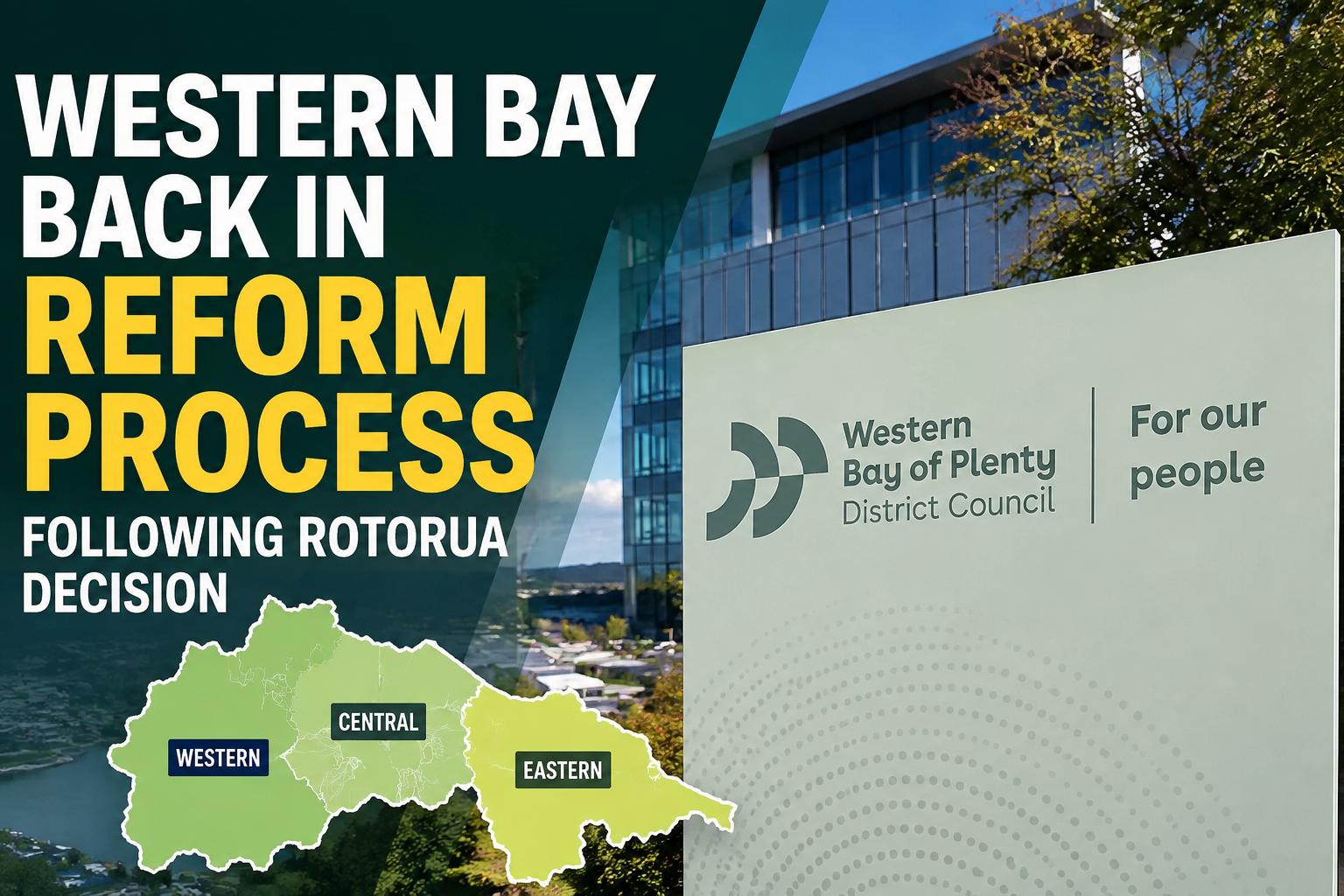
The proposal being considered would divide the region into three broad unitary council areas.
| Proposed council | Areas covered |
|---|---|
| Western unitary council | Tauranga and Western Bay |
| Central unitary council | Rotorua |
| Eastern unitary council | Kawerau, Whakatāne and Ōpōtiki |
The Western proposal is particularly significant because Tauranga City Council and Western Bay of Plenty District Council could be replaced by one new council.
That new body would be responsible for both local and regional council functions across the Western Bay area.
What does a unitary council actually mean?
For ordinary residents, the terminology can sound technical.
A unitary council is essentially one organisation carrying responsibilities that would otherwise sit across different levels of local government.
Under the proposal described by Western Bay of Plenty District Council, the new Western council would be responsible for both local and regional functions.
That means the proposal is more substantial than simply sharing staff or combining a few services.
It raises the possibility of changing the institutional structure through which decisions are made across Tauranga and Western Bay.
The exact operating model, representation arrangements, costs and service implications are not set out in the Western Bay announcement.
Those details would become increasingly important if the Government decided to take the proposal further.
Why does Western Bay's earlier vote still matter?
Western Bay councillors had already considered whether they wanted to formally enter the Head Start process.
They narrowly decided not to.
That vote matters because it shows there was not a clear local political consensus in favour of proceeding.
The current situation therefore creates an unusual position.
Western Bay did not choose to submit its own proposal, but it may still become part of a wider restructuring option considered by central government.
That could become an important issue for residents and elected members as the process develops.
The question is no longer simply whether Western Bay wanted to initiate reform itself.
The question is now what happens when a wider regional proposal includes Western Bay regardless of that earlier decision.
Mayor says Government will now decide
Western Bay of Plenty Mayor James Denyer acknowledged Rotorua Lakes Council's decision and said the next step now sits with the Government.
"We acknowledge the decision of Rotorua Lakes Council and understand the desire of their elected members to do what is best for their district and the wider Bay of Plenty region," Denyer said.
"It will now be up to the Government to consider the proposal that has been submitted."
He said Western Bay of Plenty District Council would continue focusing on the interests of its communities regardless of what decision is made.
"Whatever that decision, as a council we will continue working to achieve the best outcomes for our communities."
That is an important part of the council's position.
Western Bay is not presenting the proposed structure as settled.
It is now part of a Government assessment process.
What happens next?
The proposal will now be assessed by the Ministry for Cities, Environment, Regions and Transport, alongside other proposals from around the country.
Recommendations are expected to be provided to Ministers in September.
That means the next major decision will come from central government rather than individual councils.
At this stage, the proposal has not been approved.
No new Western council has been created.
Tauranga City Council and Western Bay of Plenty District Council continue to exist.
The significance of the announcement is that the option of replacing them with a new unitary council is now formally back on the table.
What should residents be watching?
For people living in Tauranga and Western Bay, the most important issues will be the practical details if the proposal progresses.
Residents will want to know how any new council would affect representation, local decision-making, services and the relationship between urban Tauranga and the wider Western Bay communities.
Those questions are not answered in the announcement.
But they are likely to become central if Ministers decide the Western unitary council proposal deserves further consideration.
A structural change of this size would not only affect council organisations.
It could influence how communities are represented and how decisions are made across a large and diverse area.
Tauranga and Western Bay are different communities
One of the issues likely to require careful consideration is the difference between Tauranga and the wider Western Bay.
Tauranga is a major and fast-growing urban centre.
Western Bay includes a broader mix of towns, settlements and rural communities.
A combined council would therefore have to represent communities with different needs and priorities within one organisation.
That does not necessarily mean the model could not work.
But it does mean representation and local voice would be important questions.
A structure that makes administration simpler would still need to make sure smaller communities do not feel disconnected from decision-making.
Why might Government consider larger councils?
The Western Bay release does not set out the Government's detailed case for reform.
What it does make clear is that the proposal is part of the Government's Simplifying Local Government programme.
The structure being considered is therefore aimed at changing how local government is organised rather than simply making minor operational adjustments.
A Western unitary council would bring Tauranga and Western Bay under one body and combine local and regional responsibilities.
Whether that produces better outcomes will depend heavily on how the model is designed.
Larger organisations can potentially coordinate functions across a wider area.
But larger organisations also need to make sure communities retain meaningful representation.
That trade-off will be worth watching if the proposal progresses.
The regional picture is just as significant
The proposal is not limited to Tauranga and Western Bay.
The wider Bay of Plenty could potentially be reorganised into three unitary councils.
The Western structure would cover Tauranga and Western Bay.
The Central structure would cover Rotorua.
The Eastern structure would cover Kawerau, Whakatāne and Ōpōtiki.
That means the Government is being asked to consider a much broader regional model.
If taken forward, it could represent a major change to the way local government is organised across the Bay of Plenty.
Nothing has been decided yet
This point is important because announcements about council reform can easily sound more final than they are.
The Western unitary council does not yet exist.
Western Bay has not been merged with Tauranga.
The Government has not yet approved the proposal.
What has changed is that the proposal is now eligible to be assessed.
The Ministry will consider it and recommendations will then go to Ministers.
That is the next stage.
The real question for Western Bay
The most interesting part of this development is not simply that another council voted to participate.
It is what that decision means for a district whose own councillors had already said no to entering the Head Start process.
Western Bay's earlier decision did not ultimately remove the district from consideration.
That will place even more importance on how Government assesses local views if it decides to move ahead.
For residents, the debate should eventually come down to practical questions:
Would a combined Western council make services easier to manage?
Would it improve coordination between Tauranga and Western Bay?
Would residents still feel properly represented?
Would communities gain from having local and regional responsibilities under one organisation?
And would the benefits of structural change outweigh the disruption involved in creating a completely new council?
Those are the questions that will matter more than the administrative language surrounding the Head Start process.
The bottom line
Western Bay of Plenty is back inside the Government's local government reform process, not because its councillors changed their minds, but because Rotorua's decision has enabled a wider Bay of Plenty proposal to proceed for assessment.
The proposal could ultimately replace Tauranga City Council and Western Bay of Plenty District Council with a new Western unitary council responsible for both local and regional functions.
But that outcome is far from decided.
The proposal must first be assessed by the Ministry for Cities, Environment, Regions and Transport, with recommendations expected to go to Ministers in September.
For Western Bay residents, the next stage will be worth watching closely.
This is no longer simply a discussion about whether councils should cooperate.
It is a discussion about who could govern Tauranga and Western Bay in the future, how communities would be represented, and whether a completely different local government structure would genuinely deliver better outcomes for the people who live there.
Source: Western Bay of Plenty District Council, 20 August 2026.