
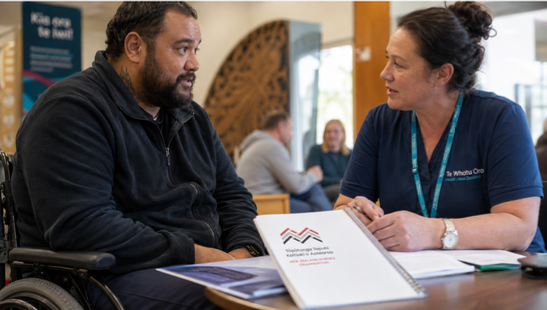
A new Waitangi Tribunal report has intensified pressure on the Government to address inequities experienced by tāngata whaikaha Māori, with the New Zealand Nurses Organisation calling for the recommendations to be acted on urgently.
The Tribunal’s Hauwhaikaha - the Disability System Report examines concerns raised through Wai 2713, the Māori Nurses Claim, and concludes that significant parts of the disability system have prejudiced Māori with disabilities.
According to the New Zealand Nurses Organisation, the report found tāngata whaikaha Māori are receiving services that are not always culturally safe and do not adequately recognise the intersection of being both Māori and disabled.
The findings reach beyond questions of clinical treatment.
They raise wider issues about who designs disability services, who has influence over their delivery, how outcomes are monitored and whether Māori are sufficiently represented when decisions affecting disabled Māori are made.
Tribunal findings put cultural safety at the centre
The Wai 2713 claim was brought by Tōpūtanga Tapuhi Kaitiaki o Aotearoa NZNO Kaiwhakahaere Kerri Nuku and honorary member Hineraumoa Te Apatu on behalf of Te Rūnanga o Aotearoa.
NZNO says the Tribunal found shortcomings relating to tino rangatiratanga, partnership, equity, culturally appropriate care and Māori participation in decision-making.
Nuku described the findings as a serious criticism of the existing system.
“This is a damning indictment on the Crown which has seen clinical competency prioritised over cultural competency and that attendance at occasional cultural competency training does not necessarily translate into culturally safe practice,” she said.
That distinction is significant.
A health or disability professional can be technically competent while the person receiving care may still feel their language, identity, whānau relationships or cultural needs are poorly understood.
The report, as described by NZNO, suggests cultural safety cannot simply be treated as a training exercise completed once and then assumed to be resolved.
Three groups identified in the findings
NZNO says the Tribunal identified breaches involving claims affecting three particular communities:
Tāngata Turi, the Māori Deaf community
Kāpō Māori, Māori who are blind or visually impaired
people with Foetal Alcohol Spectrum Disorder, or FASD
These groups can face different barriers within the disability system, which means a single national approach may not necessarily address every community’s needs.
Communication accessibility may be central for one person.
For another, navigation of health, disability, education or social services may be the major problem.
Cultural safety can sit across all of those experiences.
What NZNO wants the Government to do
NZNO is calling on the Coalition Government to adopt the Tribunal’s Wai 2713 recommendations.
Among the changes it wants are viable Māori-Crown partnership arrangements developed through co-design, including formal Māori involvement in the design and delivery of disability services.
The organisation is also calling for stronger Māori participation in governance, co-governance and co-management.
Another recommendation highlighted by NZNO is stronger monitoring of cultural safety and cultural competency.
That matters because a policy commitment at national level does not necessarily reveal what happens when a disabled person actually seeks support from a provider.
The recommendations also call for public monitoring of inequitable outcomes for tāngata whaikaha Māori.
That could make it easier to determine whether gaps are narrowing or continuing.
Service contracts could also change
One of the more consequential recommendations highlighted by NZNO concerns government contracting.
The organisation wants Te Tiriti and equity obligations explicitly incorporated into Crown service contracts.
That would move the issue beyond broad policy statements and into the agreements under which services are funded and delivered.
If implemented, providers could potentially face clearer expectations around Māori outcomes, cultural safety and accountability.
The practical details would matter considerably.
Any new requirements would need to be measurable, workable for providers and capable of demonstrating whether they actually improve experiences and outcomes for disabled Māori.
Monitoring after Te Aka Whai Ora
NZNO is also seeking replacement of the monitoring role previously undertaken by Te Aka Whai Ora, the Māori Health Authority.
Its call includes monitoring of health services delivered in prisons.
The reference to prisons broadens the issue beyond the mainstream disability support system.
People in custody may have disabilities, communication needs or complex health conditions while also having less ability to independently navigate services or seek alternatives when care is unsuitable.
Independent monitoring can therefore become particularly important in institutional settings.
A wider debate about cultural competency
Nuku also criticised the Coalition Government’s approach to cultural safety, saying the Tribunal report demonstrates why it should not be dismissed as an ideological issue.
That is NZNO’s political assessment of the Government’s approach and should be understood as such.
The wider policy question is more complex.
Governments have to decide not only whether cultural competency should form part of health and disability services, but what competent practice actually looks like, how it should be measured and what evidence should be used to determine whether it improves outcomes.
The Tribunal’s findings, as outlined by NZNO, argue that the existing system has not sufficiently met the needs of tāngata whaikaha Māori.
Cultural safety is different from identical treatment
One of the difficult issues in debates about equity is the assumption that fairness always means providing exactly the same service to everybody.
In disability care, that can be particularly problematic.
People already require different forms of support depending on the nature of their disability.
Language, communication, family involvement, geography and cultural context can add further differences.
A service can therefore be available equally on paper while still being harder for some people to access or use effectively.
The Tribunal report appears to focus on that gap between formal access and the actual experience of care.
The issue is also about decision-making power
The recommendations described by NZNO are notable because they do not stop at improving front-line interactions.
They also address governance.
Calls for Māori participation in governance, co-management and system design suggest the Tribunal sees some problems as structural rather than simply the result of individual practitioners lacking cultural knowledge.
That distinction matters.
Training can change individual behaviour.
Changing governance affects who helps decide where money goes, what services look like, how success is measured and whose concerns receive attention.
Those are much larger questions for the Government to consider.
Recommendations now move into the political arena
Waitangi Tribunal reports can carry substantial moral, historical and policy weight, but recommendations do not in themselves automatically determine government policy in most circumstances.
The next stage is therefore political.
The Government will have to consider which recommendations it accepts, which it may modify and whether legislative, contractual or administrative changes are required.
Cost will also matter.
Co-design processes, stronger monitoring, new contracting requirements and governance changes all require resources and implementation capacity.
But the counterargument, reflected in NZNO’s position, is that failing to address inequity also carries costs, particularly where people receive ineffective care, disengage from services or experience poorer outcomes.
The test will be what changes for disabled Māori
Ultimately, the importance of the Hauwhaikaha report will not be measured by the number of recommendations it contains.
It will be measured by what happens to people using the system.
For tāngata whaikaha Māori, meaningful change would need to be visible in whether services are easier to access, whether communication improves, whether people and their whānau feel heard, and whether measurable disparities begin to narrow.
NZNO believes the Tribunal has now provided the Government with a clear direction.
The Coalition Government will have to decide how far it is prepared to follow it.
And for disabled Māori who have already spent years navigating the system, the most important question may be much simpler: whether this report results in another round of discussion, or changes what happens when they actually need care.
Source: New Zealand Nurses Organisation media release.