Work has begun on a new Master Plan that will shape Wānaka Airport for decades, with Queenstown Lakes District Council pursuing a future that keeps the airport focused on general aviation while allowing the possibility of small scheduled passenger flights to Christchurch and potentially Wellington.
WĀNAKA, 25 September 2026: The next phase in deciding the long-term future of Wānaka Airport is officially underway, with specialist aviation advisors appointed and a community reference group beginning work alongside Queenstown Lakes District Council.
The Master Plan follows an extensive independent review of the airport’s future, which attracted more than 1,100 community submissions and examined options ranging from closing the airport altogether to developing an international airport.
The direction ultimately selected by Council was considerably more restrained.
Known as Scenario 3, it would preserve Wānaka Airport’s general-aviation character while allowing limited scheduled passenger services using turboprop aircraft carrying up to 30 passengers.
That could potentially create scheduled links between Wānaka and Christchurch, and possibly Wellington, without developing the airport for large-scale domestic or international operations.
What exactly has Council agreed to?
It is important to distinguish between what has already been decided and what remains under consideration.
Council has adopted Scenario 3 as the strategic direction on which the Master Plan will be based.
That does not mean scheduled passenger flights have been approved or that airlines are about to begin operating from Wānaka.
Instead, the Master Plan will determine how the airport could develop under that overall model, including infrastructure, land use, aviation activity, commercial opportunities and the practical requirements associated with limited regional connectivity.
The independent review recommended that Wānaka remain primarily a general-aviation airport while potentially supporting scheduled services to Christchurch and possibly Wellington.
It specifically envisaged aircraft of no more than 30 seats.
No plan for ATRs, Auckland flights or international services
One of the most important aspects of Scenario 3 is what it does not propose.
The Future Review considered six different scenarios.
Those ranged from completely closing Wānaka Airport to converting it into an international-capable airport.
Another option would have enabled larger turboprop aircraft such as the Q300 or ATR, potentially opening the door to Auckland services.
That was not the preferred direction.
The community consultation instead showed strongest support for the lower-impact Scenario 3.
QLDC’s review found larger domestic aircraft movements, international flights and airport closure were opposed during consultation, with concerns including tourism pressure, infrastructure expansion and effects on other airspace users.
So the Master Plan now being developed is not a blueprint for turning Wānaka into another Queenstown Airport.
It starts from a substantially smaller aviation model.
Why Christchurch could matter
Limited scheduled flights could still represent a significant change for Wānaka.
The airport currently supports general aviation rather than regular scheduled commercial passenger services.
A small scheduled connection to Christchurch could give Upper Clutha residents another option for regional travel without having to drive to Queenstown Airport.
Christchurch is also a major domestic aviation hub, meaning a Wānaka-Christchurch service could potentially provide onward connections to other parts of New Zealand.
Whether such a service would ultimately be commercially viable would depend on airlines, passenger demand, operating economics and the infrastructure and regulatory requirements identified through the planning process.
The Master Plan itself does not guarantee an airline will operate the route.
More than 1,100 people took part
The direction follows one of the most extensive recent consultations over Wānaka Airport.
The independent Future Review was undertaken by aviation consultants Egis.
During its second phase of engagement alone, QLDC recorded 1,133 online contributions.
The airport’s future has long attracted strong community interest, particularly as the Upper Clutha population and tourism economy have grown.
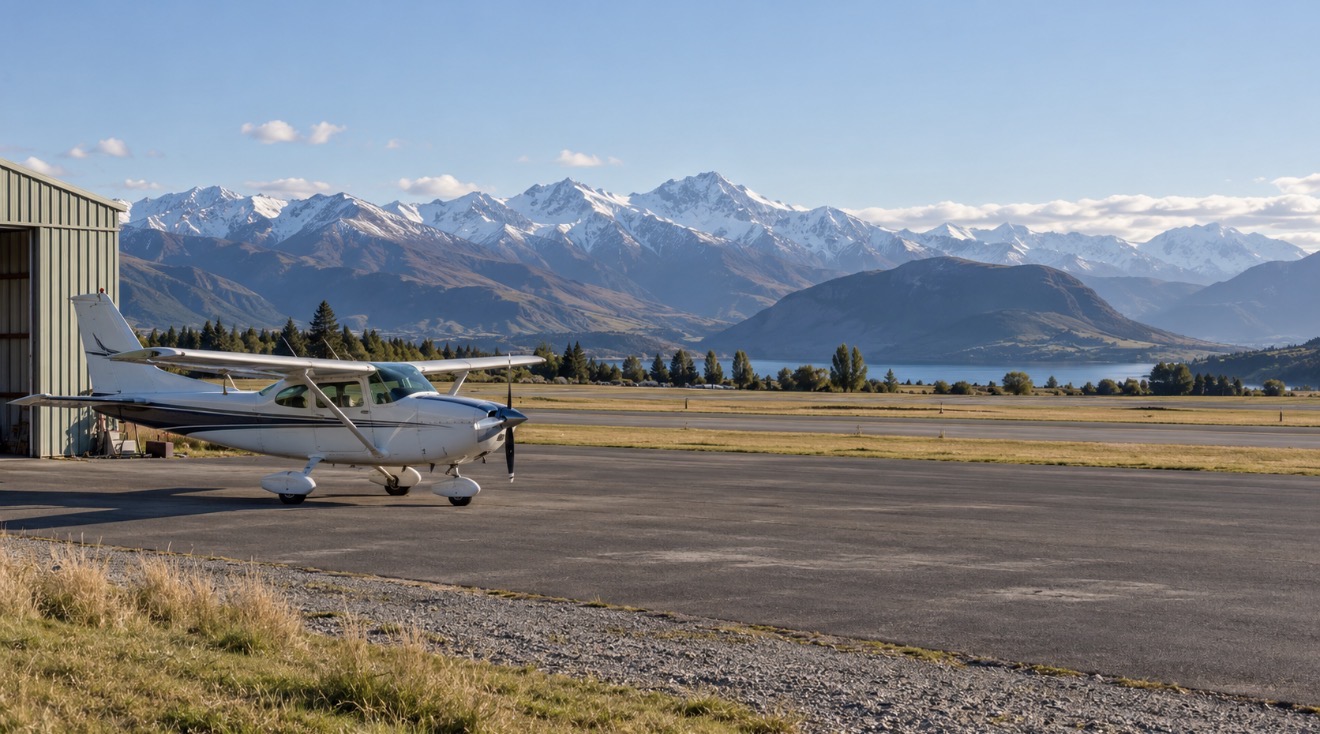
Wānaka Airport is approximately 10 kilometres south-east of Wānaka township, near Luggate.
It already supports scenic flights, skydiving, flight training, aircraft maintenance and general aviation, as well as events including the Warbirds Over Wānaka International Airshow.
QLDC says more than 11 aviation-related businesses operate there and the airport supports approximately 250 jobs.
Community group now involved in Master Plan
The Wānaka Airport Liaison Committee (WALC) has begun working as the programme’s community reference group.
Council recently changed the committee’s membership and Terms of Reference to support the Master Plan process.
Councillor Cody Tucker has joined the group, along with an independent technical expert with experience in airport operations and master planning.
WALC will provide feedback as issues, opportunities and draft material emerge.
However, the committee will not make the final decisions about the airport.
QLDC Programme Director, Special Projects, Paul Speedy said the group would provide community perspectives during development of the plan.
“WALC’s role as the programme’s community reference group is to bring community perspectives into development of the Master Plan,” Speedy said.
“These informal working sessions will allow members to test ideas, ask questions and provide feedback before recommendations are presented to Council through the formal decision-making process.”
Final decisions remain with elected councillors
QLDC has stressed that WALC’s involvement does not replace the normal public decision-making process.
Formal decisions will remain with the full Council and will continue to take place publicly.
That distinction will be particularly important if potentially contentious questions emerge around scheduled passenger services, noise, land development or future airport activity.
The wider community will also get another opportunity to comment.
Once the draft Master Plan has been prepared, councillors will be asked whether it should proceed to formal public consultation.
Only after that process would Council consider adopting a final plan.
“The wider community will have an opportunity to have its say,” Speedy said.
Master Plan will look much further than passenger flights
Although the possibility of scheduled services is likely to attract considerable public attention, the Master Plan is expected to cover much more.
The Future Review recommended planning across both a five-year and 20-year horizon.
Among the areas identified for consideration are airport economics, land use, aviation-business growth, non-aviation development, community requirements and stakeholder engagement.
Noise, airspace and flight-path boundaries are also expected to form part of longer-term planning.
The review also identified opportunities for Wānaka Airport to strengthen its role in civil defence and medical connectivity, support emerging low-emission aviation and develop further as a centre for aviation businesses and expertise.
Existing airport upgrades are separate
Other physical work is already occurring around Wānaka Airport, but not everything should be interpreted as preparation for scheduled passenger flights.
QLDC is separately upgrading the airport’s water and wastewater infrastructure.
The project will connect the airport to a reticulated mains water supply, replace existing septic systems with new wastewater infrastructure and provide improved firefighting water capacity.
Council has explicitly said those works are separate from both the Airport Future Review and the Master Plan process.
That distinction matters because infrastructure improvements at the airport do not, by themselves, signal approval for larger-scale commercial aviation.
Egis stays involved
Aviation consultancy Egis, which carried out the Future Review, will continue providing specialist advice during preparation of the Master Plan.
QLDC says retaining Egis provides continuity between the earlier technical and economic work, the community feedback, Council’s adoption of Scenario 3 and the detailed planning now underway.
Technical investigations will continue alongside targeted engagement with aviation operators and other interested parties.
Councillors will also be engaged as the work progresses.
Draft expected in 2027
The next major milestone will come next year.
QLDC expects the draft Wānaka Airport Master Plan to be presented to Council in 2027.
If councillors approve it for consultation, residents and other interested parties will then be able to formally submit feedback before any final Master Plan is adopted.
That means the future configuration of Wānaka Airport is not yet settled.
What has been settled is the broad direction.
Wānaka Airport is being planned as a general-aviation-focused regional airport, not a large domestic or international gateway.
But within that model, the possibility of small scheduled passenger flights is now firmly part of the planning conversation.
For Wānaka and the wider Upper Clutha, the Master Plan will determine whether that possibility can become a practical part of the region’s transport future while preserving the lower-impact airport model the community consultation largely supported.
Source: Queenstown Lakes District Council, 25 September 2026; Wānaka Airport Future Review and QLDC supporting information. Additional reporting and context by Webfit News.