
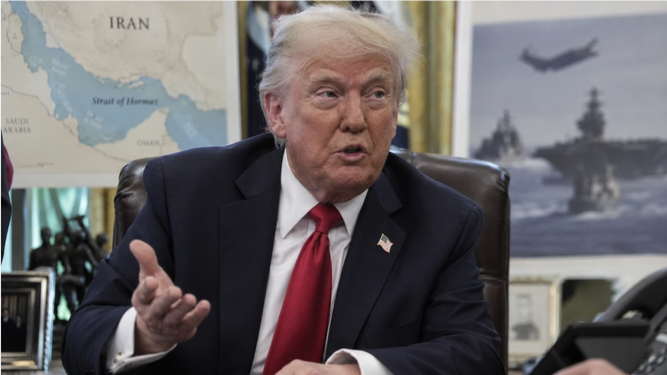
US President Donald Trump has sought to play down the scale of the continuing conflict with Iran, describing it as “small potatoes” and arguing that it should be viewed as an intermittent military confrontation rather than a full-scale war.
Speaking in the Oval Office on Friday, US time, Trump said the United States was not engaged in continuous combat despite ongoing strikes, maritime operations around the Strait of Hormuz and the deaths of American military personnel during the six-month conflict.
“A lot of people don’t call it a war. I call it a military conflict because it’s small potatoes for us. It’s not a big thing,” Trump said.
His comments follow similar remarks from Vice President JD Vance, who has also resisted describing the confrontation as a war.
But the administration’s terminology sits alongside a substantial and continuing military operation.
According to CNN’s reporting, the United States this week targeted nearly 60 military sites around the Strait of Hormuz while simultaneously escorting commercial shipping through one of the world’s most strategically important waterways.
The conflict has also contributed to higher fuel prices and has resulted in the deaths of 18 American service members.
Trump says fighting is “intermittent”
Trump characterised the confrontation as a series of occasional strikes rather than sustained warfare.
“I would say that it’s intermittent. You know, we do intermittent strikes,” he said.
He went further, saying there were periods in which there was effectively no active fighting.
“There’s a lot of truth that we’re not fighting right now. There’s no fighting.”
The distinction appears central to how the White House wants the conflict understood publicly.
Rather than describing the situation as an open-ended war, the administration is portraying it as a controlled military campaign involving targeted operations when necessary.
Whether that description matches the experience of those directly involved is a separate question.
An intermittent conflict can still carry serious human, economic and geopolitical consequences.
Nearly 60 Iranian military targets reportedly struck
The scale of the latest American operation illustrates that the confrontation remains significant even if fighting is not continuous.
The United States said it had targeted nearly 60 military sites around the Strait of Hormuz.
According to the administration, those targets included:
air defence installations
radar systems
maritime assets
mine-laying capabilities
military communications sites
At the same time, US forces have been escorting ships through the Strait.
That reflects the broader importance of the waterway.
The Strait of Hormuz is one of the world’s most important energy transit routes, and instability there can quickly affect oil markets, shipping costs and fuel prices far beyond the Middle East.
That means the consequences of the conflict are not limited to the countries directly involved.
“Not a war” is partly a political argument
The disagreement over terminology is more than semantics.
Calling a military confrontation a “war” carries political, legal and public expectations.
It can raise questions about congressional authority, duration, military objectives, casualties and the conditions required to end hostilities.
Describing the same operations as a limited military conflict allows an administration to emphasise their restricted scope and argue that the country is not entering another major prolonged war.
Vance said a day earlier that the confrontation should not be considered a war because major combat operations had ended months ago.
Trump reinforced that position.
“It’s a military conflict, but it’s very intermittent. I could see somebody not calling it a war,” he said.
He added: “I don’t think it matters what you call it. What matters is the fact that we have had tremendous success.”
That may be the administration’s preferred political framing, but the substance of the conflict is ultimately measured by military activity, casualties and strategic consequences rather than terminology alone.
Eighteen American service members have died
One fact complicating efforts to portray the confrontation as relatively minor is the reported loss of American military personnel.
CNN reported that 18 US service members have died during the six-month conflict.
For the families of those killed, language such as “small potatoes” is likely to carry a very different meaning than it does in a discussion about the scale of American military capability.
The United States may possess overwhelming military resources compared with many countries, but a conflict does not have to threaten the survival of the US itself to produce significant human costs.
The same applies to Iranian military personnel and civilians affected by the confrontation, although the material provided does not give a full casualty figure for Iran.
Washington shifting towards financial pressure
The Trump administration has also indicated it wants to increasingly use economic pressure against Iran.
That strategy centres on targeting Tehran’s international trading relationships and reducing its ability to generate revenue.
In theory, such a strategy could allow Washington to reduce reliance on military operations while continuing to put pressure on Iran.
The difficulty is China.
Beijing remains one of Iran’s most important economic relationships and is described in the reporting as Tehran’s biggest economic lifeline.
So far, Washington has stopped short of imposing the strongest possible penalties on China over that relationship.
China remains the difficult part of the strategy
Trump is expected to host Chinese President Xi Jinping for a state visit this month, adding another layer of complexity.
Asked about China’s role in supporting Iran, Trump played it down.
“They are not really involved. Very little involvement by China. China could have plenty of involvement,” he said.
That position leaves the administration balancing two competing objectives.
It wants to increase economic pressure on Iran.
But it also appears reluctant to allow the Iran conflict to derail wider negotiations and diplomacy with Beijing.
How Washington handles that contradiction may determine whether economic pressure can genuinely replace military action.
If Iran retains access to major international markets and trading partners, sanctions may have less impact than the administration wants.
Could the Strait of Hormuz become less important?
Trump also raised the possibility of developing alternative energy routes that could reduce international dependence on the Strait of Hormuz.
He referred to possible new routes and pipelines, including an overland alternative through Syria.
“They’re going to end up with a horrible strait that’s not really necessary any more,” Trump said.
The strategic logic is understandable.
Reducing dependence on a narrow maritime chokepoint would make global energy supplies less vulnerable to regional instability.
But constructing major new energy infrastructure is neither quick nor simple.
Pipelines require financing, agreements between governments, security guarantees, construction and long-term commercial viability.
Any route through politically unstable territory would carry its own risks.
So while bypassing the Strait may form part of a longer-term strategy, it would not necessarily solve the immediate security problem.
Trump raises prospect of another nuclear-site strike
Despite emphasising that the conflict is limited, Trump also suggested another military operation may be approaching.
He raised the possibility of striking a suspected Iranian nuclear facility south of Tehran.
“We may hit Pickaxe very soon,” Trump said, using the name given to the underground site.
Iran is believed to have moved some of its stockpile of highly enriched uranium to the facility.
Any operation against an underground nuclear site would be highly significant.
It could further damage Iran’s nuclear infrastructure, but it could also provoke another round of retaliation and deepen the confrontation.
That illustrates one of the central contradictions in the current situation.
The White House is presenting the conflict as limited and intermittent while simultaneously keeping open the possibility of further major strikes.
Fuel prices show how distant conflicts reach ordinary households
For people outside the United States and Iran, one of the most immediate consequences has been energy prices.
Conflict around the Strait of Hormuz can increase uncertainty in oil markets even if actual supplies remain available.
Markets price risk.
Shipping companies can face higher insurance and security costs.
Energy traders react to the possibility that supply could be interrupted.
Those pressures can eventually feed into fuel prices paid by households and businesses around the world.
For countries heavily dependent on imported fuel, including New Zealand, developments in the Gulf can therefore have consequences even thousands of kilometres away.
The question is not simply what the conflict is called
Trump may be correct that the confrontation is very different in scale from wars involving large ground armies, occupation or sustained combat across an entire country.
But that does not make the distinction between “war” and “military conflict” straightforward.
The United States is carrying out military strikes.
Iran has responded.
US military personnel have died.
Energy markets have been disrupted.
Ships are being escorted through a strategic waterway.
And the possibility of another strike on a nuclear facility remains openly under discussion.
Those are substantive realities regardless of the terminology used by political leaders.
The more important questions are how long the confrontation continues, whether diplomatic channels can regain momentum and whether each new round of strikes makes escalation more or less likely.
Trump says the United States has achieved “tremendous success”.
The lasting measure of that success, however, will not simply be the number of targets destroyed.
It will be whether the conflict ultimately ends without triggering a larger regional confrontation, whether Iran’s nuclear programme is genuinely constrained and whether stability returns to one of the world’s most important energy corridors.
Reporting note: This article was developed from reporting by CNN on comments made by US President Donald Trump and the continuing US-Iran military confrontation. Webfit News has restructured and expanded the story with additional context and analysis while retaining clear attribution for claims originating in the source material.
Original reporting: CNN.