
The traditional image of exam cheating is almost quaint now.
A note hidden up a sleeve. Answers scribbled on a hand. A formula tucked under a water-bottle label.
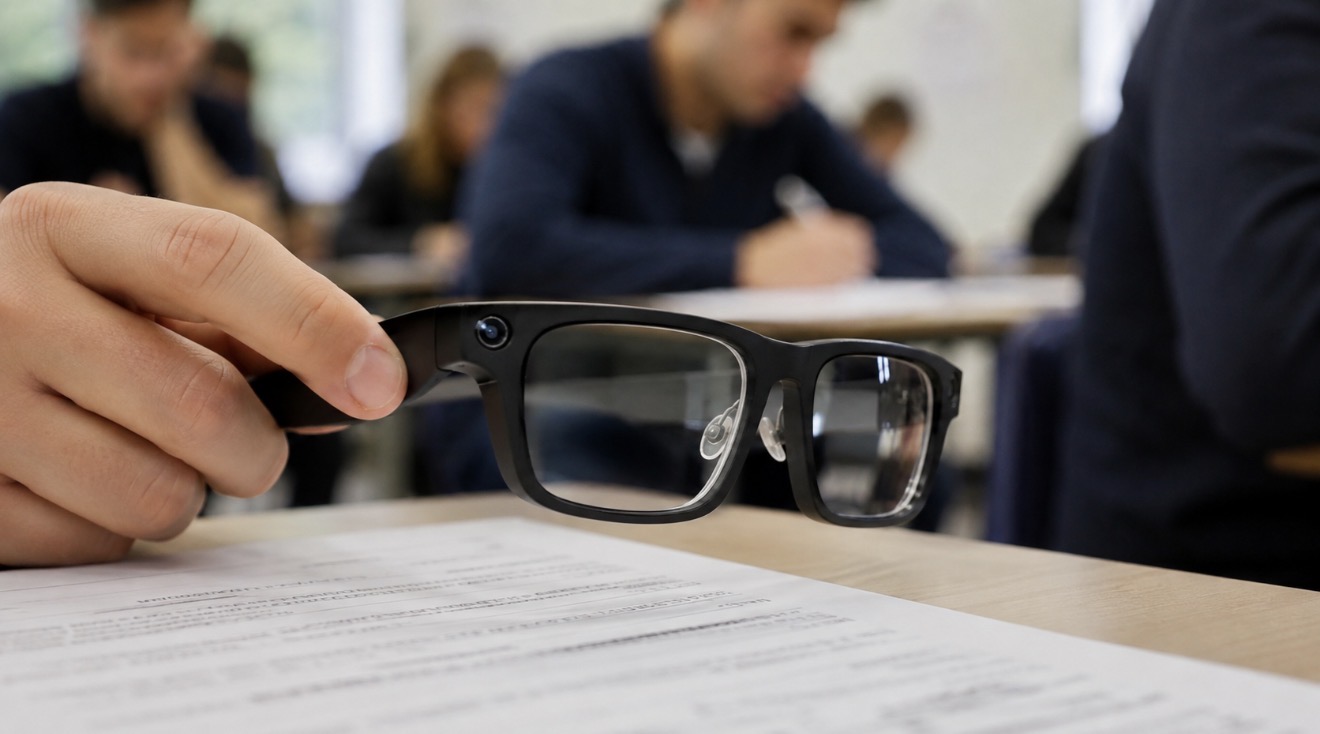
At the University of Auckland, an incident involving a student wearing smart glasses during a test has offered a glimpse of what universities may be dealing with next: technology that looks close enough to ordinary eyewear but can carry cameras, microphones, wireless connectivity and, increasingly, artificial intelligence.
The student was spotted by an invigilator despite students having been explicitly told before the test that smart glasses and smart watches were not permitted, according to reporting by RNZ.
The glasses were removed, the student was allowed to finish the test, and the university subsequently carried out an academic integrity investigation.
A penalty was imposed, although the university did not disclose its nature.
On its own, it is one student and one test.
The wider issue is much bigger.
Why smart glasses create a completely different cheating problem
Modern smart glasses can look remarkably similar to conventional prescription glasses or sunglasses.
But hidden inside the frame can be technology capable of seeing and hearing much of what the wearer does.
Depending on the model, smart glasses can include:
- a built-in camera
- microphones
- wireless connectivity
- speakers
- voice-controlled artificial intelligence
- the ability to photograph or record material in front of the wearer
- communication with smartphones and online services
- in some newer devices, visual displays capable of presenting information directly to the wearer
In an examination environment, those capabilities create an obvious problem.
A student could potentially capture a question, communicate it outside the room or use an AI system to obtain assistance without reaching for a phone or laptop.
University of Auckland computer science academic Professor Ulrich Speidel told RNZ that smart glasses could potentially be used to record examination questions and send them to an outside helper.
Some glasses are also capable of displaying information to the wearer in a way that other people nearby cannot easily see.
That turns eyewear into something universities must now consider alongside phones, smart watches and other prohibited electronics.
What happened at Auckland
According to RNZ, a University of Auckland spokesperson said an invigilator noticed the student wearing smart glasses during a test.
This followed a pre-test announcement specifically stating that smart glasses and watches were not allowed.
The glasses were removed.
The student then continued with the assessment.
The university later conducted an academic integrity investigation, which resulted in a penalty.
No further details about the student or sanction were publicly released.
That means there is an important distinction to make: the incident establishes that prohibited smart glasses were worn during the test, but the publicly available information does not establish exactly how the student was using them or whether AI assistance was actually obtained.
That should not be assumed without evidence.
But the incident was enough to force attention onto a vulnerability that universities increasingly have to confront.
Auckland’s exam rules already prohibit electronic devices
The University of Auckland’s examination rules prohibit students from possessing electronic devices, mobile technology or watches during on-campus examinations unless specifically permitted.
Medically prescribed devices are an exception.
Where a prohibited electronic device is found during an on-campus examination, it can be removed and the matter can also feed into academic misconduct proceedings where integrity concerns arise.
The problem with smart glasses is therefore not necessarily a lack of rules.
It is detection.
A smartphone sitting on a desk is obvious.
A smart watch is reasonably easy to identify.
Glasses are different.
Millions of people genuinely need eyewear to see.
Invigilators cannot simply ban every pair of glasses entering an examination room.
How do you tell ordinary glasses from AI glasses?
Speidel told RNZ there are physical clues invigilators can look for.
Smart glasses can have unusually wide arms, thicker hinge areas or larger bridges because the frames need room for batteries, cameras, speakers and other electronic components.
Universities may therefore need to train exam supervisors to recognise common devices.
Where prescription smart glasses are being worn, Speidel suggested that cameras could potentially be covered with masking tape rather than forcing students to remove eyewear they need for vision.
It is a practical solution, but it also illustrates how strange examination security is becoming.
Invigilators are no longer only watching what students write.
They may now need to inspect what students are wearing.
A tiny camera changes the equation
Current smart glasses are capable of recording from the user’s point of view, often through a camera built unobtrusively into the frame.
Meta, one of the largest manufacturers in the category, markets AI glasses with built-in cameras, microphones and voice-controlled AI features that can respond to questions about what the wearer is looking at.
Those functions have legitimate everyday uses.
People can record activities hands-free, receive assistance while travelling, translate information or use accessibility features.
For people who are blind or have low vision, similar technology can describe surroundings and identify objects.
The problem is context.
The same camera that can help someone navigate a street could also photograph an exam paper.
The same AI capable of explaining a restaurant menu can potentially answer an academic question.
Technology itself is not the offence.
Using it where independent assessment is required is.
The flashing light is not a perfect safeguard
Some commercially available smart glasses use a small light to indicate that the camera is recording.
That makes covert use more difficult.
An Auckland University of Technology engineering student interviewed by RNZ said he owned Meta glasses for creating point-of-view videos for his business but would not use them in a test partly because the recording indicator was conspicuous.
However, RNZ also pointed to overseas reporting showing that services have been offered to modify some devices so that the light can be disabled.
That creates another uncomfortable reality for universities.
Security measures built into consumer technology cannot necessarily be relied upon as examination-security measures.
The price barrier is disappearing too
Smart glasses were once niche and expensive.
That is changing.
RNZ reported that Meta-branded models were selling in the hundreds of dollars, while simpler camera-equipped smart glasses could be bought in New Zealand for around $99.
Not every inexpensive model includes sophisticated AI.
It does not need to.
A camera capable of capturing an exam question can itself be enough to create an integrity risk if that information can reach somebody outside the room.
As the technology becomes cheaper, universities cannot treat smart eyewear as something only a tiny number of technology enthusiasts will own.
The deeper problem is that wearables are becoming invisible
This is where the Auckland incident becomes more important than one student’s conduct.
Consumer electronics have spent decades becoming smaller.
Computers moved from desks into laptops.
Laptops gave way to smartphones.
Smartphones were joined by watches.
Now computing is moving into ordinary-looking objects worn on the body.
The direction of travel is clear.
Devices will become smaller, more capable and less obvious.
Speidel put the challenge starkly when speaking to RNZ, saying he dreaded the point at which comparable technology might become available in something as discreet as contact lenses.
His conclusion was essentially that this could become “checkmate” for conventional invigilation.
That may sound futuristic.
But smart glasses that can see what their wearer sees and communicate with AI would also have sounded futuristic not long ago.
Does this mean traditional exams are becoming obsolete?
Not necessarily.
But universities may need to rethink what an assessment is supposed to prove.
If an exam is designed primarily to determine whether a student can recall information, increasingly capable wearable AI creates an obvious threat.
Universities can respond with tighter surveillance.
But there is another approach: design assessments where simply receiving an AI-generated answer does not guarantee success.
That can mean asking students to:
- explain reasoning
- defend conclusions
- apply knowledge to unfamiliar scenarios
- demonstrate working
- undertake oral assessments
- solve individualised problems
- complete practical tasks
- critically evaluate competing answers
The harder an assessment is to outsource, the more resilient it becomes to technology.
Auckland computer science is already adapting
Speidel told RNZ that his department had moved largely towards pen-and-paper tests using randomised multiple-choice questions.
Randomisation means students sitting alongside each other may not receive identical questions in the same order.
That reduces traditional copying.
But smart AI introduces a different problem because the potential source of assistance does not need to be another student in the room.
That is why universities increasingly have to think about assessment design and technology control at the same time.
There is also a fairness issue for honest students
Academic misconduct is not simply a dispute between a university and the person accused.
It affects everyone sitting the assessment honestly.
Students invest substantial amounts of time and money in university education.
Grades determine course progression, scholarships, postgraduate opportunities and sometimes employment.
If one student gains hidden technological assistance while another completes the same assessment independently, the integrity of the result is compromised.
That is why universities have little choice but to take new cheating methods seriously.
A qualification only retains value if employers and the public can reasonably trust what it represents.
But universities also need to avoid treating every pair of glasses with suspicion
There is an equally important caution.
Smart-glasses enforcement cannot become an excuse to treat students wearing ordinary or prescription eyewear as presumptively dishonest.
Some students may also use technologically enhanced devices for legitimate accessibility purposes.
Rules therefore need to be clear before the exam begins.
Students should know what is prohibited.
Invigilators need appropriate training.
And where a device is required for medical or accessibility reasons, there should be a workable process that protects both the student and examination integrity.
Otherwise, attempts to solve one problem could create another.
AI has changed the cheating conversation extraordinarily quickly
Universities have spent the past few years grappling with students using generative AI to write essays and assignments.
Smart glasses move the same problem into supervised assessment.
A university may be able to restrict ChatGPT on an examination computer.
It cannot assume that the only computer in the room is sitting on the desk.
That is the significance of the Auckland case.
The next generation of academic integrity problems may be wearable.
The uncomfortable question universities now face
For more than a century, the supervised examination worked largely because an invigilator could see the resources available to a student.
A pen.
Paper.
A calculator, if permitted.
Perhaps a formula sheet.
The boundary was physical and obvious.
AI-enabled wearables weaken that assumption.
When cameras, microphones, connectivity and computing power can be hidden inside something as ordinary as a pair of glasses, universities face a choice.
They can turn examination rooms into increasingly intensive security environments.
They can redesign assessment so external AI assistance becomes less useful.
Most likely, they will have to do both.
The University of Auckland incident may ultimately prove relatively minor.
But the technology behind it is not.
The important question is no longer whether students will bring increasingly sophisticated wearable technology into education.
They already are.
The question is whether universities can adapt their assessment systems quickly enough to stay ahead of it.
Reporting note: This story was developed after Webfit News first read RNZ’s reporting by journalist Luka Forman on the University of Auckland smart-glasses incident. Webfit News has expanded the story with additional context and analysis of the implications for examination security and academic integrity.
Original reporting: RNZ, Luka Forman. Additional context: University of Auckland examination regulations and publicly available information on current smart-glasses technology.