
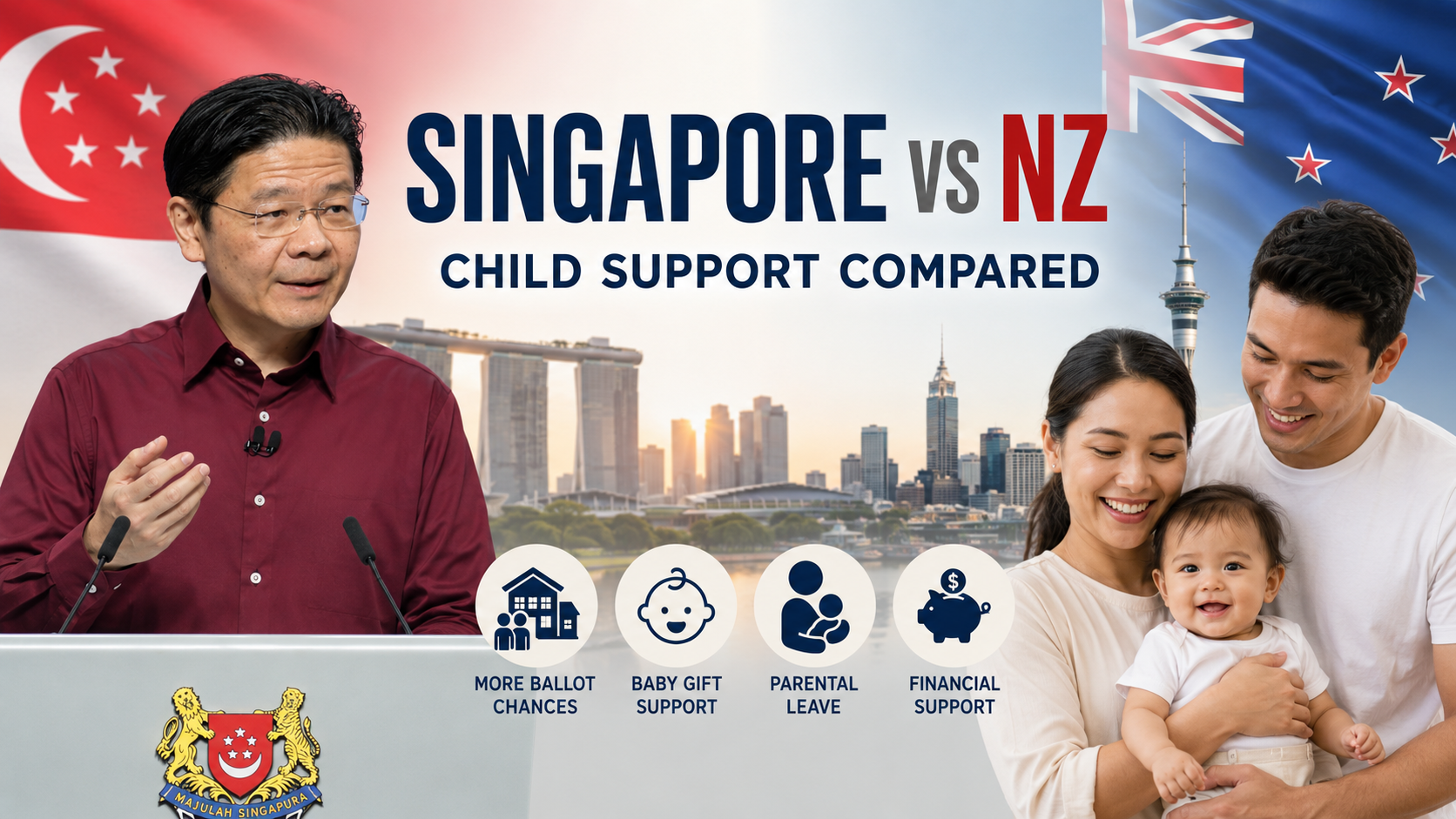
A viral video from Singapore is drawing attention for a simple reason: its Government is putting a remarkably clear number on how much support it wants to provide families raising children.
At Singapore’s 2026 National Day Rally, Prime Minister Lawrence Wong announced a major expansion of family support that will provide almost S$70,000 in direct financial assistance for every Singaporean child as they grow up.
The package goes well beyond a one-off baby payment.
It includes cash at birth, healthcare savings, childcare support, annual credits through childhood, education assistance and, for first-home families, better odds in the public housing ballot.
The announcement, highlighted in a Channel NewsAsia reel, naturally raises a question for Kiwi parents:
How does New Zealand compare?
What Singapore is actually offering
The headline figure of almost S$70,000 is not a lump sum handed to parents when a baby is born.
It is accumulated Government support delivered across the child’s first 17 years.
Under the new SG Child Support Package, every Singaporean child will eventually receive the same basic level of assistance regardless of whether they are the first, second or third child.
The package includes:
|
Singapore support |
Amount or benefit |
|
Baby Gift |
S$10,000 cash |
|
MediSave newborn grant |
S$5,000 |
|
Child Development Account initial grant |
S$5,000 |
|
Government matching into CDA |
Up to S$5,000 |
|
Annual Child Credits |
S$2,000 a year from age 1 to 16 |
|
Post-secondary education top-up |
S$10,000 at age 17 |
|
Other education support |
Annual Edusave top-ups |
|
Total direct support |
Almost S$70,000 |
Most of the new arrangements begin from April 2027.
The Government is also aiming to reduce full-day childcare fees at supported centres to S$150 a month and infant care to S$300 a month by 2030.
More children will also mean better housing odds
One of the most unusual parts of Singapore’s announcement has nothing directly to do with cash.
First-time families applying for a new public Housing and Development Board flat will receive an additional ballot chance for every Singaporean child they have, or are expecting.
So a family with more children gets more opportunities in the ballot.
The policy reflects Singapore’s wider concern about falling birth rates and the practical barriers young couples face when deciding whether to have children.
Housing, childcare and financial security are being treated as connected issues rather than separate policies.
Singapore has also expanded parental leave
For children born from 1 April 2026, eligible Singapore families can access up to 30 weeks of paid parental leave across the parents.
That comprises 16 weeks of maternity leave, four weeks of paternity leave and another 10 weeks of shared parental leave.
The shared component gives couples more ability to decide how caregiving is divided.
This is where the comparison with New Zealand becomes particularly interesting.
What does New Zealand provide?
New Zealand also has substantial family support, but it is spread across several different programmes rather than presented as one lifetime package.
Eligible parents can receive Government-funded paid parental leave for up to 26 weeks.
From 1 July 2026, the maximum payment is $811.05 before tax each week.
The payment can be transferred between eligible partners, but only one person can receive it at a time.
That is different from Singapore, where maternity, paternity and shared parental leave create separate entitlements that can give both parents a more explicit role.
New Zealand also has Best Start, Working for Families, childcare subsidies, FamilyBoost and 20 Hours ECE.
New Zealand family support at a glance
|
New Zealand programme |
Current support |
|
Paid parental leave |
Up to 26 weeks |
|
Maximum parental leave payment |
$811.05 gross per week |
|
Best Start |
Up to $77 a week |
|
Best Start duration |
Up to first 3 years, subject to income rules |
|
FamilyBoost |
Up to 40% of eligible ECE costs |
|
Maximum FamilyBoost |
$1,560 per quarter |
|
20 Hours ECE |
Up to 20 funded hours weekly for ages 3 to 5 |
|
Childcare Subsidy |
Income-tested assistance for eligible families |
For babies born from 1 April 2026, Best Start is income-tested from the first year. The maximum is $77 a week, with the entitlement reducing as family income rises above the relevant threshold.
FamilyBoost can refund up to 40 percent of eligible early childhood education costs, with a maximum payment of $1,560 per quarter for qualifying households.
Children aged three, four and five can also receive up to 20 hours of funded early childhood education each week.
So which country is actually more generous?
There is no simple winner because the systems are designed differently.
Singapore is moving towards a highly visible, child-by-child package.
It provides universal support to Singaporean children, spreads assistance across childhood and links family policy with housing, healthcare and education.
New Zealand places more emphasis on income-tested family support, paid parental leave and subsidising childcare.
New Zealand’s 26 weeks of paid parental leave is substantial, particularly for the primary caregiver.
Singapore, however, now gives fathers four dedicated weeks and couples another 10 weeks to share, meaning the overall paid leave available across a household can reach 30 weeks.
Singapore is also making an unusually strong long-term financial commitment directly to each child.
But money alone does not determine whether people have children
This is the part governments everywhere are struggling with.
Giving parents more money helps.
Affordable childcare helps.
Paid leave helps.
Housing security helps.
But family decisions are also influenced by working hours, career pressure, housing prices, relationship stability and whether parents feel they actually have enough time to raise children.
Singapore itself has one of the world’s lowest fertility rates despite having offered family incentives for years.
That is why its latest package goes beyond another baby bonus.
The Government is trying to address the full journey from birth to childcare, schooling and housing.
What New Zealand could take from the Singapore approach
The strongest lesson may not be that New Zealand should simply copy Singapore’s S$70,000 figure.
The two countries have different tax systems, housing structures and welfare models.
The more interesting lesson is simplicity.
A New Zealand parent trying to understand their support may need to navigate paid parental leave, Working for Families, Best Start, FamilyBoost, Childcare Subsidy and 20 Hours ECE separately.
Singapore is increasingly presenting support as one connected family policy.
For parents, knowing what help exists can be almost as important as how much is available.
The bigger question for New Zealand is therefore not simply whether we spend enough.
It is whether our family system makes it genuinely easier for people to have children, find childcare, stay connected to work and afford the first years of family life.
Singapore has just put that question firmly on the table.
Source credit: Channel NewsAsia footage from Singapore’s 2026 National Day Rally. Policy details verified against Singapore Government, Singapore Ministry of Manpower, New Zealand Employment New Zealand, Inland Revenue, Work and Income and Ministry of Education information.
Verification note, not for publication: Singapore’s almost S$70,000 figure and new child package are confirmed by the Prime Minister’s Office and Singapore Government material. Singapore’s parental leave settings are confirmed by its Ministry of Manpower. New Zealand’s 26-week paid parental leave and $811.05 maximum rate are current from 1 July 2026. Best Start, FamilyBoost and 20 Hours ECE figures are also current.