
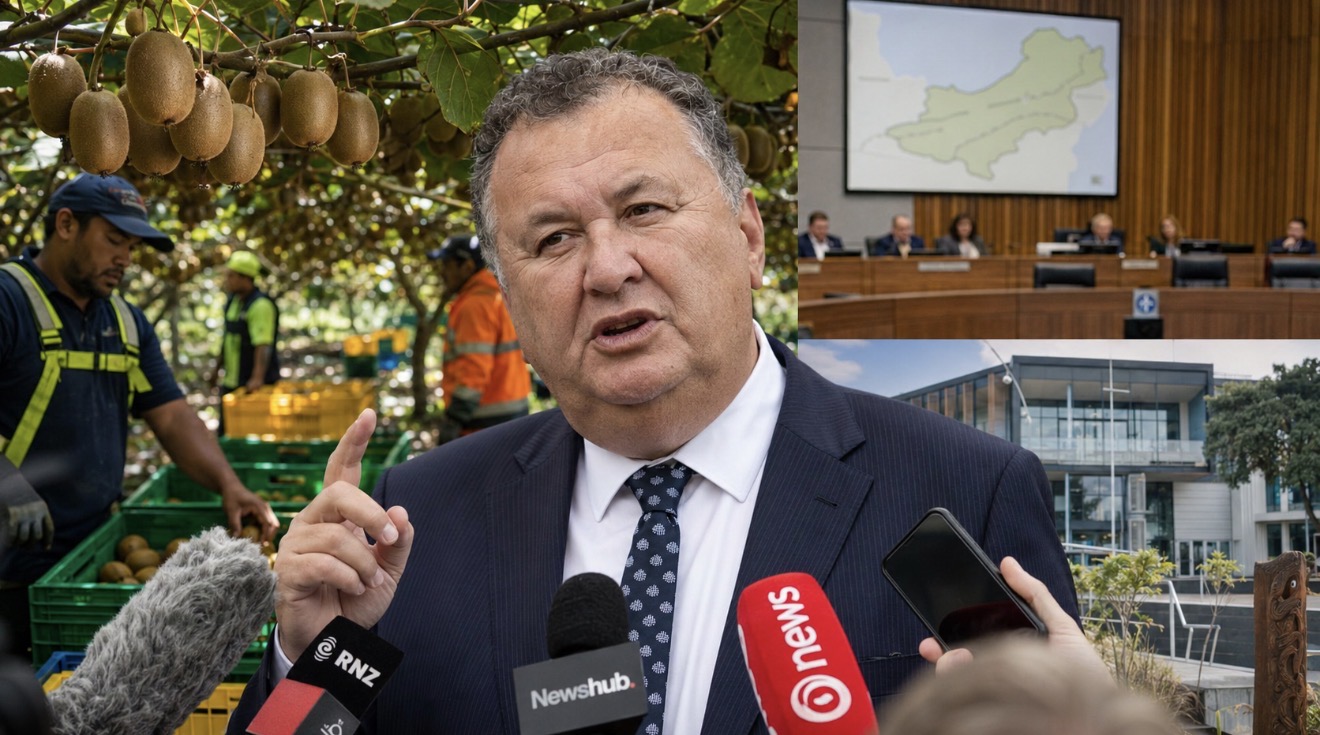
New Zealand First deputy leader Shane Jones has opened two politically explosive fronts at once, accusing parts of the Bay of Plenty kiwifruit industry of serious migrant exploitation while also distancing his party from National’s approach to regional council reform.
The comments, first reported by RNZ political reporter Russell Palmer after a public meeting in Lower Hutt, are significant not simply because of Jones’ language, but because they expose deeper tensions inside the governing coalition only months before the 7 November general election.
Jones described practices he says exist in parts of the kiwifruit labour market as “medieval slave practices” and called for a review of the legislation governing Zespri.
At the same meeting, he said New Zealand First would campaign on abolishing regional councils, while arguing National should seek an electoral mandate before proceeding with its preferred reform model.
Those are two very different policy debates, but politically they point in the same direction: New Zealand First is increasingly drawing lines between itself and National as the election approaches.
Jones’ claims need separating from what is already proven
The strongest part of Jones’ argument is that migrant exploitation in horticulture is not imaginary.
There is documented evidence of serious employment breaches in the Bay of Plenty kiwifruit sector.
In July, a horticulture company and its director were ordered to pay $135,000 in penalties after employment authorities found breaches affecting migrant workers.
In May, the owner of a kiwifruit contracting company was ordered to pay $40,000 in penalties over migrant exploitation, including a case where a worker paid more than $23,000 to secure employment.
More recently, a Bay of Plenty horticulture labour hire company and its former director were ordered to pay more than $400,000 in penalties and arrears after migrant workers were exploited through unlawful payments and employment breaches.
That matters because Jones is not raising a problem that exists only in political rhetoric.
But there is also an important distinction.
Documented cases of exploitation involving contractors do not, by themselves, establish that the entire kiwifruit industry operates through what Jones called “slave practices”, nor do they prove institutional wrongdoing by Zespri itself.
That is where political language needs to be tested against evidence.
What regulators are actually finding
Government regulators have already identified the horticulture sector as an area requiring close scrutiny.
An MBIE operation in Bay of Plenty earlier this year involved inspections of orchards, labour hire companies and contractors.
Officials said some workers were found working in roles inconsistent with their visa conditions and further investigations were underway.
The Labour Inspectorate has described seasonal and migrant workers as potentially vulnerable and said regulators need to disrupt employers who exploit them.
At the same time, MBIE has publicly acknowledged its ongoing work with Zespri to identify and remove non-compliant operators.
That produces a more complicated picture than either side of the political argument may prefer.
There have been real and serious cases of exploitation.
But there are also active enforcement systems, investigations and industry compliance processes operating to detect them.
Zespri rejects suggestion industry tolerates exploitation
Zespri told RNZ it takes allegations of poor working conditions seriously and has systems designed to prevent unsuitable contractors entering the industry and remove those who breach standards.
Growers supplying Zespri are required to meet international certification requirements, while contractors undergo vetting and compliance checks.
Zespri also operates a confidential reporting mechanism and says information gathered through its investigations is passed to government enforcement agencies when appropriate.
Importantly, at least one recent Labour Inspectorate case began after workers complained to Zespri, which subsequently removed the contractor’s compliance approval.
That does not mean the system is perfect.
If exploitation continues to occur despite those safeguards, the reasonable question is whether the system needs strengthening.
But that is a different claim from saying Zespri itself is responsible for exploitation.
Why Jones is targeting Zespri
Jones has gone further than demanding tougher enforcement.
He wants the legislation governing Zespri reviewed and says the company risks losing its “social licence”.
Zespri operates under a distinctive regulatory structure giving it the dominant role in exporting New Zealand kiwifruit outside Australasia.
A review of that model would therefore be a major intervention in one of New Zealand’s most successful export industries.
And the timing is particularly interesting.
The newly concluded New Zealand-India Free Trade Agreement gives New Zealand kiwifruit valuable new access to the Indian market, including tariff-free quota access and reduced tariffs outside that quota.
So just as New Zealand is seeking to grow one of its premium horticultural exports into India, Jones is arguing that the industry’s domestic labour practices require greater scrutiny.
That tension deserves attention.
Export growth is valuable, but international market access also makes supply-chain credibility increasingly important.
The political problem for National
Jones also used the meeting to challenge National over regional government reform.
The Government’s Head Start programme invited councils to propose ways of simplifying local government structures.
Ministers Chris Bishop and Simon Watts announced earlier this month that 18 proposals had been submitted.
National’s argument is that New Zealand’s current system is too complicated and expensive and that reform should be considered alongside major changes to resource management legislation.
Jones agrees that the system should change.
Where he parts company with National is over how and when.
He says New Zealand First wants to campaign on removing regional councils and then seek a mandate from voters.
He favours stronger catchment-based organisations in some areas rather than imposing a single nationwide replacement model.
More importantly, Jones says New Zealand First never agreed to National pushing through large-scale statutory restructuring before the election.
That is politically significant because these are not opposition parties attacking each other.
They are coalition partners.
Is this coalition disagreement or election positioning?
Probably both.
Coalition governments routinely contain policy disagreements.
But an election changes the incentives.
National, New Zealand First and ACT will all need to persuade voters why they deserve a larger share of the next Parliament.
That means differences that were managed quietly during government increasingly become selling points during the campaign.
Jones can tell regional voters that New Zealand First will protect local control.
He can tell working-class voters that the party will pursue migrant exploitation and labour abuses.
He can tell nationalist voters that New Zealand First is willing to challenge large institutions, including Zespri.
And he can simultaneously signal that National does not automatically speak for the entire coalition.
The missing question: what would NZ First actually change?
Jones’ criticism is politically powerful, but policy detail will now matter.
If New Zealand First wants a review of Zespri, voters deserve to know what problem the review is intended to solve.
Is the party questioning the single-desk export structure?
Does it want Zespri to carry greater legal responsibility for labour practices among contractors?
Would growers face new obligations?
Would employment regulators receive more investigative powers?
And if regional councils are abolished, exactly who takes over their responsibilities for environmental management, flood protection, public transport and regional infrastructure?
Catchment groups may work for river management.
They do not automatically replace every function currently performed by a regional council.
Those are the practical questions that campaign speeches eventually have to answer.
A story bigger than one provocative phrase
Jones’ “slave practices” language will inevitably dominate headlines.
But the more important story sits underneath it.
There are proven cases of migrant exploitation in New Zealand horticulture.
There is a legitimate question about whether existing enforcement and industry safeguards are strong enough.
There is also a legitimate requirement for politicians to distinguish isolated criminal or employment breaches from evidence of systemic industry-wide misconduct.
And there is now an increasingly visible disagreement between National and New Zealand First over how much structural change should happen before voters have their say.
With the election approaching, expect more of this.
The coalition may still govern together.
But increasingly, its parties are campaigning separately.
Reporting note
This article draws on original reporting by RNZ political reporter Russell Palmer, including Shane Jones’ comments, Zespri’s response and reporting from the Lower Hutt public meeting. Webfit News has added further context from Employment New Zealand, MBIE, government local government reform material and the New Zealand-India Free Trade Agreement to examine which parts of the political claims are supported by documented evidence and which remain matters of political argument.