What happens when psychiatrists, researchers and spiritual teachers sit at the same table and ask one of the most basic questions facing modern society: how do we understand and train the human mind?
That conversation is at the centre of a new New Zealand initiative launching in September.
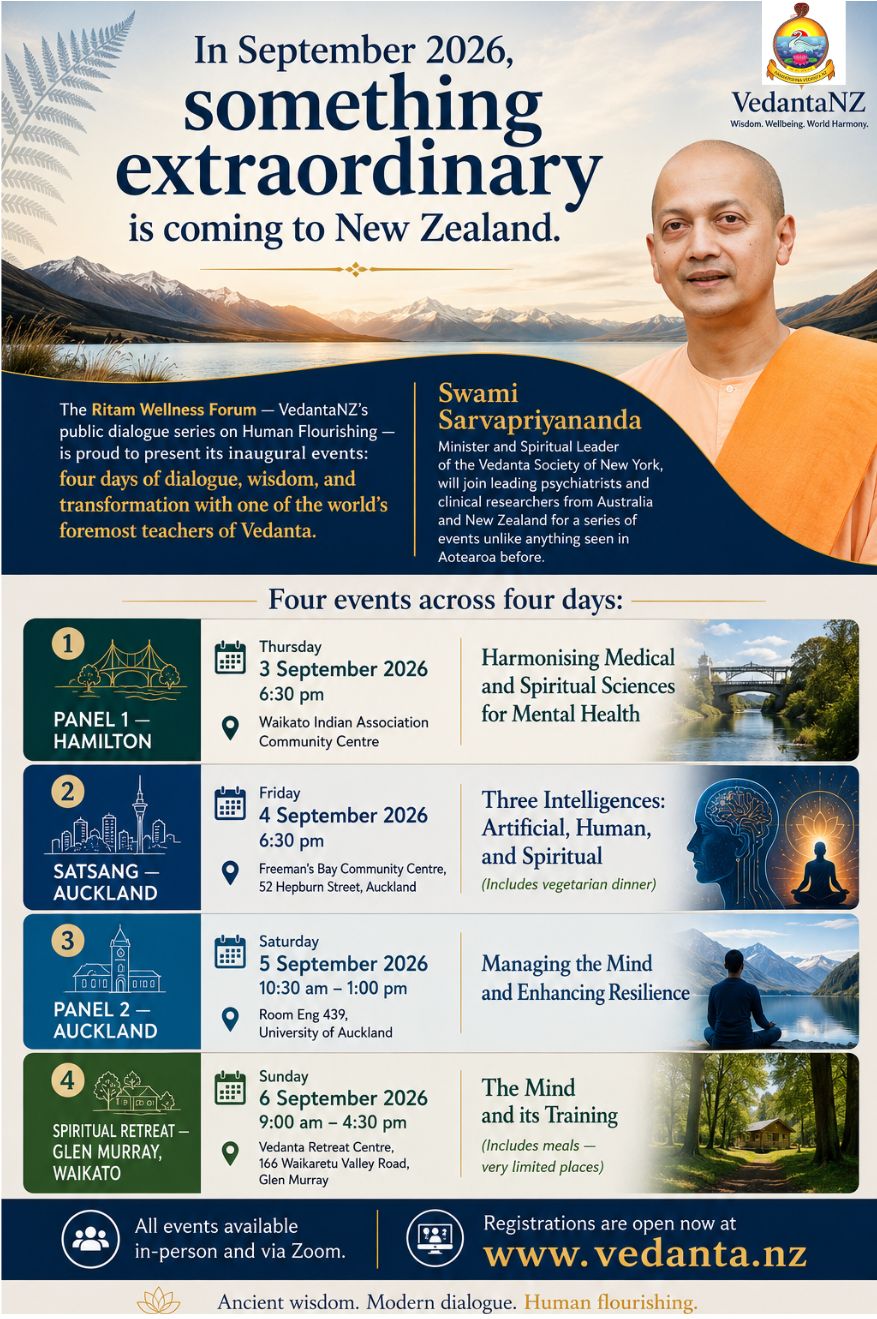
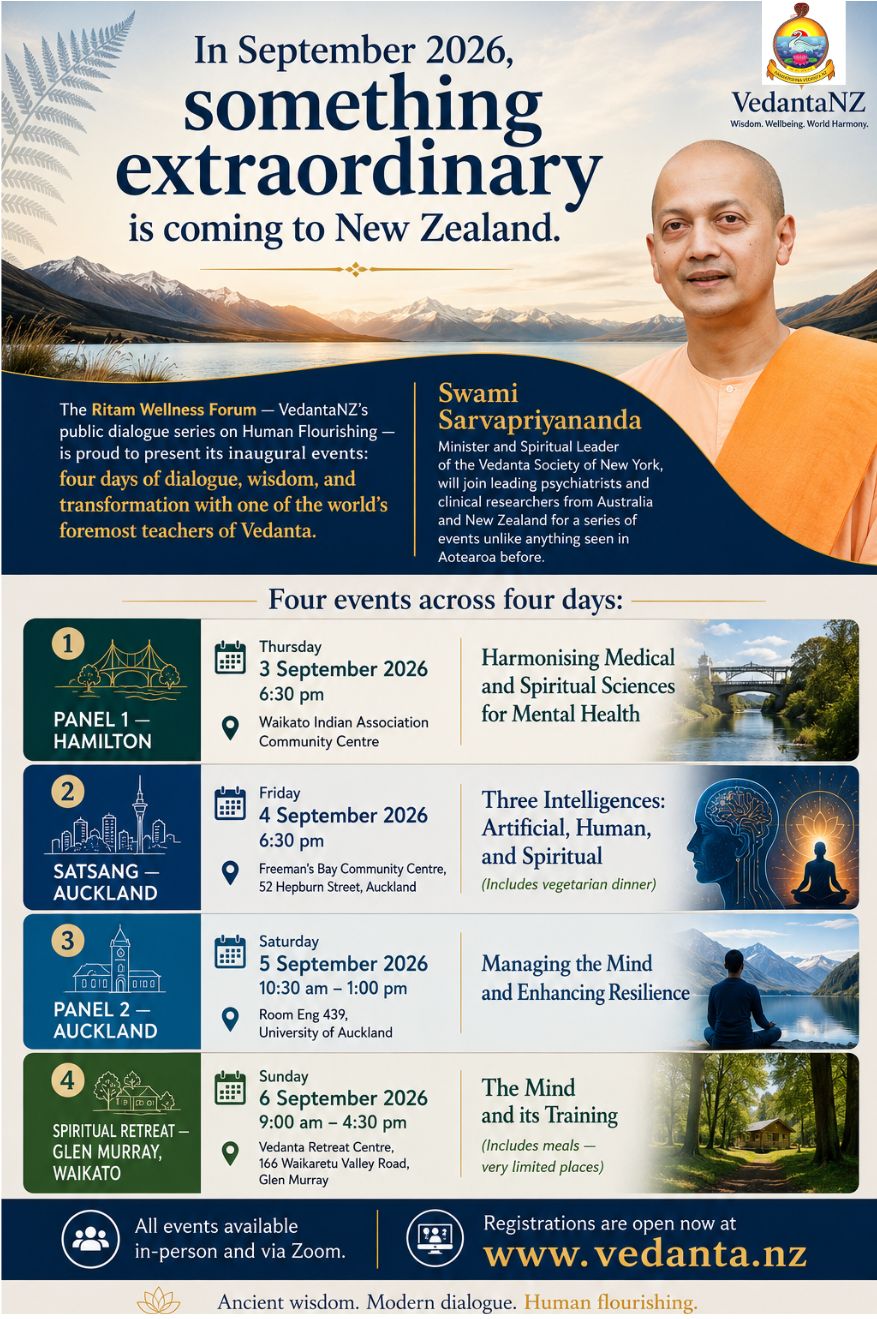
The Ramakrishna Vedanta Centre in Auckland is introducing the Ritam Wellness Forum, a four-day programme across Hamilton, Auckland and Glen Murray that will bring together medical professionals, contemplative teachers and members of the public to discuss mental wellbeing, resilience, artificial intelligence, human intelligence and the practical training of the mind.
Rather than presenting spirituality as an alternative to medicine, the organisers say the aim is to create a dialogue between modern scientific thinking and contemplative wisdom.
That distinction is important.
The programme is not being positioned as medical treatment, nor as a religious event intended only for followers of one tradition.
It is being presented as a public conversation about human flourishing, with events designed for parents, teachers, health professionals, young people, workplaces and anyone interested in understanding how the mind responds to stress and how greater resilience might be developed.
Why this conversation is being organised now
Mental wellbeing has become an increasingly important issue for families, workplaces, schools and health professionals.
In its invitation to community organisations, the Ramakrishna Vedanta Centre says figures cited from the Mental Health Foundation of New Zealand indicate that around one in five New Zealanders experiences a mental health condition each year.
Behind a statistic like that are very different personal experiences.
A parent may be worried about a teenager struggling with stress.
A teacher may be trying to support students whose emotional wellbeing is affecting their learning.
A health professional may be looking for additional ways to talk with patients about resilience.
A workplace may be trying to deal with burnout.
And an individual may simply feel that life is moving faster than their ability to process it.
The Ritam Wellness Forum is attempting to create space for those questions without pretending there is one simple answer.
Four events, four different conversations
The inaugural programme runs from 3 to 6 September 2026.
| Date | Location | Focus |
|---|---|---|
| Thursday, 3 September | Hamilton | Harmonising Medical and Spiritual Sciences for Mental Health |
| Friday, 4 September | Auckland | Three Intelligences: Artificial, Human and Spiritual |
| Saturday, 5 September | University of Auckland | Managing the Mind and Enhancing Resilience |
| Sunday, 6 September | Glen Murray, Waikato | The Mind and its Training, full-day retreat |
The structure is deliberate.
The series begins with mental health and the relationship between medical and spiritual approaches.
It then moves into a wider discussion about artificial, human and spiritual intelligence.
The third event focuses on resilience and practical mind management.
The programme concludes with a full day devoted to the mind and its training.
Taken together, the four events move from discussion toward practice.
Hamilton opens the conversation with mental health
The first forum, on Thursday, 3 September, is centred on the theme Harmonising Medical and Spiritual Sciences for Mental Health.
The panel brings together Swami Sarvapriyananda, Dr Shailesh Kumar and Dr Ashim Majumdar, with Swami Tadananda moderating.
The event material describes the purpose as bringing modern psychiatric science and contemplative wisdom into genuine dialogue.
That is a more interesting proposition than simply asking whether one approach is "right" and the other "wrong".
Modern psychiatry works within clinical, scientific and medical frameworks.
Contemplative traditions approach the mind through practices developed around attention, self-observation, inner discipline and reflection.
The forum asks what happens when those perspectives are allowed to speak to one another.
For clinicians, educators and members of the wider community, that could mean exploring not only how mental distress is treated, but how people understand their own minds before reaching a point of crisis.
Auckland discussion asks a very modern question about intelligence
The second event, on Friday, 4 September, turns toward one of the defining issues of the present era.
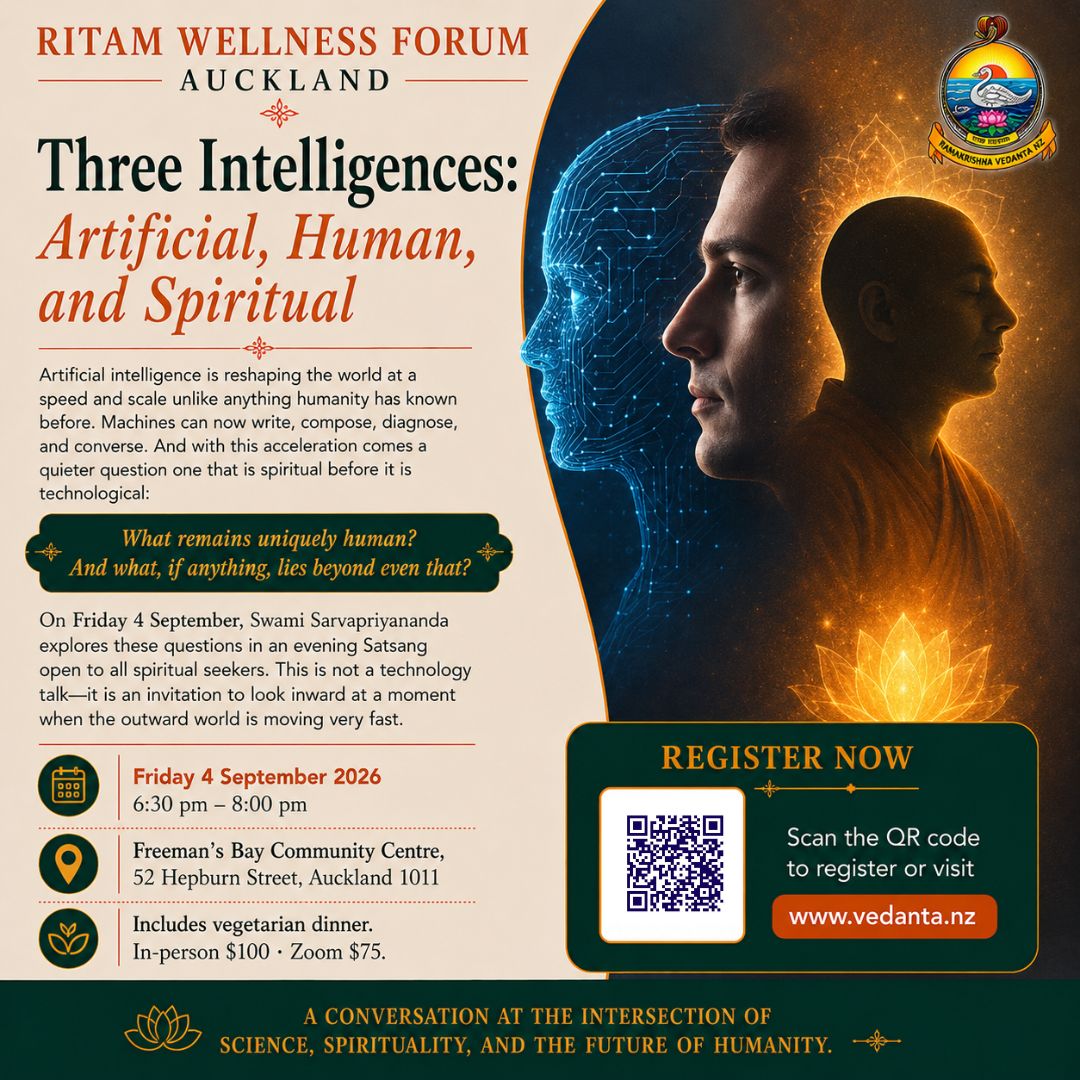
Three Intelligences: Artificial, Human and Spiritual will be led by Swami Sarvapriyananda.
Artificial intelligence is developing rapidly.
Machines can now write, analyse, converse, generate images and perform tasks that only a few years ago were considered distinctly human.
The event takes that technological development and asks a different question.
If machines become increasingly capable, what remains uniquely human?
And beyond intellectual ability, is there another dimension of human intelligence connected to self-awareness, values, meaning or inner life?
The organisers describe the evening as a satsang rather than a technology lecture.
Its focus is therefore not expected to be on software or technical development.
It is a conversation about what rapid technological change may force human beings to reconsider about themselves.
Resilience moves from a popular word to a practical question
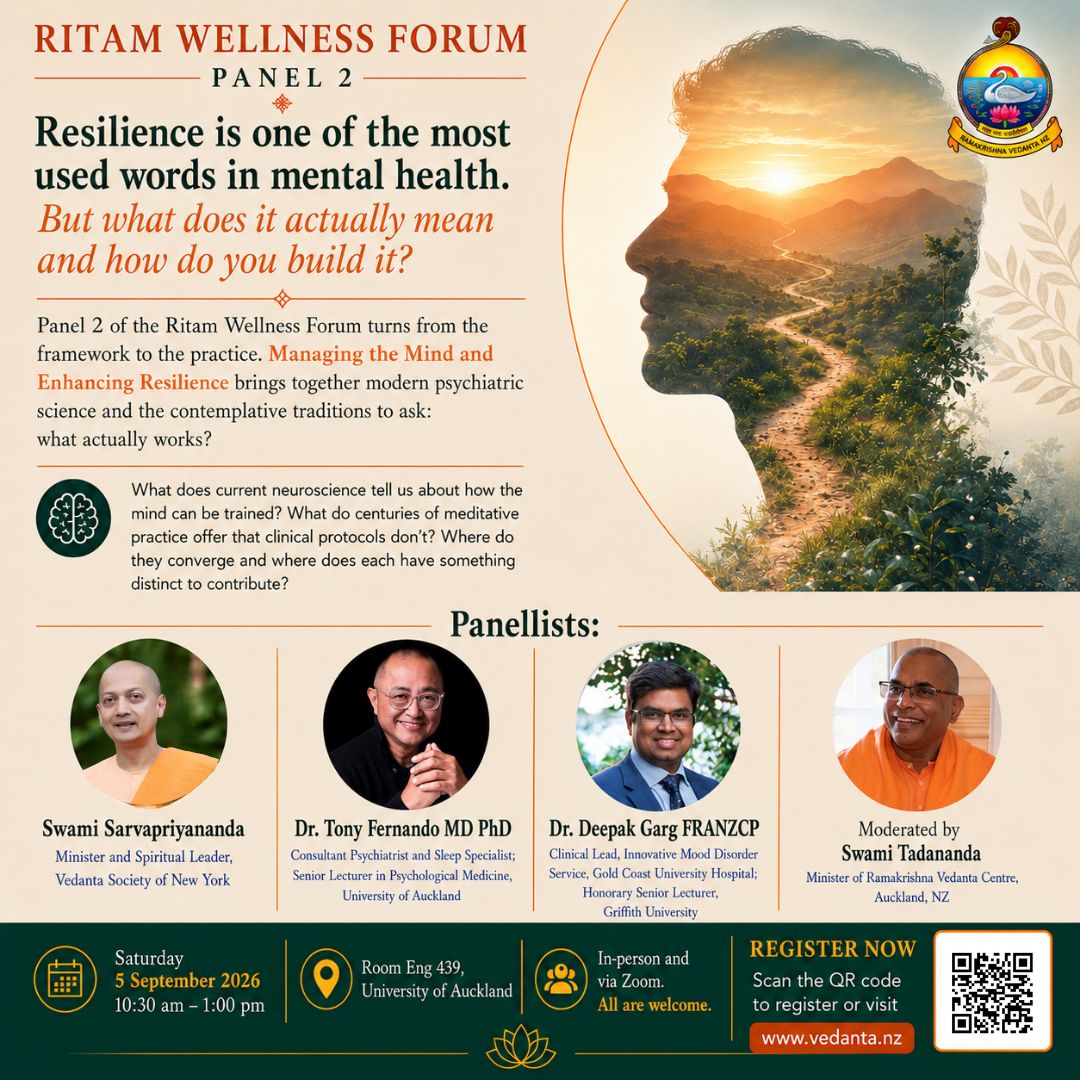
The third event takes place at the University of Auckland on Saturday, 5 September.
Its subject is Managing the Mind and Enhancing Resilience.
Resilience is now used constantly in discussions about mental health, education, workplaces and wellbeing.
But the organisers raise a useful question:
What does resilience actually mean, and how do people build it?
The panel will include Swami Sarvapriyananda, Dr Tony Fernando and Dr Deepak Garg, with Swami Tadananda moderating.
The event is designed to look at both modern psychiatric perspectives and contemplative traditions.
Instead of treating resilience as simply "being strong", the discussion is expected to explore how people relate to stress, thought patterns and emotional pressure, and whether the mind itself can be trained in ways that improve our ability to cope.
The final day asks participants to move beyond discussion
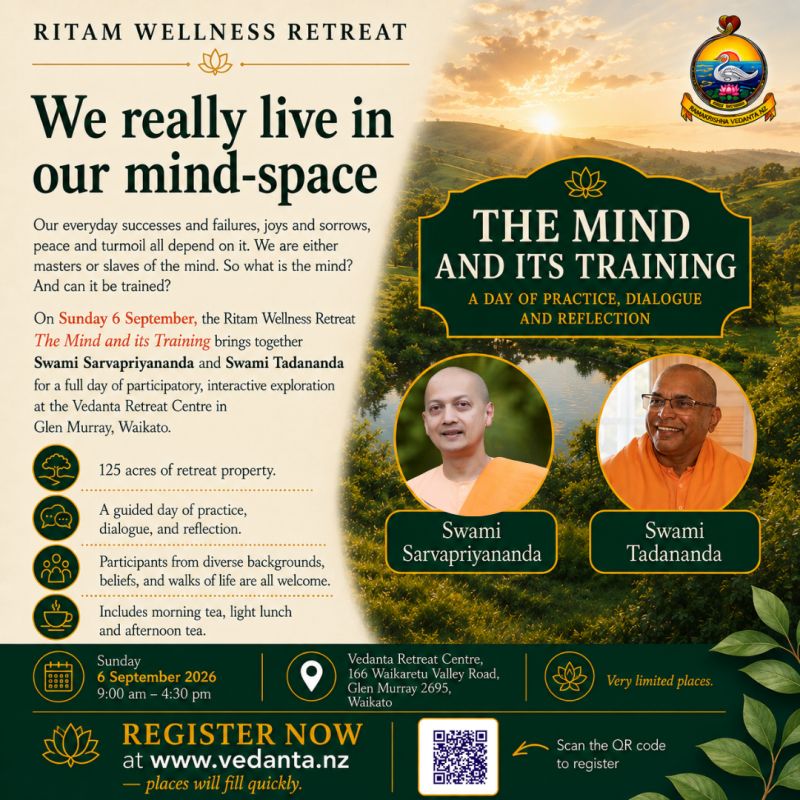
The programme ends on Sunday, 6 September, at the Vedanta Retreat Centre in Glen Murray, Waikato.
The retreat is titled The Mind and its Training.
This is the most practical component of the four-day programme.
Swami Sarvapriyananda and resident monk Swami Tadananda will lead a day of practice, dialogue and reflection.
The retreat material describes the venue as a 125-acre property and says participants from different backgrounds, beliefs and walks of life are welcome.
Morning tea, a light lunch and afternoon tea are included.
The basic idea is straightforward.
After three days of discussing mental wellbeing, intelligence and resilience, the final event asks participants to spend time actually examining the mind and engaging with practices intended to train attention and awareness.
Who is Swami Sarvapriyananda?
A major focus of the inaugural forum is the visit of Swami Sarvapriyananda, Minister and Spiritual Leader of the Vedanta Society of New York.
The organisers describe him as one of the leading contemporary teachers of Vedanta and someone known for making traditional philosophical ideas accessible to modern audiences.
His previous speaking engagements include the United Nations, Harvard University, Google and TEDx.
In New Zealand, however, the emphasis is not simply on giving a series of lectures.
The programme places him in conversation with psychiatrists and clinicians.
That format could be one of the more valuable elements of the initiative.
Rather than having a spiritual teacher speak only to people who already share his outlook, the forum puts different disciplines into the same conversation.
The medical voices are an important part of the programme
The September series also includes senior clinicians from New Zealand and Australia.
For the Hamilton discussion, the programme names Dr Shailesh Kumar, a consultant forensic psychiatrist in Waikato and Honorary Clinical Associate Professor at the University of Auckland, and Dr Ashim Majumdar, a consultant psychiatrist and senior lecturer in psychiatry at the University of Queensland.
The Auckland resilience panel includes Dr Tony Fernando, described as a consultant psychiatrist and sleep specialist and Senior Lecturer in Psychological Medicine at the University of Auckland, and Dr Deepak Garg, a clinical lead and honorary senior lecturer at Griffith University.
Their involvement helps clarify what the Ritam Wellness Forum is trying to achieve.
This is not simply a spiritual programme borrowing the language of mental health.
The organisers are attempting to create an actual exchange between clinical experience and contemplative perspectives.
What does Vedanta have to do with mental wellbeing?
For someone unfamiliar with Vedanta, this may be the first question.
The organisers describe Vedanta as an ancient contemplative wisdom tradition concerned with understanding the mind, human experience and inner life.
The forum does not suggest that such ideas replace psychiatry or medical treatment.
Instead, it asks whether contemplative traditions may offer useful practices or perspectives alongside modern scientific knowledge.
That difference matters, particularly when dealing with mental health.
A responsible conversation should never imply that someone with a serious mental health condition simply needs to meditate, think positively or become more spiritual.
The value of the forum is more likely to come from examining where different disciplines can contribute and where their limits remain.
Why parents and teachers may find the conversation relevant
The organisers are particularly encouraging parents and educators to participate.
For parents, the programme aims to offer insights into emotional development, resilience and the wellbeing of the family.
For teachers, it raises questions about stress, attention, learning and the way young people understand their own minds.
These are not abstract issues.
Children and teenagers increasingly grow up in an environment shaped by constant digital stimulation, social media, academic pressure and rapid technological change.
A forum asking how attention, resilience and inner balance are developed therefore has relevance well beyond people already interested in spirituality.
There is also a workplace conversation here
The programme is also being promoted to workplaces, HR professionals and wellbeing officers.
That makes sense.
Workplace discussions about mental health often centre around policies, leave, burnout and access to support.
Those remain important.
But there is another layer.
How do people actually respond internally to pressure?
How much of stress comes from circumstances, and how much comes from the way the mind processes those circumstances?
Can attention be trained?
Can people learn to recognise harmful patterns earlier?
Those are difficult questions, but they are relevant to almost every workplace.
Not a forum only for one community
Although the series is being organised by the Ramakrishna Vedanta Centre, the organisers repeatedly emphasise that the events are open to people from different backgrounds and traditions.
That may be important to the success of the initiative.
If the Ritam Wellness Forum becomes simply an event for people already familiar with Vedanta, the conversation will remain narrow.
If psychiatrists, teachers, parents, young people, workplaces and people with no previous exposure to contemplative traditions participate, the discussions could become much broader.
The organisers say both in-person and online participation options are available for the programme.
More than four events?
The Ramakrishna Vedanta Centre describes the September series as the beginning of an ongoing dialogue, rather than a one-off programme.
That ambition is significant.
Mental wellbeing is not an issue that can be addressed through a weekend seminar.
Nor can a four-day programme solve New Zealand's broader mental health challenges.
What an initiative like this can do is create another place for serious discussion.
The most useful outcome may not be convincing everyone to adopt the same view.
It may instead be encouraging people from medicine, education, spirituality and the wider community to listen to one another and examine the assumptions they bring to questions of wellbeing.
A conversation worth having
There is something timely about the Ritam Wellness Forum.
Modern life has given people extraordinary technological capabilities, but those capabilities have not necessarily made the human mind calmer.
We can communicate instantly, work from almost anywhere and access more information than any previous generation.
Yet questions about anxiety, resilience, attention, loneliness, purpose and mental wellbeing remain.
The September programme does not claim to provide a single solution.
Its proposition is more modest, and perhaps more useful.
Bring serious people from different traditions together.
Ask difficult questions.
Listen carefully.
And see whether medical science, lived experience and contemplative wisdom have something meaningful to say to one another.
For New Zealanders interested in mental wellbeing, resilience or simply understanding their own minds a little better, that could make the inaugural Ritam Wellness Forum worth paying attention to.
Ritam Wellness Forum, 3 to 6 September 2026, with events in Hamilton, Auckland and Glen Murray, Waikato. Registrations are now open through VedantaNZ.
Source: Ramakrishna Vedanta Centre Auckland and Ritam Wellness Forum event material.