Who Are Mahesh and Tejal Ranchhod?
Mahesh Ranchhod is the Chief Executive Officer of the Ranchhod Group, a privately held investment and property enterprise with operations across New Zealand and Australia. Under his leadership, the group has evolved from its early automotive roots into a diversified commercial portfolio managing high-value assets in Auckland’s central business district and beyond.
Tejal Ranchhod, a Chartered Accountant and senior financial lead within the group, has played a critical role in structuring the organisation’s disciplined investment strategy and philanthropic governance. Together, they represent the second generation of a migrant family enterprise that began with modest retail beginnings and matured into a professionally managed, cross-border business network.
Their leadership sits on a legacy foundation built by Raman Ranchhod, a respected entrepreneur, Justice of the Peace, and recipient of the Queen’s Service Medal. The Ranchhod family story is one of long-term economic integration, civic participation, and structured community investment.
This context matters because the recent $300,000 ambulance donation to Hato Hone St John is not an isolated act. It is the continuation of a multi-decade pattern of institutional philanthropy.
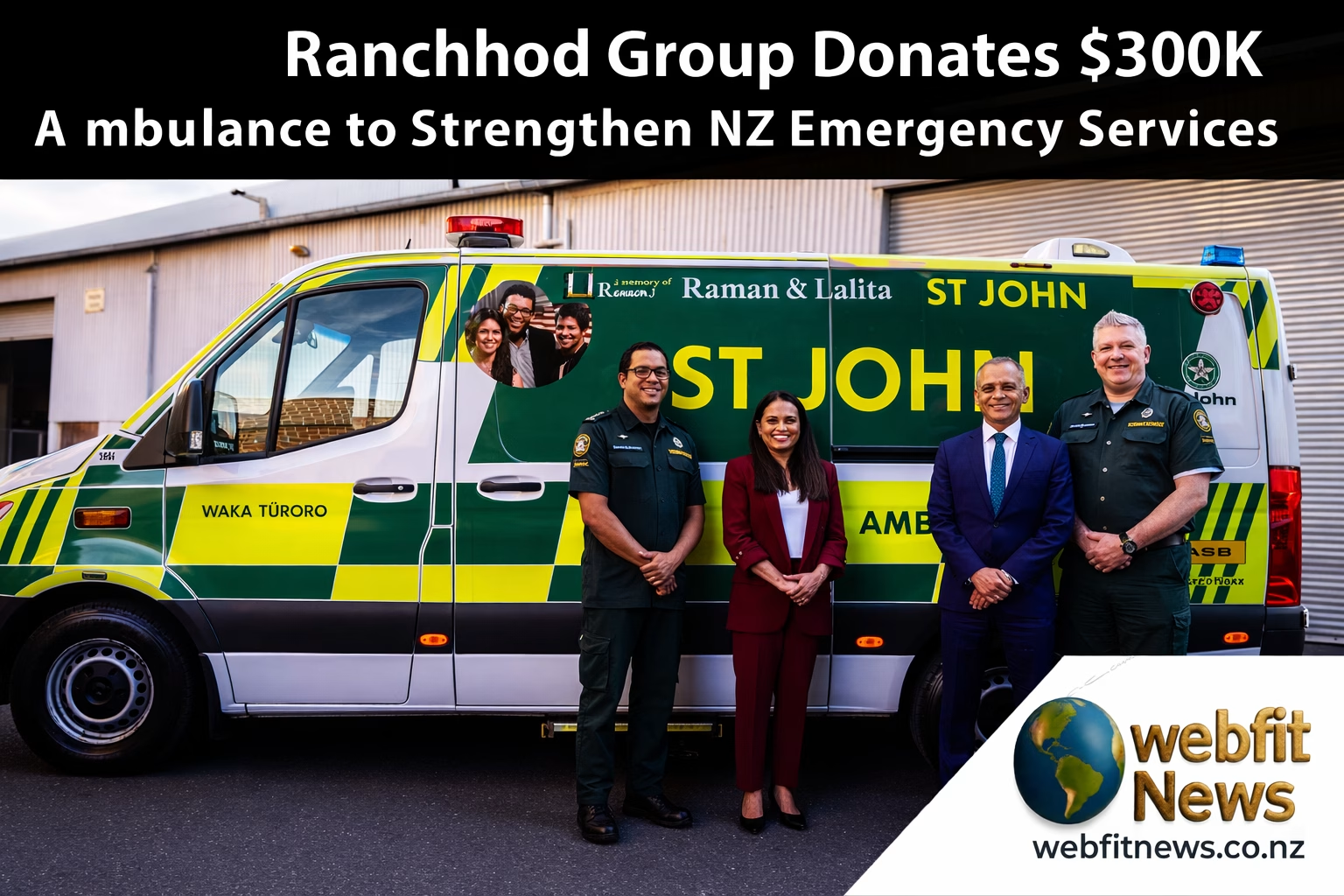
A $300,000 fully equipped ambulance donated to Hato Hone St John by the Ranchhod Group is more than a generous act of charity. It reflects a deeper shift in how emergency healthcare in New Zealand is sustained and how the Kiwi-Indian diaspora is shaping the nation’s social and economic landscape.
Dedicated to the memory of Raman and Lalita Ranchhod, the donation highlights a legacy of entrepreneurship, civic duty, and the principle of Seva, meaning selfless service. At a time when emergency services face rising costs and funding pressures, this contribution represents both a practical intervention and a symbolic milestone.
The Funding Reality Behind Emergency Services
Hato Hone St John provides ambulance services to roughly 90 percent of New Zealand’s population. Only the Greater Wellington and Wairarapa regions are serviced by Wellington Free Ambulance.
Despite its essential role, the organisation operates within a tight financial framework. Government contracts cover just under 90 percent of ambulance operating costs. The remaining gap must be filled through donations, corporate sponsorship, and commercial revenue.
Key operational realities include:
• More than 389,000 emergency incidents annually
• A volunteer-to-paid staff ratio of approximately 3:1
• Volunteers contributing an estimated $30 million in commercial value
• A base ambulance cost of approximately $225,000
The Ranchhod Group’s $300,000 vehicle suggests a top-tier specification model, likely fitted with advanced hydraulic stretcher systems, enhanced telemetry, and modern life-support equipment.
In practical terms, that means faster response capability and better clinical outcomes for patients.
From Migrant Roots to National Impact
The story behind the donation spans more than six decades.
Raman Ranchhod arrived in New Zealand with limited resources and began selling fruit and vegetables in Wellington. Over 16 years, he built a retail foundation before moving into the automotive sector, eventually managing multiple dealerships with integrated rental and finance operations.
The strategic pivot to commercial property investment during the 2008 global financial crisis marked a turning point. Under the leadership of Mahesh Ranchhod and Tejal Ranchhod, the business evolved into the Ranchhod Group, operating across New Zealand and Australia.
What began as small-scale migrant entrepreneurship matured into a diversified commercial enterprise managing high-value assets.
Strategic Investment: The Convent and Boutique Hospitality
One of the Ranchhod Group’s recent notable moves was the acquisition of The Convent in Grey Lynn for approximately $12 million.
Originally St Joseph’s Convent, the property had once fallen into neglect before being restored and transformed into a boutique 23-suite hotel. Rather than leasing it to a third-party operator, the Ranchhod Group chose an owner-operator model, signalling deeper involvement in the hospitality sector.
Mahesh Ranchhod has publicly expressed a preference for heritage buildings, citing their structural quality and character. Plans to expand the property while preserving its aesthetic demonstrate a long-term, quality-focused investment philosophy.
This pivot shows a diaspora leadership that is no longer confined to traditional retail sectors but actively shaping high-value urban redevelopment.
Global Seva: The Ranchhod Foundation
In 2011, Raman Ranchhod formalised the family’s philanthropic vision through the Ranchhod Foundation.
The foundation’s work spans both New Zealand and international projects, including:
• Starship Children’s Hospital support
• Shanti Niwas emergency housing assistance
• Disaster relief efforts in Nepal
• The Laduben Ranchhod Urban Hospital in Navsari, India
• Contributions to global health initiatives, including Tanzania
Raman Ranchhod was awarded the Queen’s Service Medal in 2015 and served as a Justice of the Peace. His commitment to civic duty established a blueprint now carried forward by the next generation.
Civic Leadership and Legal Volunteering
Remela Ranchhod-Patel continues that civic legacy through her involvement in the Auckland Justice of the Peace Association. The JP system is a critical pillar of New Zealand’s legal framework, enabling witnessing and certification services for property transactions, immigration processes, and legal documentation.
This form of volunteer civic service reinforces social infrastructure without financial compensation. It is a reminder that philanthropy extends beyond money.
Trade Influence and the Rise of the Kiwi-Indian Professional Class
The Ranchhod Group’s public engagements also intersect with influential figures such as Jacob Mannothra, founder of Zindia.
Forestry exports to India represent roughly 21 percent of bilateral trade, valued at approximately $200 million annually. Mannothra has played a key role in expanding New Zealand pine exports to major Indian ports and advocating for the removal of phyto-sanitary barriers.
This demonstrates how the Kiwi-Indian professional class now influences trade policy, economic diplomacy, and export growth.
The diaspora is no longer peripheral to national strategy. It is central.
The Role of Community Media
The rise of digital platforms such as Webfit News reflects the growing narrative power of diaspora communities.
As official media partner for events such as the Fiji Business Awards NZ 2025, Webfit News has amplified stories of migrant entrepreneurship, achieving over 750,000 social media views and more than 12,000 engagements around those awards.
Media platforms that understand diaspora audiences are now shaping public perception, celebrating success stories, and building cross-community bridges.
Seva as Strategic Infrastructure
The Ranchhod donation underscores a broader structural trend. With emergency services facing funding pressures and operational expansion needs, private philanthropy is increasingly bridging critical gaps.
This model can be described as a public-private hybrid in which community wealth reinforces national infrastructure.
The ambulance funded in memory of Raman and Lalita Ranchhod is not symbolic. It is an operational infrastructure placed directly into frontline service.
It demonstrates how Seva, when scaled through institutional capacity, becomes nation-building.