WELLINGTON, 31 July 2026
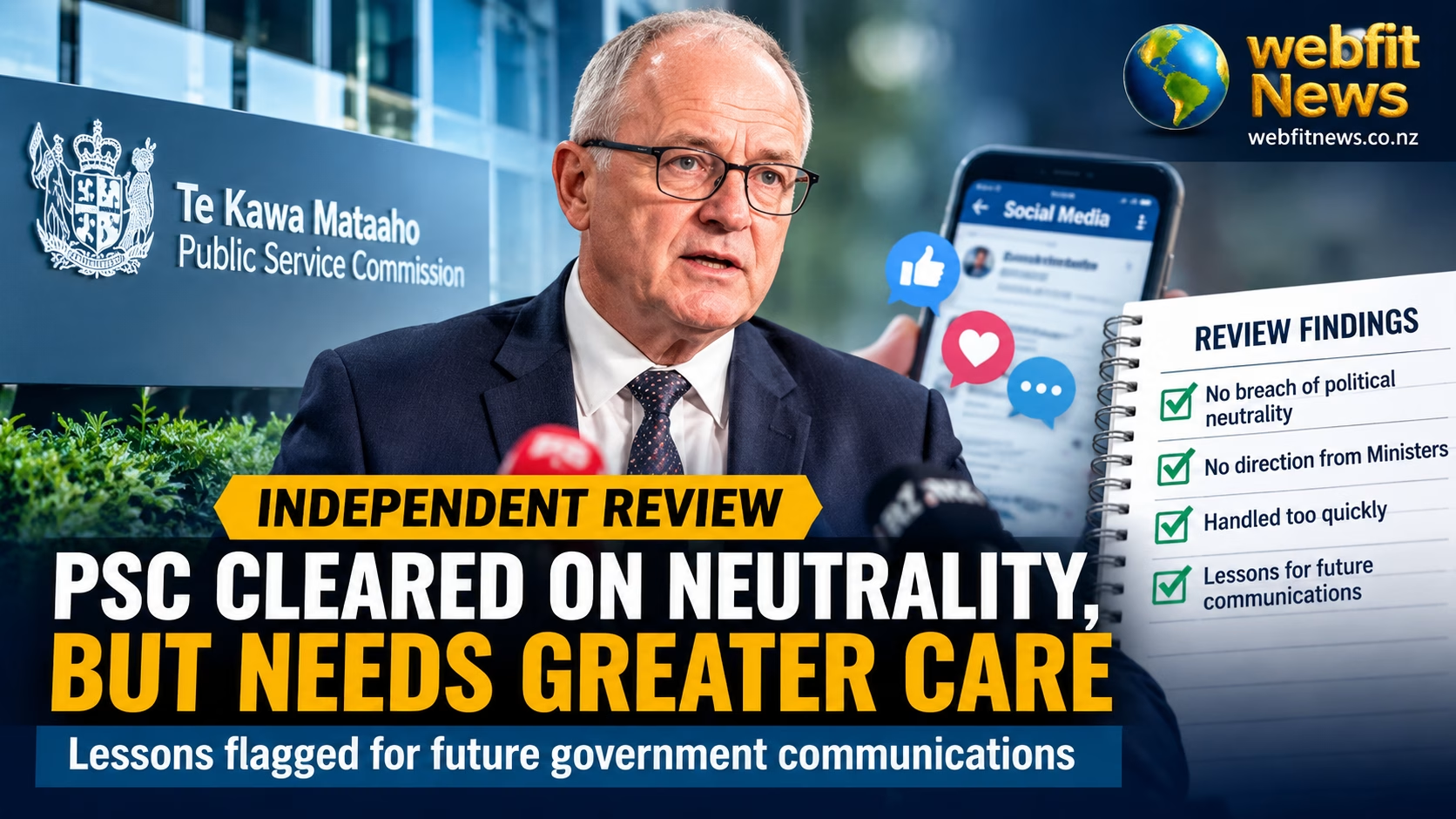
An independent review into social media messages published by the Public Service Commission during collective bargaining and ahead of the public sector day of action in October 2025 has found that the campaign did not breach political neutrality, but should have been handled more carefully.
The review was commissioned by Public Service Commissioner Sir Brian Roche to examine the decision-making process behind the messaging and identify lessons for future communications in politically sensitive situations.
While the review concluded that the Commission was entitled to communicate publicly about bargaining progress and possible disruption from strike action, it found weaknesses in how the messages were designed, assessed and approved for paid social media distribution.
Sir Brian said he accepted the findings and recommendations.
“The review does not find we were directed by Ministers. It does not find that we breached political neutrality. But it did find we should have handled this more carefully. I accept that,” he said.
Review examined messaging during tense bargaining period
The social media posts were published while the Public Service Commission was involved in education sector collective bargaining and preparing for possible disruption linked to the October 2025 public sector day of action.
The review found the Commission was operating in a difficult environment.
On one hand, it had responsibilities as an employer involved in bargaining. On the other, it held a broader leadership role across the Public Service, including responsibility for maintaining public trust and political neutrality.
The review concluded that the Commissioner was entitled to explain the employer’s position and communicate information about bargaining progress and possible strike-related disruption.
However, it also found that communication which may be appropriate in a formal media statement can create different risks when converted into short social media posts or paid advertisements.
Social media format increased risk
One of the main findings was that the messaging had not been sufficiently adapted to the social media environment.
The Commission had also issued media statements and participated in interviews, where the wider bargaining context and the Commissioner’s role as employer could be explained in more detail.
The review found that people who saw only the social media tiles may not have understood that the Commissioner was communicating in his role as the employer’s representative during bargaining.
Without that context, there was a greater risk that the posts could be perceived as politically partisan or as taking sides in a wider political dispute.
The review did not conclude that the Commission’s posts or media statements breached political neutrality.
Instead, it found that the format, tone and limited context of the paid social media material increased the risk of the campaign being interpreted in that way.
Political neutrality was not breached
The review specifically found that neither the Commission’s media statements nor its social media tiles breached the political neutrality obligations expected of the Public Service.
It also found no evidence that Ministers directed the Commission to carry out the social media campaign.
That finding is significant because questions around ministerial influence and political neutrality can affect confidence in the independence of public sector institutions.
Sir Brian said the review provided assurance that the campaign was not ordered by Ministers and that the Commission had not crossed the line into politically partisan communication.
However, he acknowledged that avoiding an actual breach was not enough.
Public agencies must also consider how their actions could reasonably be perceived by the public, particularly during industrial disputes, election periods or other politically charged events.
Integrity advice was sound, but process moved too quickly
The review found that the Commission had sought integrity advice before publishing the material.
That analysis was described as robust and appropriately focused on the relevant risks.
However, the review concluded that the Commission moved too quickly after receiving the advice and did not spend enough time considering the implications of using paid social media advertising.
Sir Brian said the failure was not in seeking advice, but in not fully working through it.
“We did the right thing in seeking integrity advice. Where we fell short was not giving ourselves enough time to fully work through that advice before paid social media posts were published,” he said.
Paid social media advertising can reach large and targeted audiences quickly, but it can also remove messages from the context in which they were originally prepared.
Unlike a media release, interview or full public statement, a short advertisement may be seen without background information, explanation or clarification.
The review found that this should have been more carefully considered before the campaign went live.
Recommendations for future high-risk decisions
The review made several recommendations aimed at improving future communications and decision-making.
These include allowing more time for integrity analysis, considering external peer review of advice in high-risk situations and strengthening sign-off arrangements for contentious decisions.
The recommendations are intended to create more distance between the development of communications material and the final decision to publish it.
External peer review may be particularly important when the Commission is assessing its own conduct or communicating about matters in which it has a direct institutional interest.
A stronger sign-off process could also ensure that senior decision-makers fully understand the reputational, legal and political risks before material is approved.
Sir Brian said the Commission needed to adopt a more deliberate approach in situations involving heightened risk.
“The lesson for us is clear. In a high-risk situation, particularly one involving our own conduct, we need to be more deliberate in our steps, fully consider the advice, and make sure our decision-making is as robust as it should be,” he said.
Broader lessons for public agencies
The findings are likely to have relevance beyond the Public Service Commission.
Government departments and public agencies increasingly use social media to communicate directly with the public, including through sponsored posts and targeted campaigns.
These platforms can be useful for distributing urgent information, but they also create risks when messages concern industrial disputes, political debate, public sector policy or contentious government decisions.
Short-form content can be separated from its original context, shared by others or presented to audiences who have not seen the accompanying media statements.
The review highlights the importance of assessing not only whether a message is factually accurate and legally permissible, but also how it may be understood when viewed on its own.
Public agencies are expected to remain politically neutral while still carrying out legitimate operational, leadership and employer responsibilities.
Balancing those obligations can be difficult, particularly when an agency is itself involved in a dispute.
Commission accepts need for improvement
The Public Service Commission has accepted the review’s findings and recommendations.
The review did not identify ministerial direction or a breach of political neutrality, but it concluded that more time, stronger oversight and greater consideration of the social media environment were required.
The Commission’s response indicates that future high-risk campaigns will face more detailed scrutiny before publication.
The central lesson from the review is that public sector communications must be judged not only by their intention, but also by their format, timing, audience and likely public interpretation.