
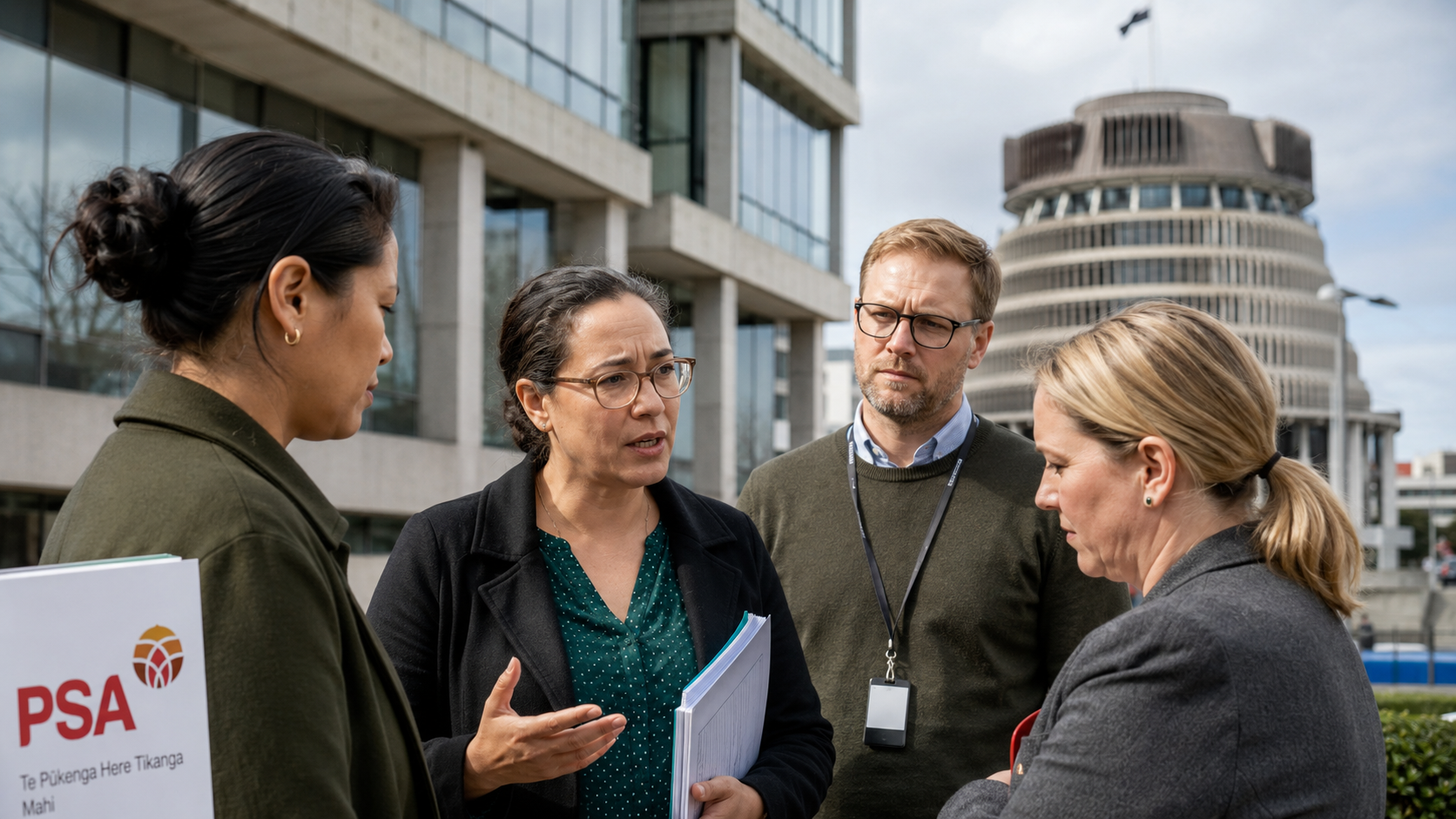
Labour is being urged to go beyond broad promises about the value of public services and clearly state whether it would reverse planned public service job cuts if it returns to Government.
The Public Service Association, or PSA, has called on Labour to commit to rolling back what it describes as plans by the National-led Government to cut almost 9,000 public service jobs over the next three years.
The union’s intervention follows the release of Labour’s fiscal strategy, which included the statement that “strong public services are an investment in New Zealand’s future”.
For the PSA, that language is not enough.
The union wants Labour to spell out exactly what that means in practice.
What is the PSA asking Labour to do?
PSA National Secretary Fleur Fitzsimons says Labour should make a clear election commitment that it would not continue with further large-scale reductions in the public service.
Her argument is that New Zealand is heading into a period where public services may become more important, not less.
She points to an ageing population and the growing effects of climate change as examples of pressures that will require capable and properly staffed public institutions.
“As our population ages and the impacts of climate change are felt, we need a strong public service,” Fitzsimons said.
The PSA wants Labour to go further than simply describing public services as important.
It wants a commitment to reverse cuts.
Why does this matter to ordinary New Zealanders?
Public service job numbers can sound like an internal Wellington issue.
But the work carried out by public servants reaches into many parts of daily life.
Government agencies help administer benefits, process permits, regulate workplaces, support emergency responses, collect and analyse public data, manage environmental programmes, oversee public health systems, develop policy and deliver services used by businesses and households.
The real question is therefore not simply how many public servants there are.
It is whether agencies still have enough people, skills and capability to do the work expected of them.
That is the point the PSA is trying to bring into the election debate.
The argument from the union
The PSA says the current Government’s approach has been driven too heavily by savings targets.
Fitzsimons described the cuts as “arbitrary” and argued they were not supported by a clear long-term strategy for improving public services.
She warned that further reductions could lead to thousands more job losses and weaken services New Zealanders rely on.
The union also raised concerns about the use of mergers and artificial intelligence as possible justifications for reducing staff numbers.
The PSA’s position is that technology and structural changes should not become a substitute for maintaining enough skilled people to deliver public services properly.
But Labour now faces a difficult question
Labour’s fiscal strategy creates a political tension.
On one hand, the party says strong public services matter.
On the other, it is also trying to convince voters that it can manage Government spending responsibly and return the books to surplus.
Those two objectives are not necessarily contradictory.
But they do require detail.
If Labour wants to rebuild public service capacity, voters will want to know:
Which job cuts would be reversed?
Which agencies would receive more staff?
How much would that cost?
Would all previously lost roles return, or only selected ones?
How would Labour balance higher staffing with its wider fiscal targets?
The PSA’s challenge is effectively asking Labour to put numbers and policy behind its language.
What exactly is being claimed?
The PSA says the National-led Government plans to cut almost 9,000 public service jobs over the next three years.
That figure is central to the union’s argument.
However, the material provided with the PSA statement does not include the Government’s detailed explanation of how those reductions would be achieved, nor does it include a response from National to the union’s criticism.
It also does not include a detailed response from Labour confirming whether it intends to reverse the cuts.
That means the key political question remains open.
Labour has said strong public services are an investment.
The PSA now wants to know what that sentence actually commits the party to doing.
The bigger issue is not simply headcount
Debates about public service staffing often become arguments about numbers.
One side talks about reducing bureaucracy.
The other talks about protecting services.
But headcount alone does not tell the whole story.
A smaller agency can sometimes work more efficiently if systems improve, duplication is removed and technology reduces repetitive work.
Equally, cutting staff without changing workloads can lead to longer waiting times, reduced oversight, weaker institutional knowledge and greater pressure on the employees who remain.
That is why the real test should be service quality.
If fewer staff can deliver the same or better outcomes, the public may see value in reform.
If lower staffing leads to slower or weaker services, then savings on paper can create costs elsewhere.
AI is likely to become part of this debate
The PSA specifically mentioned artificial intelligence in its criticism.
That is significant because AI is increasingly being discussed as a way for governments and businesses to reduce administrative workloads.
There is a sensible case for using technology to improve productivity.
But there is also a risk in assuming every task performed by a public servant can simply be automated.
Many public service roles involve judgement, legal responsibility, complex casework, public safety, policy development or direct interaction with vulnerable people.
So the question is not whether Government should use AI.
It almost certainly will.
The more important question is where technology improves public services and where human capability remains essential.
What the parties will need to explain before the election
This debate is likely to become more important as the campaign develops.
National will need to explain how further reductions can be made without damaging service quality.
Labour will need to explain whether it would actually rebuild staffing levels or simply stop further cuts.
And the PSA will need to demonstrate where staffing reductions are causing measurable harm, rather than relying only on the argument that fewer jobs automatically mean weaker services.
That is the level of detail voters need.
At a glance
| Issue | What is being argued |
|---|---|
| PSA position | Labour should commit to reversing public service cuts |
| Jobs at issue | PSA says almost 9,000 over the next three years |
| Labour wording | “Strong public services are an investment in New Zealand’s future” |
| PSA concern | Cuts may weaken services and remove skilled staff |
| Technology issue | PSA warns against using mergers and AI to justify further dismissals |
| Key unanswered question | Will Labour actually restore jobs, and if so, which ones? |
The bottom line
The PSA has put Labour in an uncomfortable but important position.
It is easy for an opposition party to say public services matter.
It is harder to say exactly how much they should cost, how many people should work in them and which cuts should be reversed.
For ordinary New Zealanders, the important issue is not whether the public service is bigger or smaller for its own sake.
It is whether people can still get the services they need, whether agencies can respond when the country faces major challenges, and whether taxpayer money is being used effectively.
The PSA has made its position clear.
It believes the current direction goes too far and wants Labour to promise a reversal.
Labour has not, based on the material provided, yet made that commitment.
That means the next question is now firmly with Chris Hipkins and his team:
If strong public services are an investment in New Zealand’s future, how much of the current job-cutting programme would Labour actually undo?
Source: Public Service Association statement, 23 August 2026.