
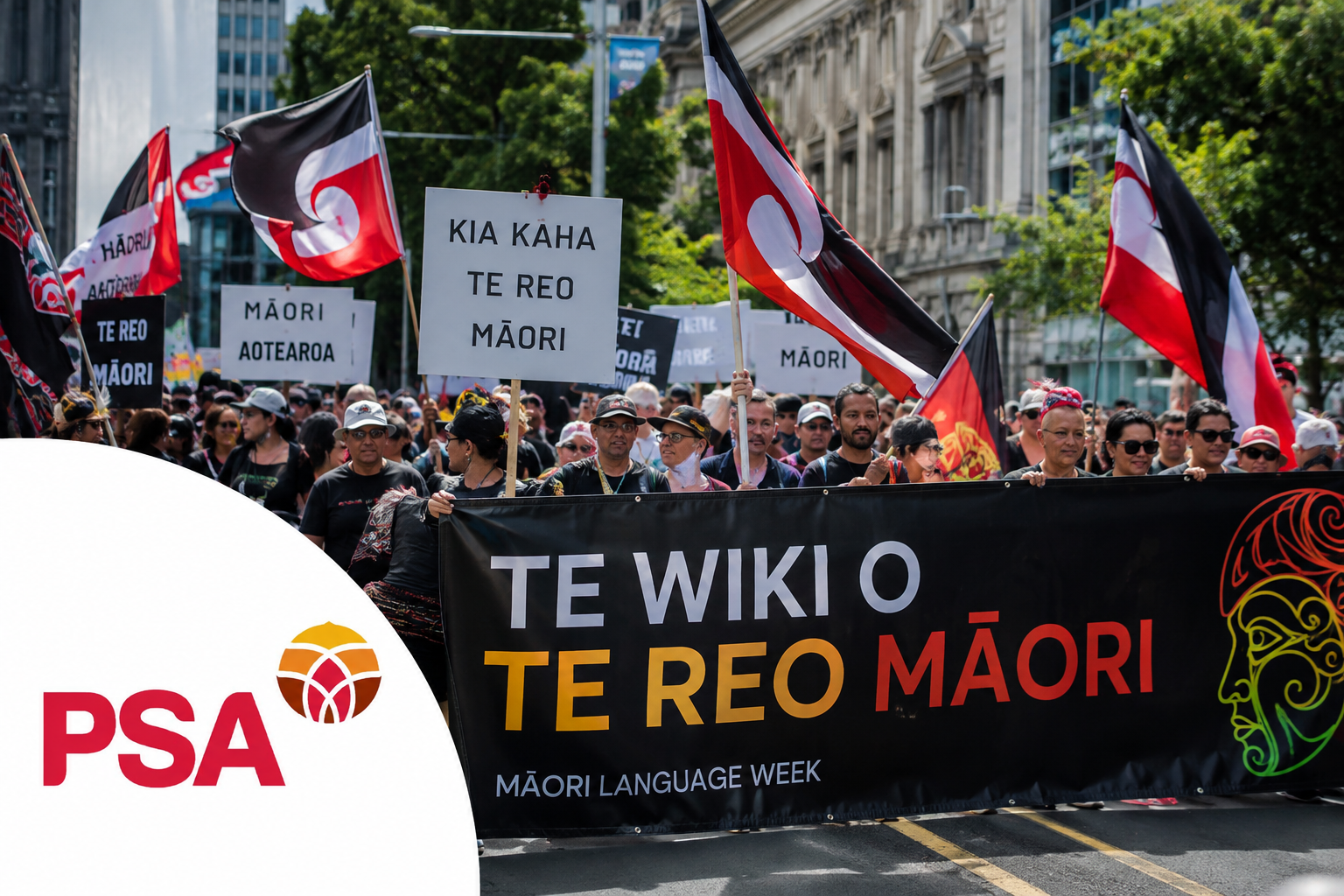
A disagreement over whether public servants should be encouraged to attend Te Wiki o te Reo Māori parades has developed into a wider debate about the Crown's obligations to support te reo Māori and the role of public servants in doing so.
The Public Service Association Te Pūkenga Here Tikanga Mahi is calling on Public Service Commissioner Sir Brian Roche to withdraw recent guidance which the union says discourages public servants from attending the annual Māori Language Week parade.
The PSA argues the guidance risks creating a "chilling effect" inside government agencies, potentially making staff less willing to take part in activities promoting te reo Māori.
But the dispute is about more than one parade.
At its centre is a larger question: when the Crown has legal commitments to protect and promote te reo Māori, should participation by public servants in official language celebrations be treated as part of that responsibility, or something that needs to be approached more cautiously?
The PSA believes the answer is clear.
What has the PSA actually asked for?
PSA Te Kaihautū Māori Jack McDonald has written directly to Public Service Commissioner Sir Brian Roche asking him to withdraw the guidance.
The union also wants the Commissioner to issue a public statement making it clear that public servants are supported and encouraged to attend Te Wiki o te Reo Māori parade events.
McDonald has also requested a meeting with Roche to discuss the issue on behalf of PSA members.
The PSA says public service departments have, for a number of years, encouraged employees to participate in Māori Language Week parades.
It argues the latest guidance represents a departure from that approach.
Why does the PSA say this matters?
The union's argument is based on three main areas:
| Issue | PSA position |
|---|---|
| Public service responsibilities | Government agencies should support the recognition and aspirations of Māori |
| Māori language obligations | The Crown has a commitment to actively protect and promote te reo Māori |
| Waitangi Tribunal findings | The Crown should take active steps to strengthen te reo Māori in the public sector |
The PSA says attendance at a parade organised by Te Taura Whiri i te Reo Māori, the Māori Language Commission, is consistent with those responsibilities.
McDonald said departments have a duty to support language revitalisation and improve the way government agencies engage with Māori communities.
"For a number of years many public service departments have appropriately supported their employees to participate in these parades," he said.
"Departments have a duty to promote te reo Māori and support its revitalisation."
The Public Service Act is central to the PSA's case
The union points specifically to the Public Service Act 2020.
Its letter refers to section 73(3)(d), which deals with the public service's responsibilities as a good employer.
The PSA says this includes recognition of the aims and aspirations of Māori, the employment requirements of Māori and the need for greater Māori participation in the public service.
From the union's perspective, allowing staff to attend a Māori Language Week parade is consistent with those obligations.
The PSA therefore rejects any suggestion that participation in the parade would somehow be inconsistent with the responsibilities of a public servant.
The Māori Language Act is another key argument
The union also relies on Te Ture mō Te Reo Māori 2016, the Māori Language Act.
The PSA points to the Crown's stated commitment to work in partnership with iwi and Māori to actively protect and promote te reo Māori for future generations.
That commitment is central to the union's criticism of the Commission's guidance.
If the Crown has a formal responsibility to protect and promote the language, the PSA argues, then public service participation in Māori Language Week events should logically be encouraged rather than discouraged.
McDonald said attendance during work hours should therefore be seen as consistent with the Crown's wider responsibilities.
Why one parade has become a bigger issue
On the surface, the dispute may appear to be about whether staff can attend a public event during work hours.
But that understates what is at stake.
The PSA is concerned about the signal the guidance may send to thousands of public servants.
Rules and guidance do not only determine what people are formally allowed to do.
They can also influence workplace culture.
If employees believe participation in te reo Māori activities could be viewed negatively, even if participation is technically permitted, some may decide it is safer not to become involved.
That is what the union means when it warns of a "chilling effect".
The PSA fears the impact could extend beyond a single parade and influence how comfortable public servants feel supporting Māori language initiatives more broadly.
The historical context matters
The PSA's letter places the dispute in the wider history of Māori language revitalisation.
In 2022, thousands of people gathered to mark 50 years since the Māori Language Petition was presented at Parliament.
That petition became an important milestone in the movement to secure recognition and protection for te reo Māori.
Then in 2025, New Zealand marked the 50th anniversary of Te Wiki o te Reo Māori.
The PSA says those milestones recognise decades of work by whānau, hapū and iwi to revitalise the language.
It also acknowledges that the public service has played a role in those efforts.
That is why the union views the latest guidance as significant.
From its perspective, the issue is not whether a parade is a nice cultural event.
It is whether the public service is continuing in the direction of supporting language revitalisation or becoming more hesitant about visibly participating in it.
The Waitangi Tribunal findings add weight to the dispute
The PSA also points to the recent Waitangi Tribunal report on the Te Reo in the Public Sector Urgent Inquiry.
According to the union's letter, the Tribunal found that the Crown is required to take active steps to address the vulnerable state of te reo Māori.
The PSA says the Tribunal also recommended increasing the bilingual capability of the public service and doing more to upskill public servants in te reo Māori.
That creates another layer to the argument.
If government agencies are being encouraged to improve their use and understanding of te reo Māori, the PSA believes discouraging participation in a major language celebration sends the opposite message.
McDonald described the Commission's guidance as being in "flagrant disregard" of those findings.
That is a strong accusation.
But it is the PSA's interpretation, and the exact reasoning behind the Public Service Commission's guidance is not contained in the material supplied with the union's statement.
That distinction matters.
What we still do not know
The PSA has been very clear about its objections.
What is less clear from the material released is the full reasoning behind the Public Service Commission's guidance.
The exact wording of the guidance has not been included in the material supplied.
Nor does the PSA release set out in detail why the Commission believes attendance should be approached differently.
That means several important questions remain unanswered.
Was the guidance primarily about attendance during paid work hours?
Was it about consistency across agencies?
Was it connected to public service neutrality?
Was it intended as a general restriction or simply advice about how participation should be managed?
Those details would be important in assessing the disagreement fairly.
Without the Commission's full reasoning, the public currently has only one side of the dispute in the material released by the PSA.
Why public service neutrality may become part of the conversation
One issue likely to sit behind the wider debate is the role of public servants themselves.
Public servants are expected to perform their roles professionally and serve governments of different political views.
At the same time, departments operate under laws and policies that include specific responsibilities relating to Māori and te reo Māori.
The challenge is distinguishing between a public servant participating in an activity because it supports an established public-service responsibility and participation that might be interpreted differently.
The PSA's position is that Māori Language Week falls clearly on the first side of that line.
It argues that attending an event run by the Māori Language Commission is entirely consistent with government agencies' existing obligations.
That is likely to be one of the central points if the dispute develops further.
Is attending a parade the same as promoting a language?
That is another legitimate question raised by the disagreement.
The PSA believes visible participation matters.
A public service that encourages employees to attend Māori Language Week events sends a message that te reo Māori is supported within government institutions.
But others may reasonably ask whether government obligations should be measured through more substantive outcomes.
For example:
how much te reo Māori is actually used in public services
whether staff can communicate effectively with Māori communities
whether agencies invest in staff language development
whether Māori can access government services in culturally appropriate ways
whether te reo capability is increasing within departments
A parade can be symbolically important.
But long-term language revitalisation ultimately depends on what happens throughout the rest of the year as well.
The PSA itself points towards this wider issue by citing the Waitangi Tribunal's call for greater public-sector capability in te reo Māori.
What does this mean for ordinary New Zealanders?
This may look like an internal dispute between a union and the Public Service Commission.
But public-service culture eventually affects the services people receive.
Government agencies interact with Māori communities across health, education, welfare, justice, employment, housing and many other areas.
If public servants have stronger understanding of te reo Māori and Māori communities, supporters argue that government services can become more responsive and accessible.
That is why language capability within the public service has implications beyond government offices.
The issue is not simply how many public servants attend a parade.
It is what sort of relationship the public service is trying to build with the communities it serves.
The PSA also raises a rights question
The union's letter questions how a restriction on attendance could be justified under the New Zealand Bill of Rights Act 1990.
Again, this is the PSA's legal position rather than an established finding by a court.
No judicial ruling on the Commission's guidance is presented in the material supplied.
But by raising the Bill of Rights Act, the PSA has signalled that it sees the issue as potentially extending beyond internal employment guidance.
That further raises the stakes of what might otherwise have remained an administrative matter.
What the PSA wants Sir Brian Roche to do now
The union is asking for three practical steps.
First, withdraw the guidance.
Second, publicly reassure public servants that participation in Te Wiki o te Reo Māori parade events is supported and encouraged.
Third, meet with the PSA to discuss the issue.
McDonald said the Commission should be helping public servants participate in activities that support te reo Māori rather than creating uncertainty about whether attendance is appropriate.
"It is very clear that the Public Service Commission should be supporting participation in events that promote and celebrate te reo Māori, not discouraging it," he said.
The real test is bigger than the parade
There is a danger that this debate becomes reduced to a simple argument about whether public servants should be allowed to spend work time walking in a parade.
The more important question is what the Government expects its public service to do about te reo Māori.
If language revitalisation is a genuine Crown responsibility, agencies need to understand what that means in everyday practice.
Does it mean attending public celebrations?
Does it mean more staff learning te reo?
Does it mean increasing bilingual services?
Does it mean stronger engagement with Māori communities?
Most likely, the answer involves more than one of those things.
That is why clear guidance matters.
Public servants should not have to guess whether supporting a nationally recognised Māori Language Week event is compatible with their professional responsibilities.
Likewise, agencies need clear boundaries around work time, public-service expectations and appropriate participation.
The bottom line
The PSA's challenge to the Public Service Commission has turned what might have been a relatively narrow workplace issue into a much broader debate about te reo Māori inside government.
The union's argument is straightforward.
The Crown has legal and Treaty-related responsibilities to protect and promote the language.
The public service has obligations relating to Māori.
The Waitangi Tribunal has called for stronger te reo capability across government.
From the PSA's perspective, encouraging staff to participate in Māori Language Week activities is therefore consistent with those responsibilities.
What remains missing is the full Public Service Commission case for its guidance.
Until that reasoning is made clear, there is a risk the argument becomes framed simply as being either "for" or "against" te reo Māori.
The more useful question is whether the guidance helps or hinders the Crown's stated objective of strengthening the language inside the public service.
That is the point on which the Commission may now need to provide greater clarity.
Source: Public Service Association Te Pūkenga Here Tikanga Mahi, media statement and letter to Public Service Commissioner Sir Brian Roche, 20 August 2026.