
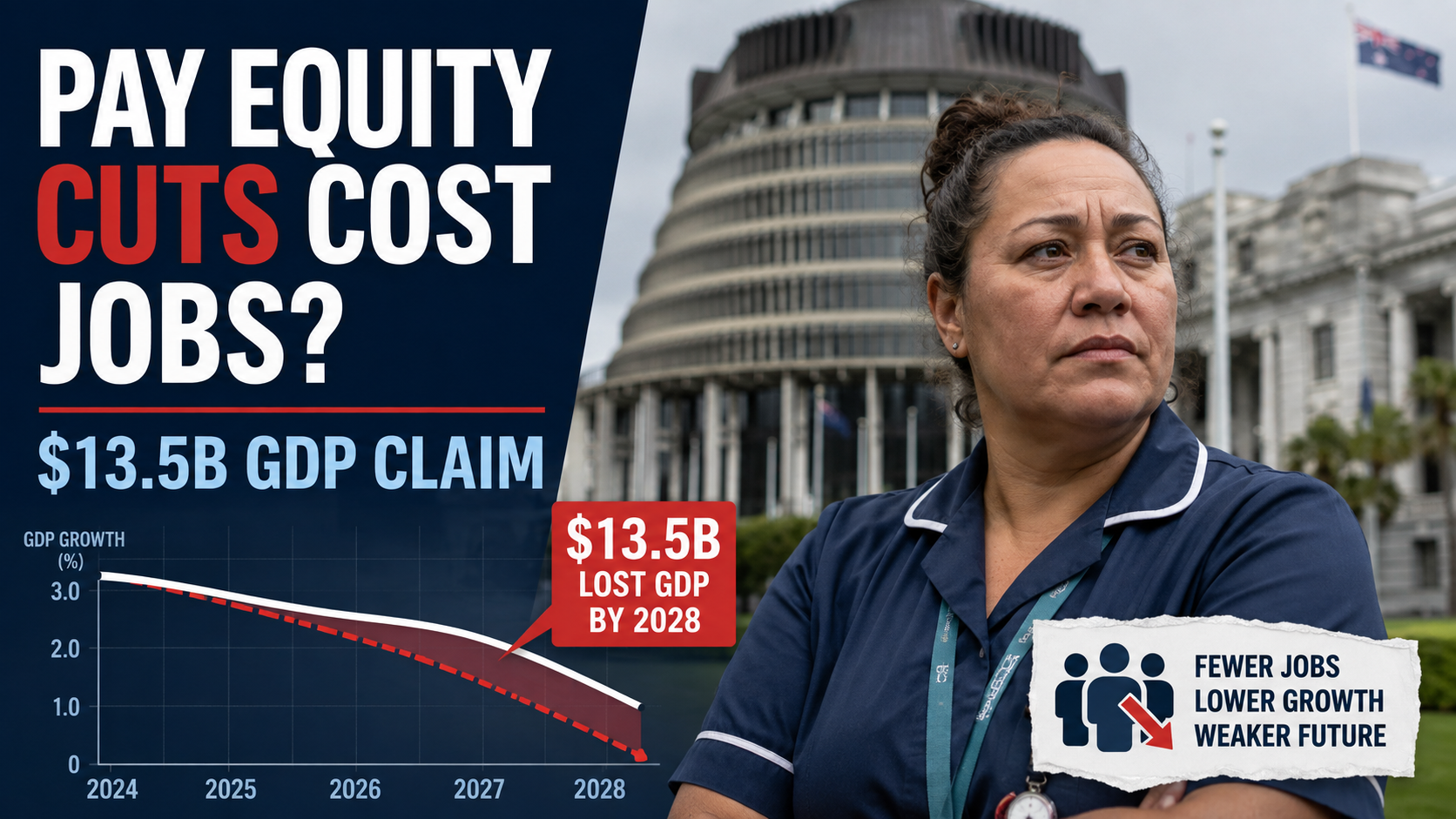
The debate over pay equity has moved well beyond wages.
The Public Service Association says new analysis based on Treasury modelling shows the Government’s decision to cancel outstanding pay equity claims in May 2025 may also have reduced economic growth, tax revenue and employment.
According to the PSA, restoring pay equity settlements would increase nominal GDP by about $13.5 billion over four years, generate around $5 billion in additional tax revenue and support roughly 13,000 more jobs across the economy.
Those are significant numbers.
But an important distinction needs to be made.
The $13.5 billion GDP and $5 billion tax figures come from Treasury modelling cited by the PSA. The estimate of about 13,000 additional jobs is the PSA’s own calculation, derived from the historical relationship between GDP growth and employment.
So this is not Treasury saying directly that 13,000 jobs would be created.
It is the PSA using Treasury’s economic modelling to estimate what the employment effect could be.
What happened to the pay equity claims?
In May 2025, the Government changed the pay equity system and cancelled existing claims that had not yet been settled.
The decision affected workers in heavily female-dominated occupations where claims had been made that historic undervaluation had resulted in lower pay.
The PSA says more than 150,000 women were affected.
The union has strongly opposed the changes from the beginning and is now trying to shift the argument from one about fairness to one about economics.
Its central claim is straightforward:
Paying lower and middle-income workers more does not simply cost the Government money.
Part of that money comes back through taxes, while increased household spending creates additional demand throughout the economy.
Where does the $13.5 billion figure come from?
The PSA analysis relies on Treasury’s MATAI macroeconomic model.
According to the Treasury material cited in the report, cancelling the pay equity settlements resulted in slower wage growth and lower Government consumption.
Treasury estimated nominal GDP would be around $13.5 billion lower cumulatively over the forecast period.
The PSA reverses that logic.
If cancelling pay equity reduces GDP by $13.5 billion, reinstating the settlements would theoretically restore around that amount of economic activity.
Spread across four years, the PSA calculates that as roughly $3.4 billion of additional GDP each year, equivalent to about 0.6 percent of GDP.
Why would higher wages increase GDP?
The argument is based on something economists call the multiplier effect.
Imagine a care worker receives a significant wage increase.
That worker may spend more at the supermarket, repair the car, replace an appliance, visit a local café or pay for services they had previously delayed.
Those businesses receive additional income.
They may then buy more stock, increase staff hours or employ another worker.
Those workers spend some of their earnings elsewhere.
Money moves through the economy several times.
The PSA argues this effect is particularly strong among low and middle-income households because they tend to spend a greater proportion of additional income rather than save it.
That does not mean every dollar immediately produces more than a dollar of economic growth.
But it explains why wage increases can have consequences beyond the worker receiving them.
How does the PSA get to 13,000 jobs?
This is one of the most important numbers in the release, but it needs careful explanation.
Treasury did not directly forecast 13,000 additional jobs.
The PSA looked at Statistics New Zealand data covering about 35 years and found a strong historical relationship between GDP growth and employment growth.
Its analysis says that, on average, a 1 percent increase in GDP has been associated with roughly a 0.7 percent increase in employment.
Using that relationship, the PSA estimates that a 0.6 percent GDP increase from pay equity could lift employment by about 0.45 percent.
Applied to forecast employment levels, that produces an average estimate of around 13,000 additional jobs.
Those jobs would not necessarily be in the occupations receiving pay equity settlements.
The PSA’s argument is that the jobs would emerge across the wider economy because households would have more money to spend.
The numbers at a glance
| Measure | PSA analysis |
|---|---|
| Additional GDP over four years | $13.5 billion |
| Average annual GDP increase | About $3.4 billion |
| GDP increase | Around 0.6% |
| Estimated additional jobs | Around 13,000 |
| Additional tax revenue | Up to $5 billion |
| Net fiscal cost over four years | Around $6 billion |
| Average net annual fiscal cost | Around $1.5 billion |
| PSA calculated return | $2.25 of GDP for every $1 of net Government cost |
Why does the PSA say the real cost is $6 billion?
One of the biggest political arguments around pay equity has been its cost to the Crown.
The PSA says the headline figure of roughly $12.8 billion does not represent the true ongoing fiscal cost.
Its analysis says about $1.8 billion related to a one-off accounting effect in 2024/25.
It also points to Treasury modelling suggesting cancellation of the settlements could reduce PAYE and GST revenue by up to $5 billion over the forecast period.
The PSA therefore argues that restoring pay equity would involve approximately $11 billion of payments over four years, but around $5 billion would return to the Government through additional tax revenue.
That leaves a net impact of about $6 billion over four years, or $1.5 billion a year.
PSA compares pay equity with Investment Boost
The union has also compared its pay equity calculations with the Government’s Investment Boost policy.
Investment Boost allows businesses to immediately deduct part of the cost of qualifying new capital investment.
According to the figures used in the PSA analysis, Treasury modelling suggests Investment Boost could generate about $6.4 billion of additional GDP from approximately $4 billion of net Government cost.
That produces a calculated ratio of about 1.6 to one.
The PSA calculates pay equity at 2.25 to one.
Its argument is therefore that pay equity would deliver more economic activity per dollar of net Government cost.
That comparison will undoubtedly be politically contested because the two policies are designed to achieve different things and may have different long-term effects.
Investment Boost is intended to encourage capital investment and productivity.
Pay equity is primarily intended to correct gender-based undervaluation in wages.
Comparing them purely through a short-term GDP multiplier does not capture every benefit or cost.
The political argument is becoming sharper
PSA National Secretary Fleur Fitzsimons says the Government focused too narrowly on Budget savings and ignored the broader economic effects.
The union wants opposition parties to make clear commitments to restoring pay equity and to properly account for those commitments in their fiscal plans.
The PSA is also arguing that workers in lower-paid occupations are more likely to spend additional income within New Zealand, creating stronger flow-on effects for local businesses.
The Government’s response to this specific PSA analysis was not included in the material supplied.
That matters because the figures are being presented by a union that has strongly opposed the Government’s pay equity changes.
The underlying Treasury modelling gives the argument more weight, but some conclusions, particularly the employment estimate and return-on-investment comparison, are PSA calculations.
The bigger question
The debate is no longer simply about whether pay equity is fair.
It is now also about what happens economically when a large group of workers receives more income.
The PSA says the Government saved money on one side of the Budget but lost economic activity and tax revenue on the other.
The Government may argue that fiscal restraint, affordability and a more tightly controlled pay equity system are necessary.
Both arguments ultimately come back to the same question:
What is the true cost of paying people more, and what is the true cost of not doing it?
The PSA believes Treasury’s own modelling strengthens its case.
The next step is for the Government and opposition parties to explain how they interpret the same numbers.
Because if pay equity really does generate stronger growth, more tax and thousands of additional jobs, this is no longer just a workplace relations debate.
It becomes an economic policy debate as well.
Source: Public Service Association analysis based on Treasury MATAI modelling and Statistics New Zealand employment data.