
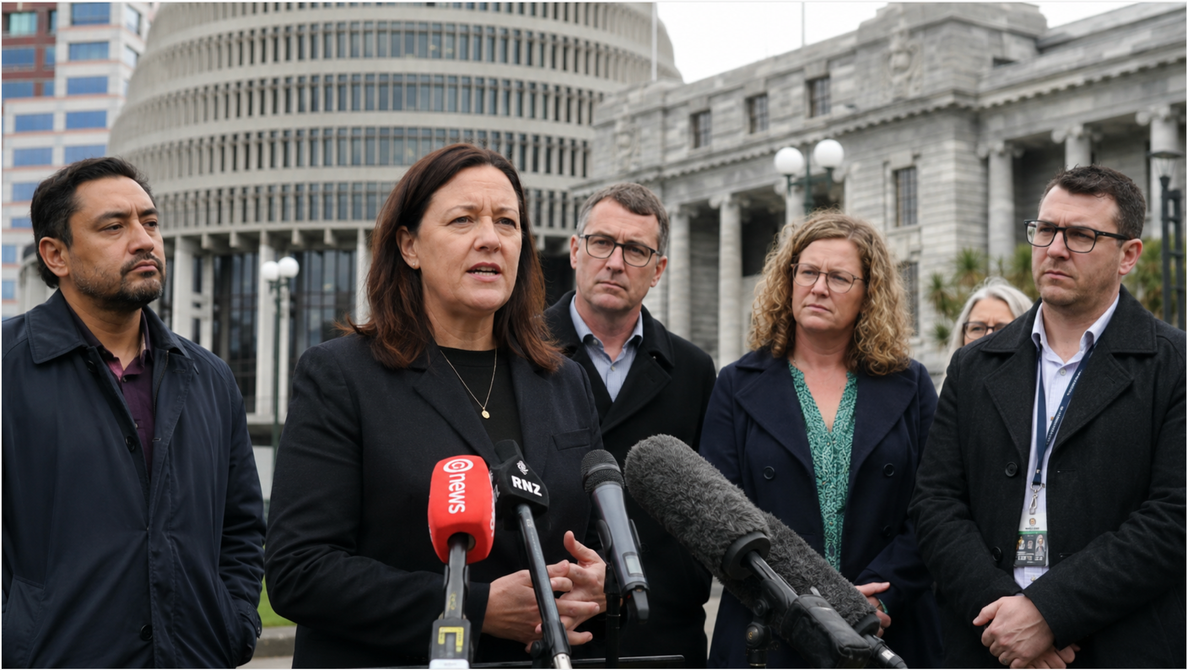
The Public Service Association is calling for a major change to the way New Zealand restructures public agencies, arguing that governments and publicly funded employers should be required to prove that large-scale cuts will not damage essential services before they proceed.
The union wants a mandatory “public good test” written into law, requiring agencies to assess the likely effect of a major restructure on services, workers, communities, Māori, workforce capability and long-term national needs.
The proposal is the central recommendation in a new PSA report, Reckless restructures: how to stop the damage caused by endless restructuring, being launched at the union’s 2026 Congress in Wellington.
PSA National Secretary Fleur Fitzsimons said the current approach to restructuring had focused too heavily on immediate cost savings and not enough on what capability, expertise and public services might be lost in the process.
“Thousands of dedicated public servants have lost their jobs and the services New Zealanders rely on have been savaged, all in this blind rush to cut costs with no real plan for what would be lost,” she said.
The union’s argument is straightforward: before a government agency cuts staff, merges teams or removes functions, it should first be required to show what the consequences will be.
What would the public good test actually examine?
The PSA is proposing that any significant restructure be formally assessed against a set of public-interest criteria before being approved.
| Proposed test | What agencies would need to consider |
|---|---|
| Service impact | Whether the restructure would reduce the quality, availability or reliability of public services |
| Te Tiriti obligations | Whether the agency could still meet its responsibilities to Māori |
| Workforce capability | What skills, institutional knowledge and specialist expertise may be lost |
| Health and safety | Whether remaining staff would face unsafe workloads or higher stress |
| Long-term impact | Whether short-term savings could create greater costs later |
| Climate resilience | Whether the restructure could weaken New Zealand’s ability to respond to climate change |
| Vulnerable populations | Whether some communities could lose access to important services |
| Inquiry commitments | Whether cuts would undermine commitments arising from Royal Commissions or Auditor-General findings |
The PSA wants the requirement embedded in the Public Service Act 2020 and applied more broadly across state services.
It also wants the principle extended to local government and publicly funded community organisations as a condition of receiving public money.
The key question: are restructures actually making government better?
At the centre of the PSA’s case is a survey of more than 4,300 public servants.
According to the union, 78 percent said restructures during the current term of government had not helped them deliver better outcomes for New Zealanders.
Only 5 percent agreed that the restructures had improved delivery.
A further 52 percent said their agency’s ability to do its job had worsened in the year to March 2026.
Those figures do not by themselves prove that every restructure has failed.
They do, however, point to a significant level of concern among the people actually working inside public agencies.
That distinction matters.
Restructuring is not inherently bad.
Organisations sometimes need to change.
Functions can become duplicated, outdated or inefficient. Technology can reduce the need for certain roles. Agencies may need to merge teams, change priorities or redesign services.
The harder question is whether restructuring is being used as a genuine tool for improving public administration, or simply as a way to hit a savings target.
The PSA believes too much of the recent restructuring has fallen into the latter category.
PSA says New Zealand is losing capability, not just headcount
The union says the real cost of job cuts cannot be measured only by how many positions disappear from an organisational chart.
Its report argues that when experienced staff leave, government can also lose institutional knowledge, technical expertise and relationships that have taken years to build.
The PSA points to cuts across health, science, conservation and community services as examples of what it considers a wider pattern.
It says nearly 3,000 health roles have been cut, more than 700 scientists and researchers have lost jobs, more than 300 Department of Conservation workers have gone, and community organisations such as RespectEd have been forced to close.
Those figures and examples are part of the PSA’s case and should be read as the union’s assessment of the impact of recent restructuring.
The broader point is harder to dismiss.
Once specialist capability disappears, rebuilding it is rarely instant.
Government cannot always replace a senior scientist, experienced policy specialist or technical adviser simply by advertising the role again later.
In some cases, those people leave the public service permanently.
Some leave New Zealand altogether.
Fitzsimons argued that Australia is benefiting from people who might otherwise have continued contributing here.
Why the PSA says short-term savings can become long-term costs
The union’s argument is also economic.
Cutting jobs may generate an immediate saving.
But if the result is slower services, weaker regulation, reduced scientific capacity, higher staff burnout or greater reliance on external consultants, the savings can become less impressive over time.
That is particularly important in areas where New Zealand is already facing long-term pressure.
The PSA specifically points to an ageing population, climate change and the country’s infrastructure deficit.
These are not short-term problems.
They require institutional capability that lasts well beyond an election cycle.
The union argues that restructuring decisions should therefore be judged not only on what they save this year, but also on what they may cost New Zealand five, ten or twenty years from now.
Te Tiriti is a major part of the proposal
The PSA is also pushing for Te Tiriti o Waitangi obligations to become a formal part of restructuring decisions.
It says teams and roles focused on improving outcomes for Māori have repeatedly been vulnerable when agencies are instructed to reduce spending.
Under the proposed test, an agency would have to assess whether a restructure would weaken its ability to meet obligations to Māori before the cuts could proceed.
The union also wants agencies to examine whether changes could disproportionately affect groups already at risk of poorer access to public and community services.
These include Māori, Pasefika, women, migrants, rainbow communities and disabled people.
That part of the proposal is likely to generate political debate.
Supporters will argue it creates a safeguard against cuts that may have unequal consequences.
Critics may question how broadly such a test should be defined and whether it could make restructuring slower, more bureaucratic or harder to implement.
Those are legitimate issues that would need to be resolved if the proposal ever became legislation.
A political issue heading directly into the election
The timing of the report is significant.
The PSA says the National-led Government, if re-elected, wants to cut another 8,700 public service roles and merge agencies.
It is also criticising Labour for not yet committing to stopping further public service job losses if it wins office.
The union has additionally pointed to the Opportunity Party, which it says has also raised the prospect of public service job cuts.
That means the PSA is not directing its argument at only one party.
Its position is broader: whichever government is in power should have to meet the same public-interest standard before embarking on large restructures.
That is likely to become one of the more interesting aspects of the proposal.
Instead of arguing over whether a particular political party should cut more or less, the PSA is trying to change the rules under which everyone would operate.
Would a public good test prevent all job cuts?
No.
At least as proposed by the PSA, the test would not automatically stop restructuring.
Its purpose would be to require employers to show that they have properly considered the consequences before proceeding.
A restructure could still go ahead.
But agencies would have to demonstrate that they had assessed the effect on service delivery, workforce capability, health and safety, Te Tiriti obligations and other public-interest factors.
In practical terms, that would move restructuring away from a narrow financial calculation.
Savings would still matter.
They would simply not be the only thing that mattered.
The obvious challenge: could it create more bureaucracy?
This is the central counterargument the PSA proposal will have to answer.
A government trying to reduce spending may argue that requiring detailed statutory assessments before every major restructure would add another layer of process and delay.
There would also need to be a clear definition of what counts as a “significant restructure”.
Would every departmental reorganisation trigger the test?
Would there be an independent body reviewing the assessment?
Could a restructure be challenged in court if the test was considered inadequate?
What happens if the test identifies substantial public harm but a minister still believes the changes should proceed?
The PSA material does not resolve all of those implementation questions.
But those questions would become critical if any political party decided to adopt the proposal.
The union is preparing to pursue the idea even without legislation
The PSA says it will not wait entirely on Parliament.
It intends to pursue public-good assessment requirements through collective bargaining with employers even if the next Government does not legislate for them.
That suggests the proposal could become an industrial-relations issue as well as a political one.
The union’s message is that restructuring should no longer be treated purely as an internal management decision when the consequences extend into communities and public services.
‘There will be future inquiries’
The strongest warning in the PSA report is about what happens if government continues making large organisational changes without properly understanding their consequences.
The union predicts that future Royal Commissions and official inquiries may eventually examine the damage caused by poorly planned cuts.
That is obviously a prediction, not an established outcome.
But New Zealand has seen major inquiries before where earlier institutional decisions, inadequate capability or failures to act became important parts of the story.
The PSA is arguing that government should learn those lessons before another inquiry has to explain what went wrong.
More than 300 delegates gathering in Wellington
The report is being launched as part of the PSA’s biennial Congress at Hnry Stadium in Wellington.
More than 300 delegates are expected to attend under the theme “Respect, Restore, Rebuild.”
The programme includes speeches from PSA President Virgil Iraia and National Secretaries Fleur Fitzsimons and Duane Leo.
Political speakers scheduled for the second day include Opportunity Party public services spokesperson Jessica Hammond, Te Pāti Māori co-leader Debbie Ngarewa-Packer, Labour leader Chris Hipkins and Green Party co-leader Marama Davidson.
Their appearances should give the union an opportunity to press opposition parties directly on how they intend to manage the public service after the election.
The bigger question is not whether government should ever restructure
That would be the wrong debate.
Governments need the ability to change agencies.
Some restructures are necessary.
Some jobs become obsolete.
Some organisations become inefficient.
The real question is whether New Zealand has developed a habit of announcing savings first and examining the consequences later.
The PSA says it has.
Its proposed public good test is an attempt to reverse that order.
First establish what services might be lost.
First understand what expertise disappears.
First assess what communities may be affected.
Then decide whether the restructure is worth it.
That is the argument at the heart of the report.
For voters, there is also a broader issue.
Public service numbers are easy to turn into political slogans.
A government can promise fewer bureaucrats.
An opposition can promise to restore services.
But headcount alone tells people very little about whether government is working well.
The more useful question may be this:
After the restructure, can the public still get the service it needs, when it needs it, and has New Zealand actually saved money once all the consequences are counted?
That is the test the PSA now wants governments to answer before the jobs disappear, rather than after.